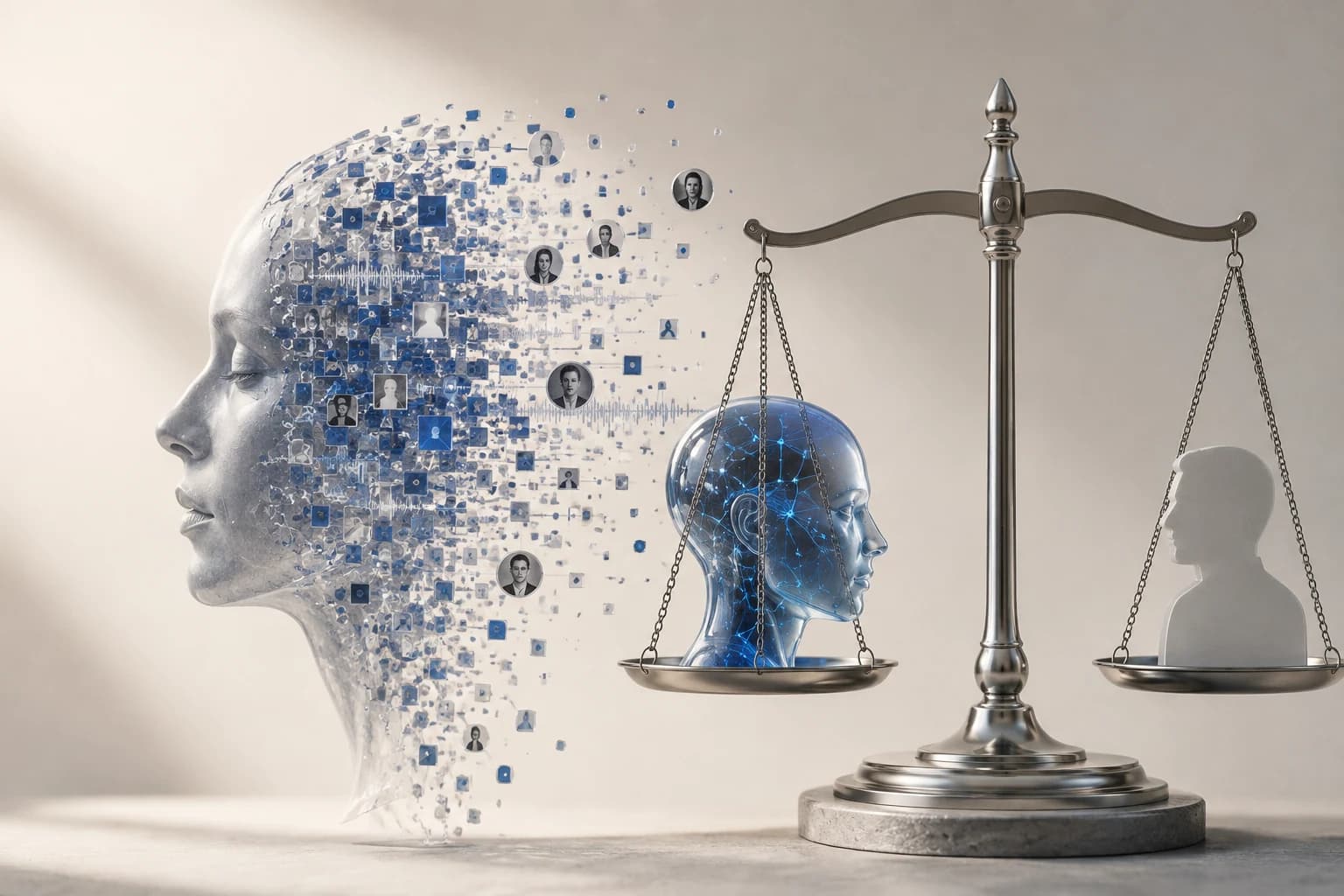
Data remains where a person has gone: photographs, voices, messages, searches and habitual patterns. Once material for remembrance, it is now material for reconstruction. With a few thousand sentences and a few hours of audio, AI begins resembling a person’s speech, response speed and even the hesitation before certain questions. Technology grows more precise, and we grow more uncomfortable. This is not merely a question of copying, but of rights.
1. The Moment Data Begins Resembling Personhood
 Digital persona rights 1View original
Law has long been accustomed to two kinds of subjects: humans and legal entities. Digital personas stand in the gap. Clearly not human, their social impact is too great to call them mere files. Someone finds comfort conversing with a deceased relative’s voice; someone else is defrauded by a celebrity’s synthesized voice. One service speaks of remembrance, another business of monetization. When the same technology enables mourning and exploitation together, legal standards can no longer be postponed.
The central question is whether a digital persona is an object or a subject of rights. As an object, it becomes a matter of ownership: survivors manage it and platforms control it through terms. Recognition closer to a subject changes the discussion. Minimum protections of personhood become necessary, such as prohibitions on distortion, misuse and out-of-context use. We must also decide who exercises those rights. Criteria are needed to establish priority when the person’s wishes during life, a will, a representative and platform responsibilities conflict.
2. An Object of Rights, or a Subject Requiring Protection?
 Digital persona rights 2View original
What matters here is the speed of social agreement, rather than technical possibility. Technology has already reached what is possible; the issue is the boundary of what is permitted. May a deceased person’s digital persona read a voice message at a family event? If so, how far may it appear in advertising? Is recreating a historical figure for education acceptable while political agitation should be prohibited? Rights must be differentiated by use context. Blanket permission or prohibition cannot handle reality.
Three practical axes are necessary. First, advance consent: people should choose the permitted uses of their digital personas while alive. Second, posthumous enforcement: survivors and representatives should be able to report violations and stop them easily. Third, transparency: platforms must disclose sources and processing histories showing which data produced which persona. Without transparency, accountability cannot exist.
Economic rights are another easily overlooked issue. A digital persona can be both an object of emotion and an economic asset. For creators, entertainers and instructors whose voices and manner of speaking are themselves brands, revenue can continue after death. Without a revenue-sharing structure, conflict is inevitable. As survivors, agencies, platforms and model developers assert conflicting rights, the individual’s own wishes disappear more easily. Contracts must therefore be designed before technology. Unless permitted scope is decided first, technology is invariably used beyond the boundary.
3. Law’s Next Task: Boundaries That Prevent Abuse and Protect Dignity
 Digital persona rights 3View original
Philosophically, this is also a question of human continuity. Are we the sum of our memories, or present consciousness? If past data is sufficiently precise, can that being be considered an extension of me? Law cannot answer every philosophical question, but it can establish minimum order: rules preventing abuse, protecting dignity and preserving time for mourning. What we need now is a first agreement that reduces harm, rather than a perfect answer.
Digital personas are already real. The choice is between leaving the market to produce accidental rules and having society declare boundaries first. I believe the latter is more humane. The more technology resembles people, the more careful our laws must be. This is not an argument for rights simply because of resemblance. It is an argument for protection first, because resemblance enables abuse.
We will increasingly ask, “Whose voice is this?” To answer with a clear conscience, we must establish criteria here and now. In an age when data imitates personhood, law must at least be able to protect its boundaries.