
We now begin our days with several kinds of assistance already running before we start work. Calendars arrange our schedules first, email arrives already categorized, and AI prepares drafts. Speed has improved, and fatigue appears to have decreased. The problem starts there: habits of judgment can also disappear from the space fatigue leaves behind. Humans naturally conserve energy, so a newly convenient routine quickly becomes the default. Eventually, even while the feeling of "I decided" remains, most of the actual decision path is quietly settled within automated recommendations and assistance.
The question we need now is not "Should I use AI?" A more practical question is "What will I delegate, and what will I hold onto myself to the end?" Cognitive outsourcing is an unavoidable trend, but outsourcing without boundaries returns as a cost to identity. When memory, judgment and expression are outsourced together, human agency cannot persist without effort. Agency is a matter of design, not willpower.
1. Cognitive Outsourcing Is a System for Distributing Authority
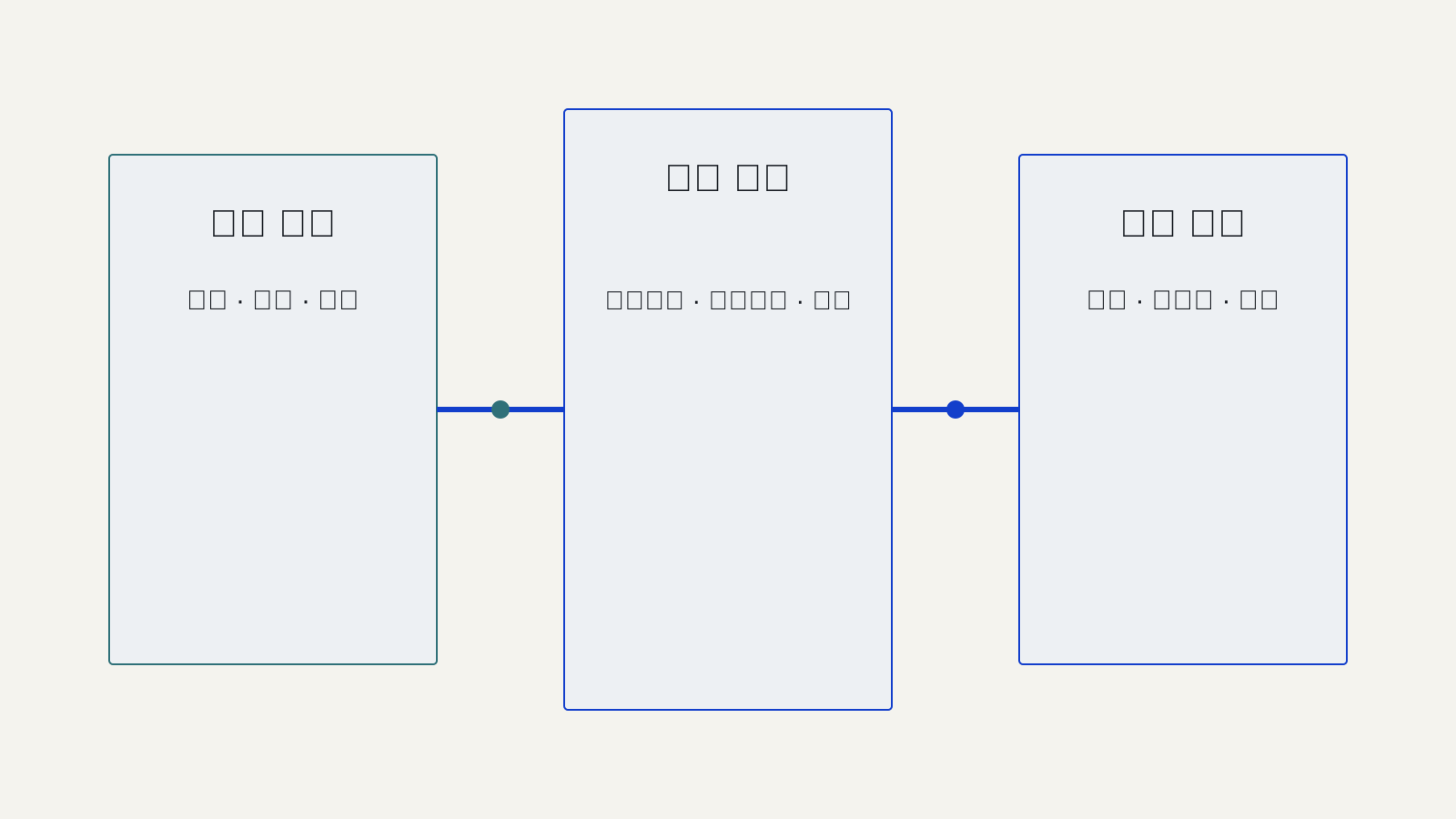 A diagram of authority distribution in cognitive outsourcingView original
Many people describe AI use only in terms of time saved. That is not wrong: summarization, organization, classification and drafting really do save time. But this explanation misses an important layer. Cognitive outsourcing is a transfer of authority, not simply automation. The moment I hand a system some interpretation and selection I previously did myself, control moves along with time. When designed well, this transfer makes the human clearer; when accumulated without design, it gradually makes the human less distinct.
Consider meeting notes. Previously, selecting key points while taking notes was itself a process of thinking. Now speech recognition and summarization models organize them first. On the surface, efficiency improves. At the same time, the criteria determining what matters risk being replaced by model defaults. There is no problem if users reread and revise the output, but the busier people are, the more readily they adopt the structure presented. The starting point of decision-making becomes fixed in system output rather than their own thought.
The issue here is direction more than accuracy. Even an accurate summary changes the next action if it omits context I consider important. Recommendations are similar. A model may propose a choice that is good on average, but only I can ultimately understand both my present state and my long-term goals. The core principle of cognitive outsourcing is therefore simple: delegate repetitive work, but not direction. Entrust organization and calculation to tools while setting priorities and assigning meaning yourself.
Viewing this as authority distribution also changes the order of adopting tools. We usually choose the most capable tool first, but should actually begin with tools in which we can intervene immediately when something fails. Control mechanisms come first: inspectable logs, side-by-side comparison of sources and summaries, the ability to disable recommendations or fix an output tone. Prioritizing recoverable control over convenience is much safer over the long term.
2. Boundless Assistance Quietly Weakens the Muscles of Decision-Making
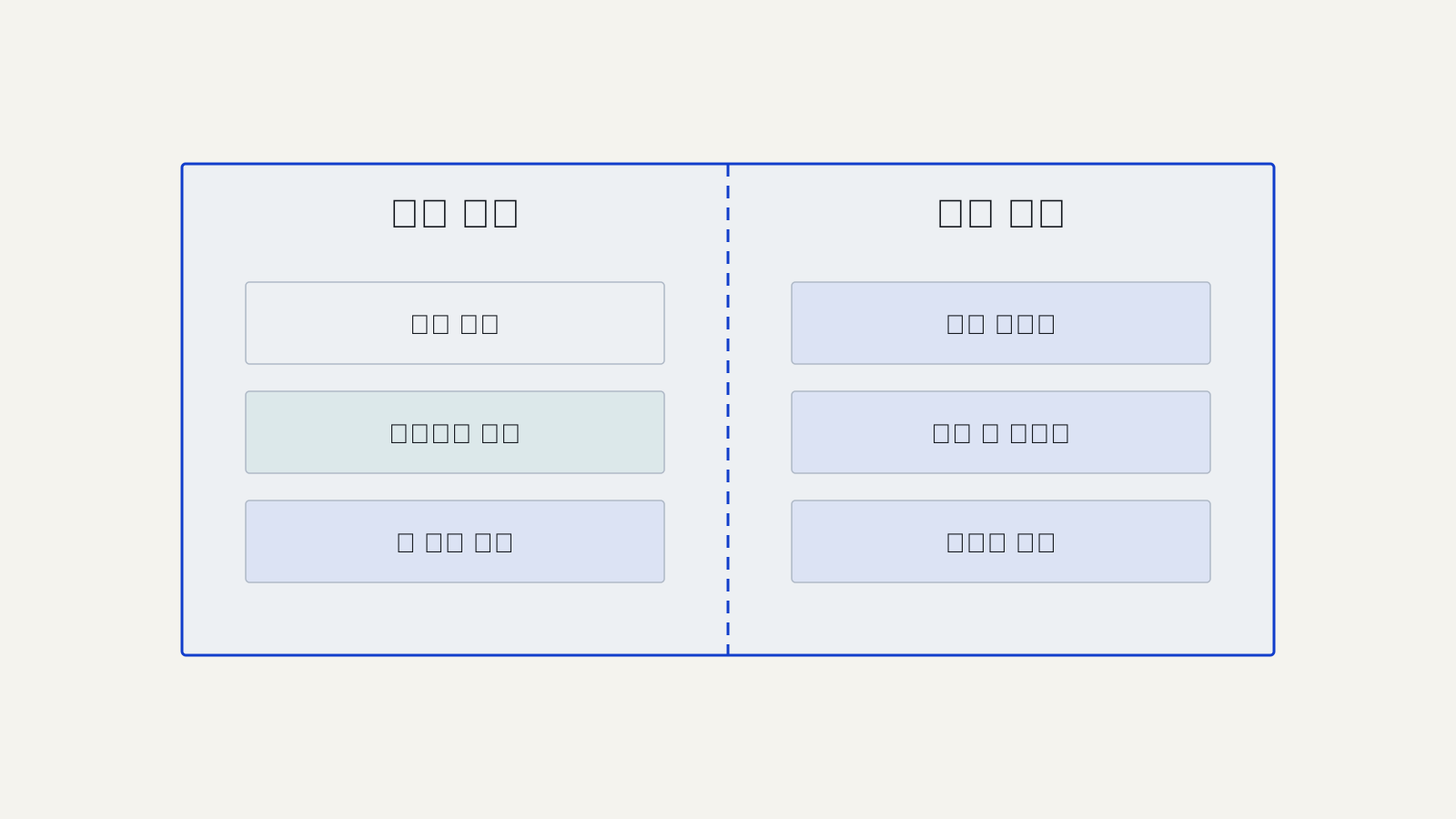 A map of the boundary between automatic assistance and human judgmentView original
People trust interfaces they use repeatedly. As experiences of saved time accumulate, it becomes especially easy to skip critical review. That is the danger. Decision-making is not a skill completed by a single result, but a muscle trained through repeatedly building evidence and comparing options. If an assistant continually replaces that process, immediate results may look good while judgment becomes much more vulnerable to fatigue over time.
Three patterns appear often in practice. First, draft dependence: adopting model-generated structures almost unchanged outsources the order of thinking. Second, overtrust in recommendations: accepting calendar arrangements, priorities and suggested reply tones bypasses contextual judgment. Third, dispersed responsibility: when a result is uncertain, "AI suggested it this way" acts as an implicit exemption. Combined, these patterns leave a person looking busy while approaching a state of lost agency.
The solution is operating rules, not grand philosophy. For important decisions, fix a three-stage sequence: source, summary, conclusion. Add a step to check the original evidence instead of turning the model’s summary directly into a conclusion. Another rule is delayed approval: hold major decisions for at least 30 minutes, then review them again. Automation strengthens immediacy, but good human judgment comes from appropriate delay. Finally, require a counterproposal: create at least 1 option pointing in the opposite direction from the model’s proposal and compare them. That single step substantially reduces the likelihood of following bias.
The goal is not to use tools less, but to move moments requiring judgment outside the tool. Humans need not do everything themselves, but must personally distinguish what matters. Without that ability, even powerful tools produce repeated execution without strategy.
3. An Operating Method for Agency: Delegation Lists, Takeback Triggers and Review Rhythms
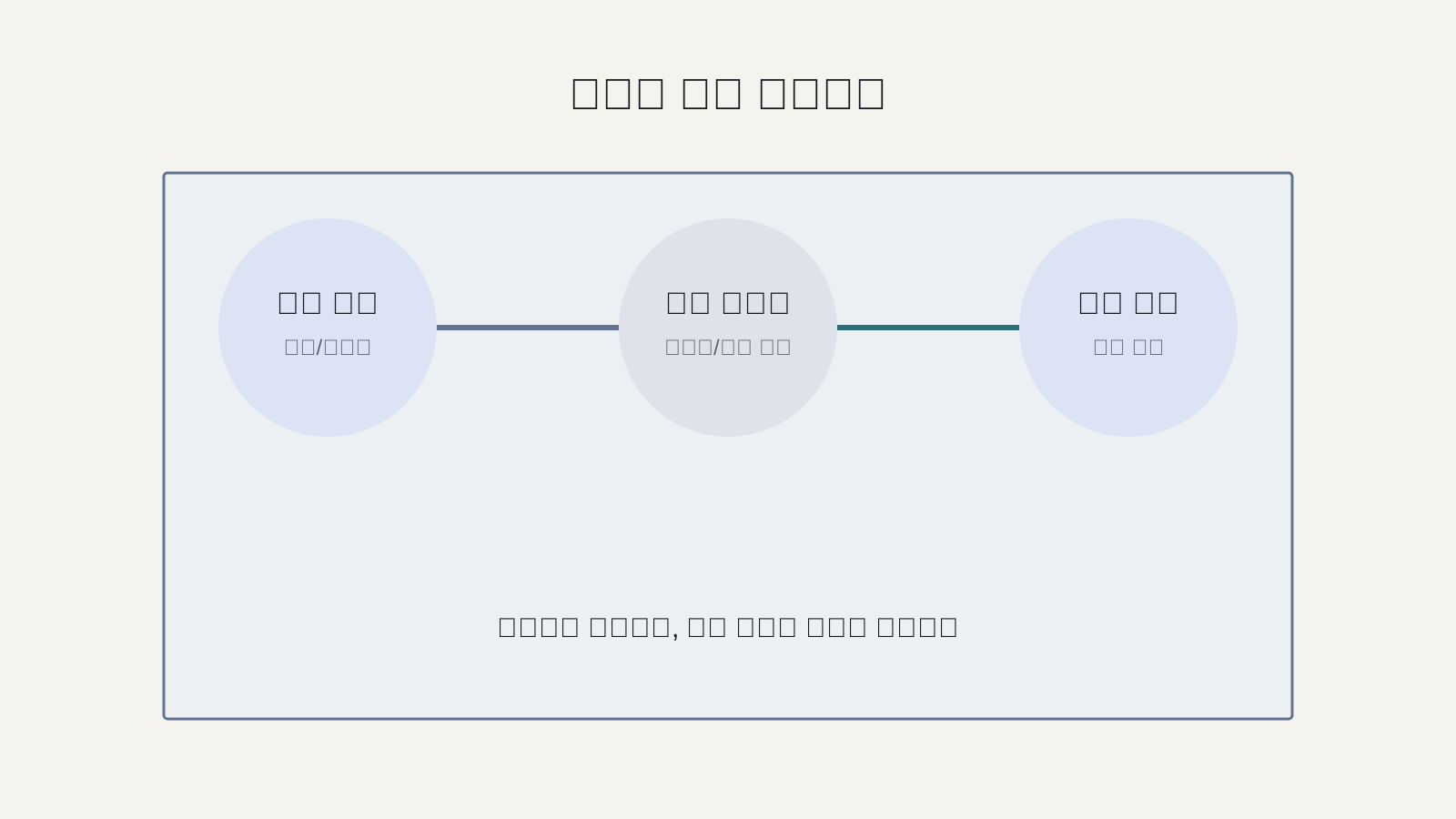 An operating protocol board for reclaiming agencyView original
In the age of cognitive outsourcing, competitive strength depends less on how much is automated than on where automation stops and I take hold again. Even individuals need an operating protocol. Start with a delegation list. Delegate demanding but relatively low-risk work such as organizing memories, summarizing meetings and proofreading. For high-responsibility work—setting priorities, reconciling stakeholder interests or finalizing external communications—always include human approval. Without this list, boundaries shift with the day’s fatigue.
Next come takeback triggers: rules established in advance for immediately switching to manual mode under specific conditions. For example, when (1) an issue involves 3 or more stakeholders, (2) communication carries financial, contractual or reputational risk, (3) 2 or more uncertain pieces of information remain, or (4) a conflict involves emotion, use automatic drafts only as reference and write the conclusion yourself. Triggers protect identity as well as handle crises. The better tools become, the more important these mechanisms are.
Finally, establish a review rhythm. Once a week, reviewing just 3 decisions in which you accepted an AI suggestion unchanged reveals patterns. Record where you delegate easily, which expressions you repeatedly borrow, and which tasks lead you to skip review, then adjust next week’s design. This loop turns outsourcing into cumulative learning. Automation without review is convenient repetition; automation with review becomes a growing system.
Human agency is ultimately protected by concrete mechanisms, not abstract resolve: documented rules, interfaces that can be switched off and on, and periodic retrospection. Technology will keep improving and suggestions will become smoother. What we increasingly need is therefore the ability to disengage well, beyond the ability to use tools well. Delegate precisely, do not miss the moment to take control back, and keep humans in the seat of final responsibility. That is the basic design for stable self-management in the age of cognitive outsourcing.