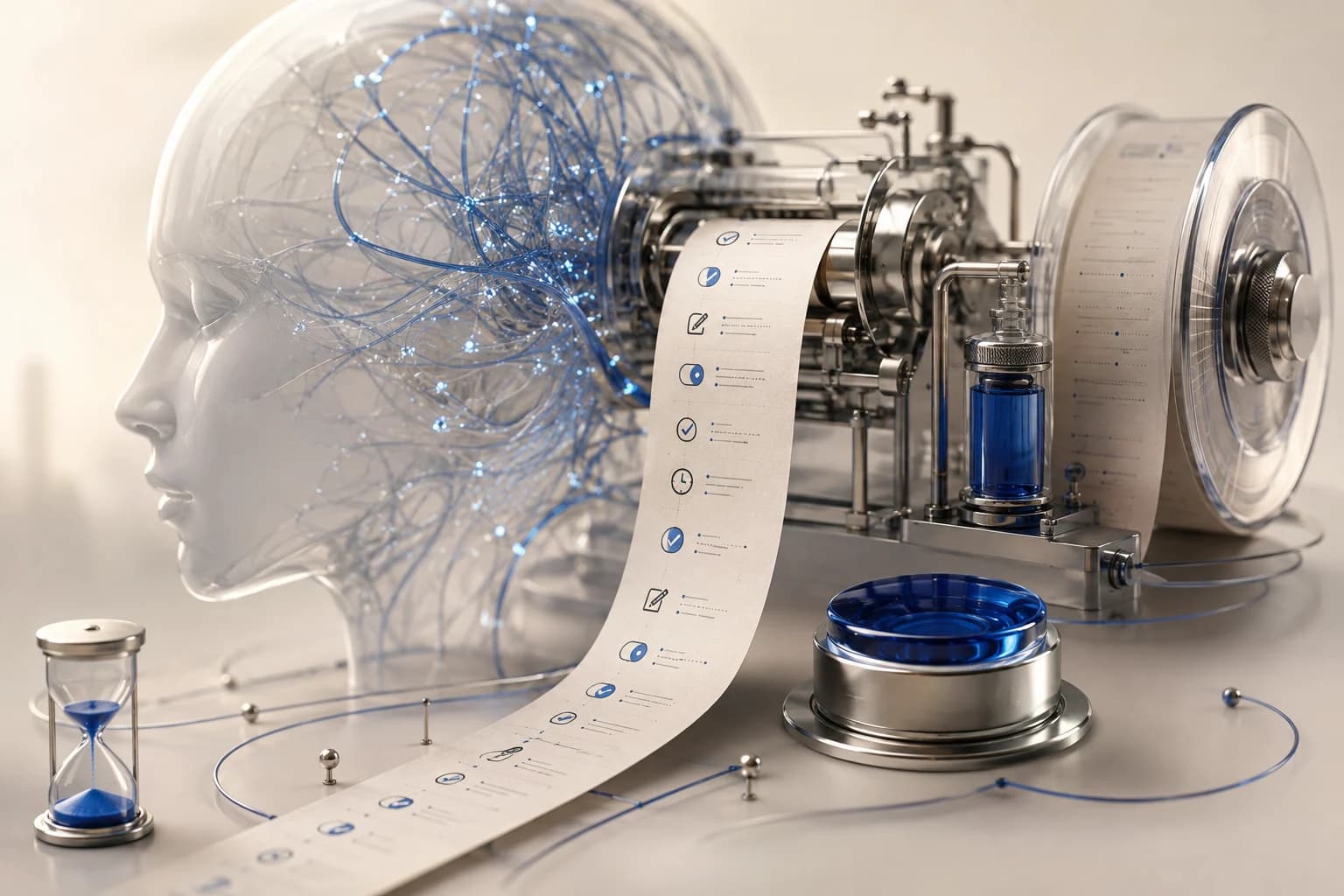
AI tools now reach far beyond search assistance into core daily cognitive work: organizing memories, writing sentences, judging schedules, and setting priorities. The problem is not that we cannot reject this change. We accept it so naturally that we lose track of what we delegated, when, and how far. Some sentences I wrote today, decisions I made, and signals I missed emerged from a mixture of my own will and external-system suggestions. Yet most people look only at the outcome and call it “my choice.” Autonomy disappears not when control is taken away, but when we can no longer explain the boundaries of delegation.
What we need is therefore not a grand philosophical declaration, but a practical operating method: a consent log. It is a minimal tracking device recording which assistance I enabled, which proposals I adopted, and which automation I approved unchanged. This is resilience, not surveillance. It lets us reverse incorrect defaults, correct accumulating unconscious bias, and explain the history of choices on which the present self stands.
1. Cognitive outsourcing is already here; visibility, not speed, is the issue
 A diagram visualizing cognitive-outsourcing flows and decision pointsView original
Most users see cognitive outsourcing as a slightly convenient feature. They schedule meetings at calendar-recommended times, finish email replies with autocomplete, and read only the essentials through document summaries. Each seems minor. Repeated dozens of times a day, however, these small acts rearrange the structure of human judgment. Not because we stop thinking for ourselves, but because suggested options repeatedly fix the starting point of thought.
The question is not whether to use tools. Many professionals and creators already work in environments where keeping pace without AI assistance is difficult. What matters is not “Do I use the tool?” but “Can I read where it intervenes?” Even if AI wrote a draft, clearly recognizing my responsibility for the final wording reduces problems. Conversely, serially approving automation suggestions while forgetting their intervention makes the process opaque even though the output bears my name.
Opacity is an operational problem before it is an ethical one. We cannot explain particular decisions to a team, struggle to find the faulty stage after an error, and repeat the same mistakes. It is especially risky in personal productivity because failure happens quietly. A slipped appointment, a message with the wrong tone, and a reversed priority accumulate into the feeling that “I haven’t been myself lately.” Feeling alone cannot restore things then. A log is needed.
2. A consent log secures the ability to revise, rather than serving as a tool of refusal
 A three-stage decision structure of consent, hold, and revisionView original
Many people hear consent log and imagine legal forms or complex compliance documents. Individuals and small teams need something far simpler. Three lines suffice: record which automation or recommendation was used; mark whether it was adopted unchanged or revised; briefly record satisfaction with the outcome. Even these lines reveal the actual decision patterns of our working systems as they accumulate.
If “email-draft autocomplete → 80% adopted → no later edits” repeats, we might suspect our communication tone is moving toward the model’s default style. If “scheduling recommendation → manual review before adoption → fewer conflicts” repeats instead, that automation can be classified as safe assistance bringing real value. A consent log is thus not a brake to block technology, but an instrument panel for deciding which technologies to adopt more deeply and which to treat cautiously.
The right to hold is another important point. Simply developing the habit of pausing before immediately approving an automated result can substantially improve quality. Fast results make us want to adopt them immediately. Add small friction—a five-minute hold, one review, one line of rationale—and unconscious approvals fall while conscious choices rise. As tools grow stronger, human dignity is protected by the method of approval, not by speed.
In practice, this format is sufficient: date, task type, assistance used, adoption percentage, whether it was revised, and a risk note. It allows reflection and reproduction. Continuity matters more than perfection. After one week, you can see where you are easily drawn in; after a month, you can see which automation truly helped you.
3. Future autonomy is demonstrated by explainable choices, not the number of choices
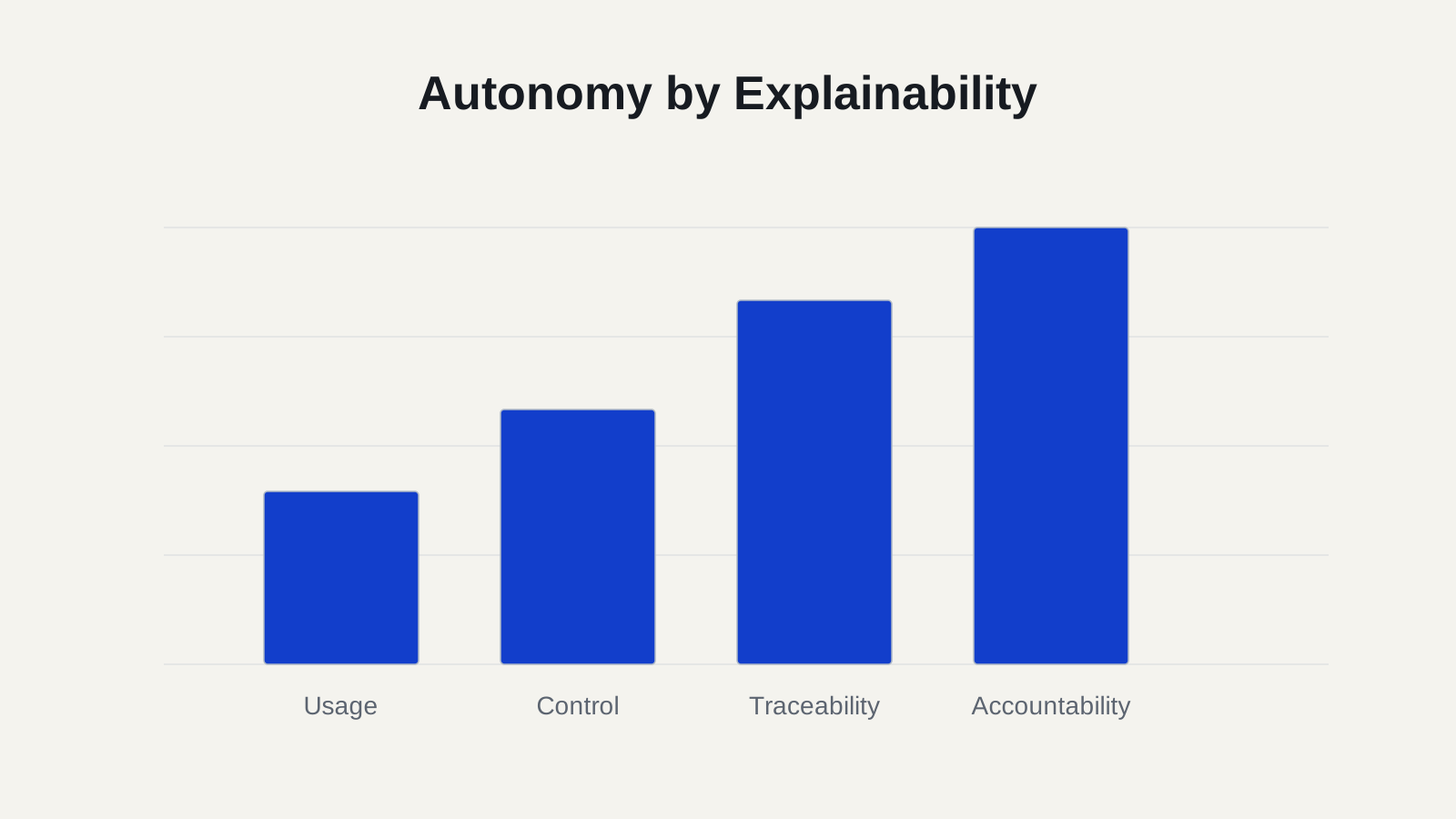 A matrix redefining autonomy metrics around explainabilityView original
Many understand autonomy as the ability to decide alone. In a world where cognitive assistance is routine, that definition increasingly diverges from reality. We are already not alone. We think and work alongside search engines, recommendation systems, note algorithms, generative models, and automation triggers. A more accurate definition is the ability to explain the basis for the final choice even while using external assistance.
Explainability is not a grand framework. It means being able to say why a sentence was selected, a schedule approved, or a priority changed. Inability to explain does not mean wrongdoing; it means the tracking system is weak. Weak tracking prevents learning from repeated errors. Humans are strong not because we are perfect, but because we can revise. Revision requires history, and history requires a recording habit.
The key question in the age of cognitive outsourcing is therefore not “Will AI replace me?” but “Which delegation did I consent to, and can I revise that consent at any time?” Answer confidently and the tool is an extension, not a threat. Without an answer, convenience rises while self-determination shrinks. We cannot stop technology, but we can design the structure of consent.
The smallest practice available today is simple. Choose one assistant tool you use and leave three lines recording today’s approvals, revisions, and holds. As those records accumulate, one thing becomes clear: whether technology is pulling you along, or you are operating it. That difference is the practical measure of humanity in the age of homo technicus.