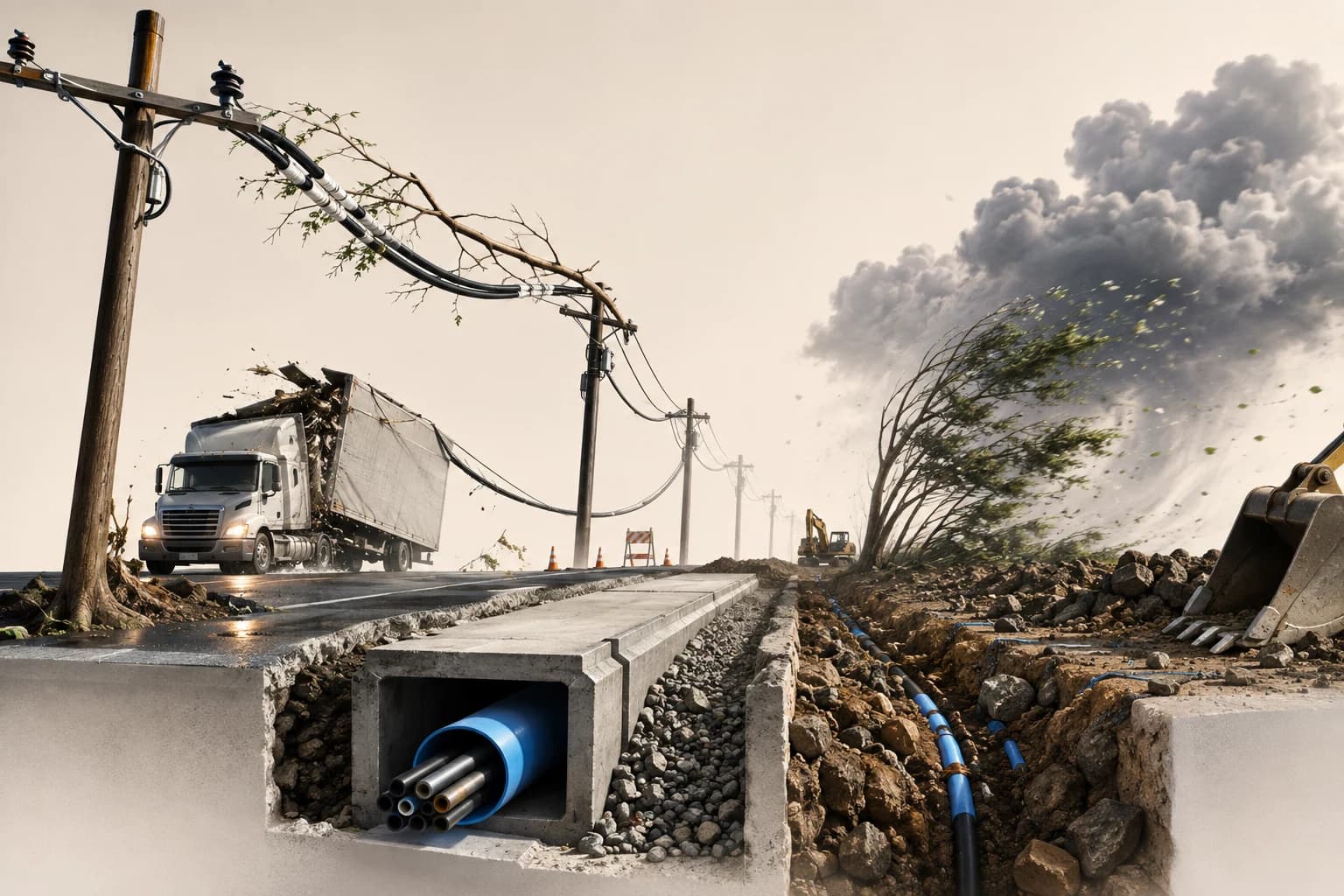
Route Choice Is a Maintenance Decision
Cable route is usually decided by what is available and what it costs. But the choice you make at construction determines what will break, how often, and how long each repair takes for the life of the plant.
Three route types dominate access networks.
Aerial — On Poles
Cable strung between poles, either self-supporting (figure-8 with an integrated messenger) or lashed to an existing strand.
Why it gets chosen: fastest to deploy, cheapest by a wide margin, easy to inspect and repair because everything is visible and reachable.
How it fails:
- Vehicle strikes. A truck catches a low span and takes out the whole route. Common near junctions and construction sites.
- Vegetation. Branches abrading the jacket over years, or a limb bringing a span down in a storm.
- Ice and wind loading. Sag increases, tension rises, and hardware or the cable itself gives.
- Third-party work. Other utilities working on shared poles.
The characteristic pattern: aerial faults are sudden, total, and easy to find. You can often see the damage from the road. Restoration is fast.
Duct — In Conduit
Cable pulled or blown into pre-installed conduit, usually with access at manholes and hand-holes.
Why it gets chosen: protected from weather and traffic, and — the real argument — you can add or replace cable later without new civil works. That is a large long-term saving.
How it fails:
- Excavation damage. Someone digs where the duct runs. Still the single largest cause of major outages in duct plant.
- Water and silt ingress into ducts and hand-holes, leading to closure flooding.
- Rodents, where ducts are not sealed.
- Damage during a later pull — pulling new cable past existing cable, exceeding tension or bend limits at a corner.
The characteristic pattern: duct faults are less frequent than aerial but each one takes longer, because access is limited and the fault location has to be determined precisely before excavating.
Direct-buried — In the Ground
Armoured cable laid directly into a trench, no conduit.
Why it gets chosen: cheaper than building duct, and better protected than aerial. Common on long rural runs.
How it fails:
- Excavation damage, and worse than duct because there is no conduit to warn a digger and no way to re-pull.
- Ground movement, frost heave, subsidence.
- Rodents and, in some regions, insects attacking the sheath.
The characteristic pattern: rare faults, but each repair means locating precisely, excavating, splicing in a new section, and re-burying. Days, not hours. There is no cheap fix; every repair adds a splice and a closure to the route permanently.
What This Means for Loss Budgeting
Route type feeds back into the power budget in a way that is easy to overlook.
Direct-buried and duct routes accumulate repair splices over their life. Each excavation-damage repair typically adds two splices and a closure. A route that has been cut four times over a decade carries eight splices that were not in the original design.
This is why the margin conversation matters. A design with 1 dB of headroom is a design that fails on its third repair. When you choose a route type, you are also choosing how quickly the budget erodes.
Locating Before You Dig
For buried and duct plant, fault localisation has to be right the first time. The sequence:
- OTDR from both ends to establish distance along the fiber.
- Convert to route distance using as-built records — subtract slack coils at each closure, account for duct routing that does not follow the straight line.
- Correlate with surface features — closures, hand-holes, road crossings.
- Use a cable locator on the tracer wire or metallic element if present.
Step 2 is where most excavation errors come from. Slack stored at closures adds up. A route with six closures each holding twenty metres of slack carries an offset large enough to put you in the wrong property.
Choosing, in Practice
If you get to choose:
- Dense urban, long life, expect growth → duct. The ability to add cable later dominates.
- Rural long spans, low density, tight budget → aerial where poles exist, direct-buried where they do not.
- Anywhere with high third-party excavation activity → duct with good records and marker tape, and expect to defend the route.
And whichever you choose, the as-built record is part of the infrastructure. A perfectly built duct route with lost records behaves, during a fault, like a direct-buried route.
Summary
- Aerial: cheap and fast, fails often but visibly. Short restoration.
- Duct: protected and extendable, fails rarely but repairs are slow. Excavation damage dominates.
- Direct-buried: cheapest protection for long runs, worst repair cost. Every repair permanently adds splices.
- Repair splices erode the power budget over the plant's life — design margin accordingly.
- Fiber distance is not route distance. Slack at closures is the usual reason people excavate in the wrong place.