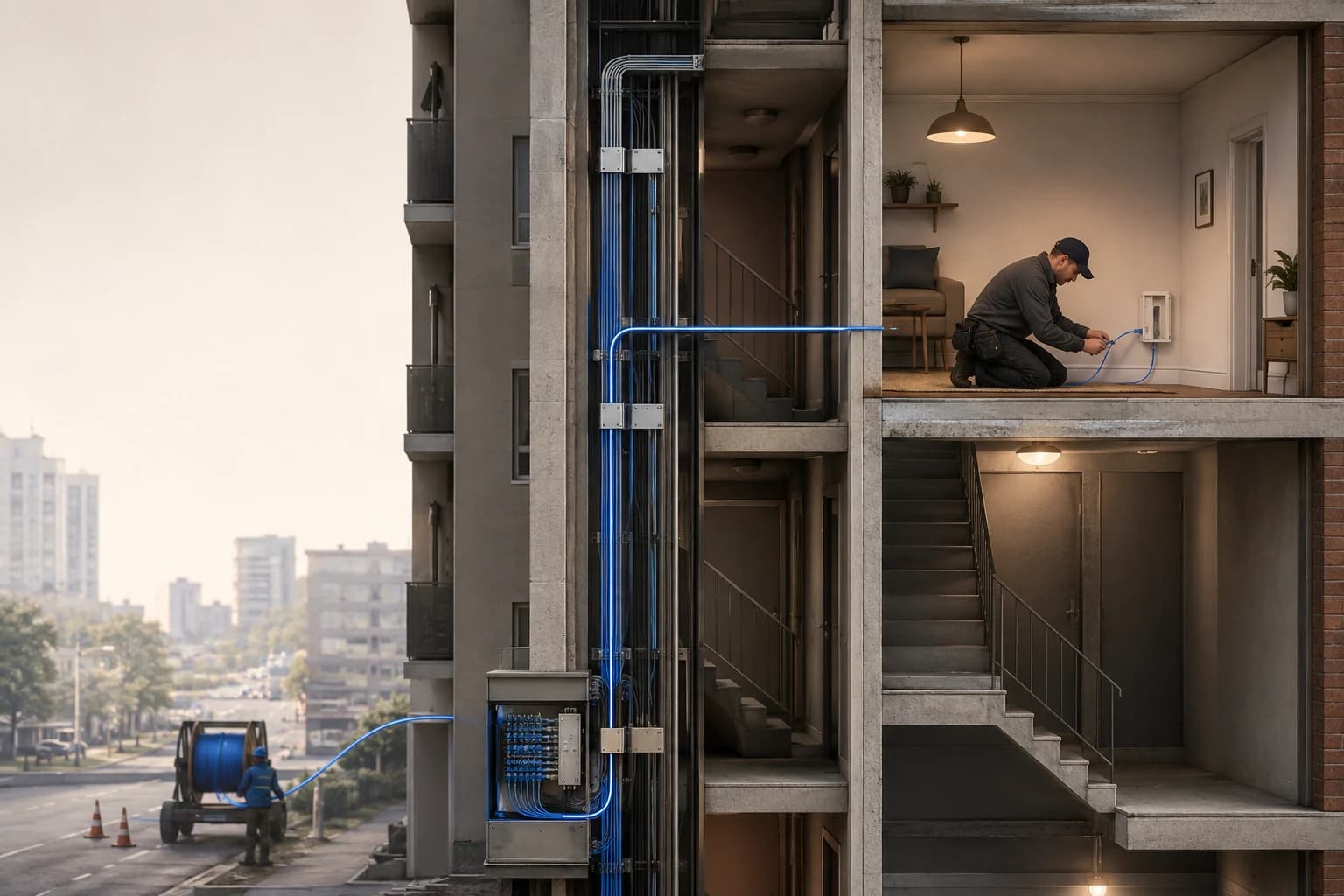
The Expensive Thirty Metres
Feeder and distribution work is planned, mechanised and predictable. In-building work is none of those things. It happens in occupied buildings, around other people's property, with a resident waiting.
Per metre, the last stretch inside a building is by far the most expensive part of an FTTH deployment, and it is where schedules slip.
The Two Building Types
New build. Conduit exists, routes are designed, and the work is straightforward. Fiber can be installed before occupancy. If you get to influence the design, ask for conduit to every unit and a properly sized communications room.
Existing building. No conduit, or conduit already full. Routes have to be found — stairwells, existing risers, external walls, ducting behind trim. Access requires coordination with residents and building management. This is the normal case, and it is why in-building surveys matter more than any other survey in access work.
Riser Topologies
Home run. A dedicated fiber from the building's distribution point to each unit. Simplest to understand and to fault-find, and the most fiber. Practical in smaller buildings.
Floor-by-floor. A riser cable with floor-level enclosures, from which drops run to units on that floor. Fewer fibers in the riser, more enclosures. Standard in larger buildings.
Distributed splitting in the building. A splitter in the building serving units directly. Minimises fiber from outside but constrains capacity per building and complicates later changes.
The choice interacts with the capacity planning discussed in the previous lesson. Splitting inside the building saves feeder fiber but fixes the architecture in place; if take-up exceeds expectation, changing it means working in the building again — the expensive place.
Why Bend-insensitive Fiber Changed This Work
As covered in the fiber types lesson, G.657 tolerates much tighter bends than standard G.652.
Inside a building that is not a marginal improvement. It is the difference between routing behind trim, around door frames, and along skirting boards — or not being able to at all. G.657.A2 and B3 are what make discreet in-building installation practical.
The caveat from that lesson still applies: bend-insensitive fiber buys margin, it does not eliminate the limit. A fiber stapled hard against a corner will still lose light, and the installation will still be the cause of a fault report later.
Installation Realities
The route must be agreed before you start. Residents care what the cable looks like. Going back to reroute because someone objected costs more than the original run.
Fire stopping is mandatory when penetrating compartment boundaries. This is a legal and safety requirement, not an optional finish, and it is regularly the reason an installation fails inspection.
Label at both ends, immediately. In a riser with dozens of identical fibers, an unlabelled drop is found only by testing. As covered in the VFL lesson, this is exactly what a visual fault locator is for — but doing it right the first time is faster.
Leave slack at the unit and at the floor enclosure. As covered in the slack lesson, the next repair depends on it. Inside buildings the temptation to trim tight is strong because slack is visible.
Test after installation, before leaving. The resident is present, access is available, and a fault found now costs minutes instead of a return visit.
Handover Records That Matter Here
In-building plant is where records decay fastest, because changes happen often and are made by whoever is on site.
Minimum per unit:
- Which riser fiber, which floor enclosure, which port
- Measured loss at handover
- ONU serial and location within the unit
- Route taken, if not obvious
That last one sounds excessive until someone has to trace a cable behind three rooms of trim.
The Survey Is the Whole Job
If there is a single lesson from in-building work, it is that the survey determines the cost, and a bad survey cannot be recovered later.
A good survey establishes: where the entry point is, where the distribution point will sit, what riser routes exist and whether they have capacity, what the unit-level route looks like, who grants access, and what the building's rules require.
Getting this wrong produces the most common failure in FTTH programmes: an appointment booked, an engineer dispatched, and the job abandoned on the day because the route was not viable.
Summary
- The last thirty metres inside a building cost more per metre than the kilometres outside.
- Existing buildings without conduit are the normal case; survey quality decides cost.
- Home run, floor-by-floor and in-building splitting each trade fiber count against future flexibility.
- G.657 bend-insensitive fiber is what makes discreet routing possible, but the limits still exist.
- Agree the route with residents first, fire-stop properly, label immediately, leave slack, test before leaving.
- Record riser fiber, enclosure, port, measured loss and route per unit.