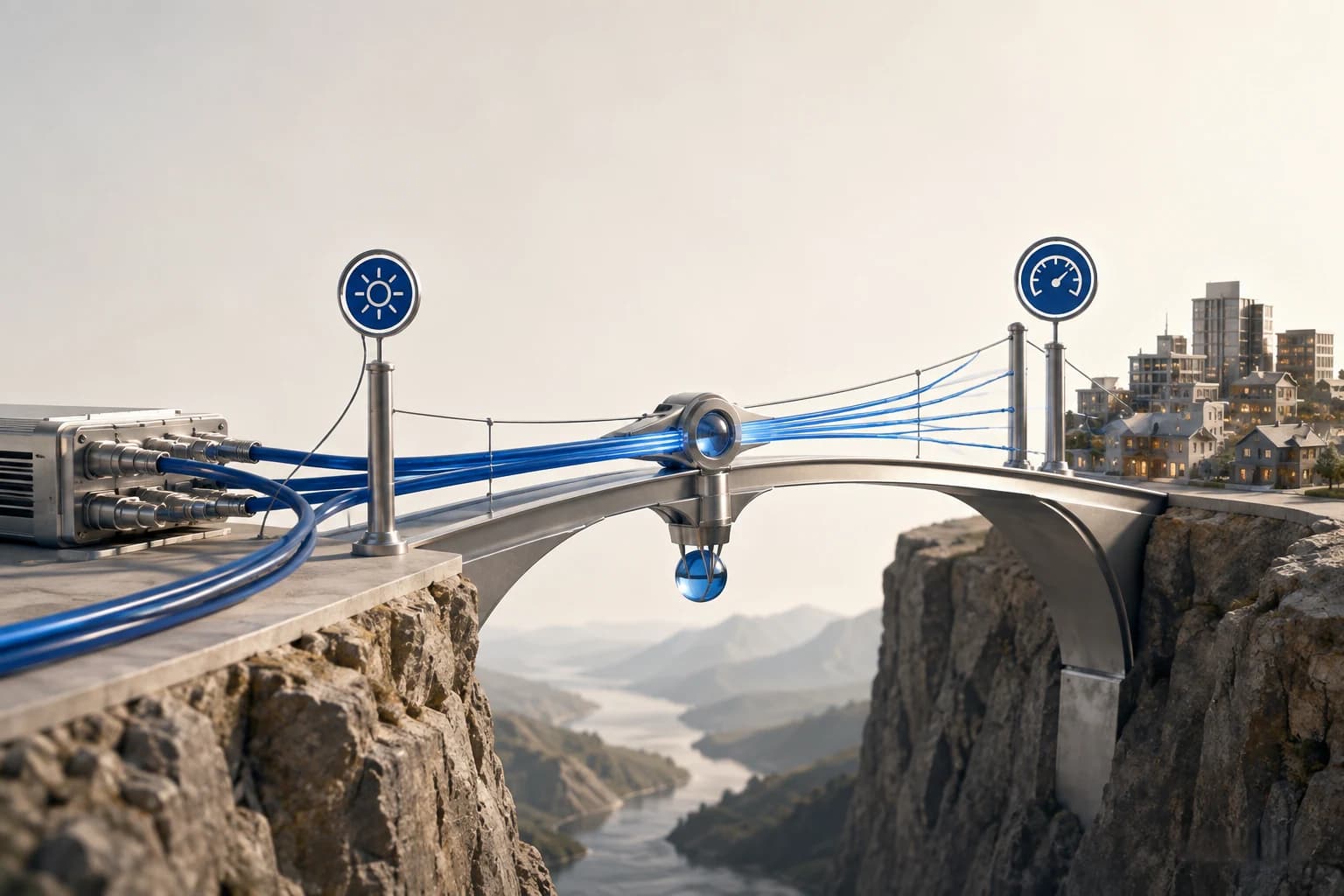
The Number That Decides Everything Downstream
Choosing a split ratio looks like an optical engineering decision. It is really a decision about cost per subscriber, service quality, and how long the plant stays adequate.
As covered in the PON lesson, every doubling of the split adds roughly 3 dB. What that lesson did not address is the other half: every doubling also halves the bandwidth available per subscriber.
Both constraints move together, and capacity planning is about finding where they cross for a particular deployment.
The Two Ceilings
Optical ceiling. How much loss the system tolerates. Determined by the equipment's loss class, the fiber distance, splice and connector count, and the margin you intend to preserve. This ceiling is hard — exceed it and the link does not work.
Bandwidth ceiling. How much traffic the port can deliver, divided by how many subscribers share it. This ceiling is soft — exceed it and service degrades at peak times rather than failing.
A GPON port delivers 2.5 Gbit/s downstream. Across 32 subscribers that is roughly 78 Mbit/s each if everyone transmits simultaneously — which they do not. Across 64 it is 39 Mbit/s.
Oversubscription Is Normal and Has a Limit
Nobody dimensions for every subscriber using full capacity at once, because that never happens. Real usage is bursty and concentrated in evening peaks.
The planning question is therefore what happens at peak, not on average. Two networks with identical split ratios behave very differently if one serves households streaming video in the evening and the other serves businesses uploading during the day.
Which is why the honest answer to "what split ratio should we use" is: it depends on the traffic profile, and you should measure it rather than assume it.
What Pushes the Ratio Down
Long distances. Distance consumes budget, leaving less for splitting.
Existing plant with accumulated repairs. As covered in the route types lesson, each repair adds splices permanently. Older plant has less headroom.
Plans to upgrade to a higher rate later. As covered in the wavelength plan lesson, higher-rate systems tolerate less loss. A ratio that works for GPON today may block XGS-PON tomorrow.
Business or high-value subscribers with committed rates.
What Pushes the Ratio Up
High subscriber density. Apartment blocks make aggressive splitting economical.
Constrained duct capacity. If there is no room for more feeder fiber, splitting harder is the only way to serve more subscribers.
Cost pressure on the feeder. Each doubling halves the feeder fiber count required.
The Two-Stage Question, Revisited
The PON lesson introduced single-stage versus two-stage splitting as an architecture choice. From a capacity planning perspective the trade-off sharpens:
Single-stage makes the loss budget simple and the capacity picture uniform. Every subscriber on the port sees the same architecture.
Two-stage lets you match splitting to actual subscriber distribution — a light split at the first stage, then heavier splits only where density justifies it. It also lets you add capacity incrementally, by populating second-stage splitters as demand appears rather than building for the final count on day one.
That incremental property is often the deciding factor in areas where take-up is uncertain. You build the feeder and first stage, and defer the rest.
Planning for Take-up, Not for Homes Passed
A common planning error is dimensioning for every home passed rather than for realistic take-up.
If take-up is expected to reach 40%, a 1:32 splitter serves roughly 80 homes passed. Dimensioning as though all 80 will subscribe wastes budget on splitting you never need — and, worse, consumes optical margin permanently.
Conversely, dimensioning for today's 15% take-up and finding yourself at 60% in five years means revisiting plant. The workable approach is to build the passive infrastructure for the long-term case and populate it progressively, which is exactly what two-stage architectures enable.
A Checklist Before Committing
- Measured or estimated peak traffic profile, not average.
- Loss budget at the intended ratio, with 3 dB of margin preserved.
- Same calculation for the next-generation system you might deploy later.
- Take-up projection over the intended life, not today's number.
- Duct and feeder capacity available for future expansion.
- Repair allowance — how many future splices the budget can absorb.
Item 6 is the one that is almost never in a design document, and it is the one that decides whether the plant is still healthy in ten years.
Summary
- Split ratio trades optical budget against bandwidth per subscriber, and both move with every doubling.
- The optical ceiling is hard; the bandwidth ceiling is soft and shows up at peak.
- Distance, accumulated repairs and future upgrades push the ratio down. Density and duct constraints push it up.
- Two-stage architectures let you defer capacity, which suits uncertain take-up.
- Plan for realistic take-up over the plant's life, and explicitly budget for future repair splices.