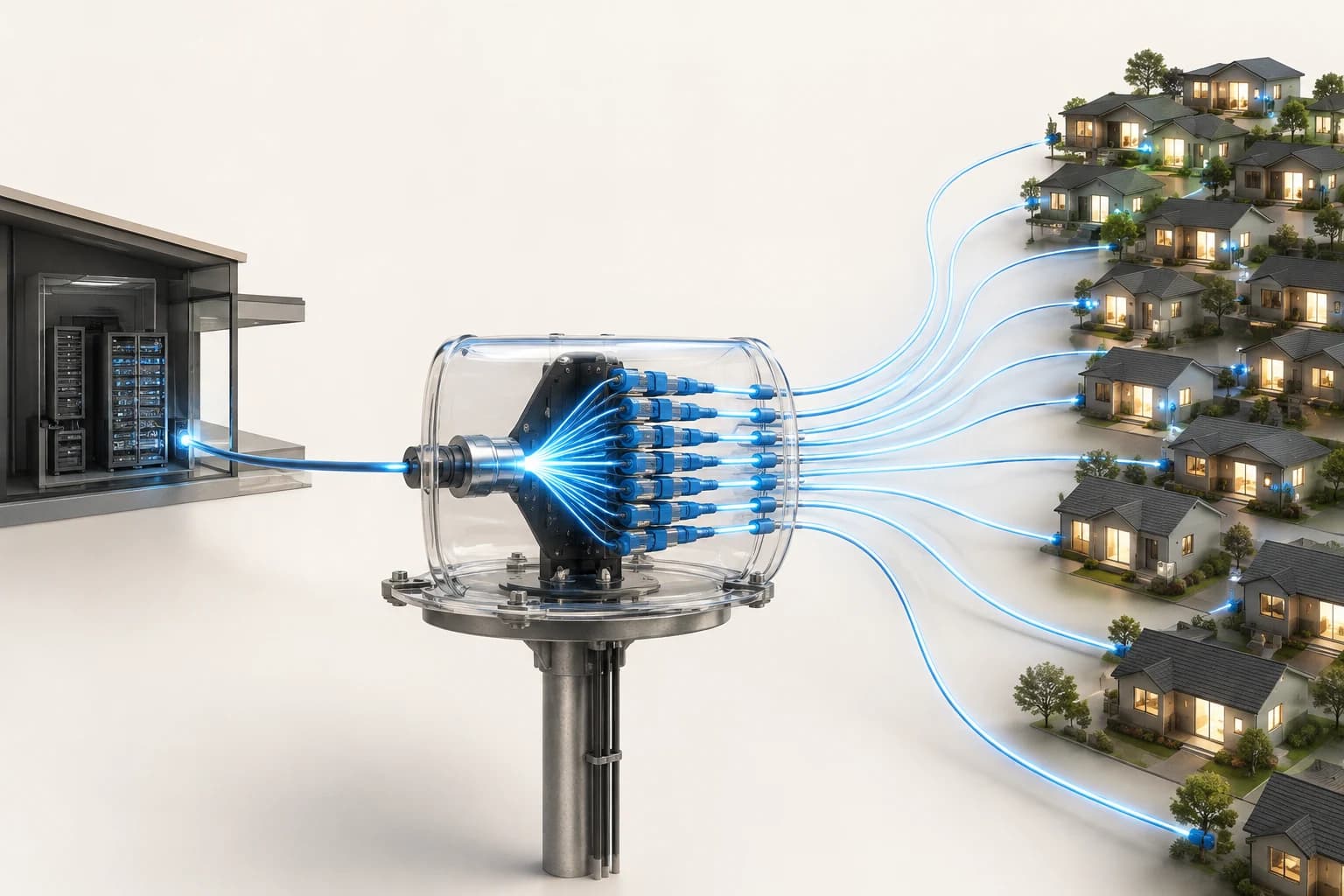
Can We Just Run a Separate Fiber to Each Subscriber?
We can. Technically there is nothing wrong with it, and point-to-point delivers the best performance available.
The problem is cable count. Ten thousand subscribers means ten thousand strands leaving the central office. Duct capacity, frame space, and construction cost all fall apart at that scale.
PON is how we get around it.
PON — Splitting Without Power
The P in PON (Passive Optical Network) stands for passive. It means there is no powered equipment anywhere between the two ends.
One fiber leaves the central office. Somewhere along the way, a splitter divides it into 32 strands. Each strand goes to a subscriber. The number of fibers leaving the office drops by a factor of 32.
Because splitters need no power, they can sit on a pole, inside a manhole, or in a building basement. Nothing to energize, and almost nothing to fail and replace. This is the single biggest reason FTTx became economically viable.
But Does the Traffic Get Mixed Up?
If 32 homes share one strand, it is fair to ask whether a neighbor data stream arrives at your door. Physically, it does. Two mechanisms deal with that.
Downstream — Broadcast and Filter
From the OLT toward subscribers, every frame is broadcast to all 32 homes. Each ONU picks out what is addressed to it and discards the rest.
This is why downstream traffic is encrypted. Reaching a device and being readable by that device are two different things.
Upstream — Taking Turns in Time
The subscriber-to-OLT direction is trickier. If 32 homes transmit simultaneously, their bursts collide on the shared fiber.
So the OLT tells each ONU when it may transmit. Home 1 now, home 2 next, and so on. This is TDMA, time division multiple access.
One practical consequence follows directly from this. The OLT compensates for the fact that subscribers sit at different distances, so that every burst lands precisely in its assigned slot. That is why attaching a new ONU triggers a registration and ranging process before any traffic flows. If a freshly installed unit does not come up instantly, this is usually what you are waiting on.
Choosing a Split Ratio
1:8, 1:16, 1:32, 1:64. Bigger numbers save more fiber and leave a weaker signal. There is no correct answer here, only a trade-off.
표가 넓으면 좌우로 스크롤하여 확인하세요.
| Ratio | Theoretical split loss | Character |
|---|---|---|
| 1:8 | about 9 dB | Generous loss headroom, modest fiber savings |
| 1:16 | about 12 dB | Middle ground |
| 1:32 | about 15 dB | The common FTTH choice |
| 1:64 | about 18 dB | Tight budget, real distance limits |
Every doubling of the split adds roughly 3 dB. And 3 dB means half the optical power. At 1:32 you are working with something like a thirtieth of what you started with, and that is the right intuition.
On top of that come connector loss, splice loss, and the attenuation of the fiber itself. Design to the theoretical number alone and the link will not come up in the field.
One Stage or Two?
You can concentrate the split in one place (1:32 at a single point), or cascade it (1:4 first, then 1:8 on each branch).
- Single-stage, centralized — easier to manage, simpler loss math. The cost is that cable concentrates at the splitter location.
- Two-stage, distributed — saves more cable and adapts better to scattered subscribers. The cost is more junction points, therefore more loss contributors, and harder fault isolation.
Scattered subscribers generally favor two stages; dense apartment blocks favor one. In reality, duct availability and maintenance staffing tend to drive the decision more than either principle.
Mistakes That Show Up Repeatedly
Leaving splitter ports unmanaged. If only 12 homes hang off a 1:32 splitter, 20 ports sit empty, and dust gets into empty ports just fine. Months later, when a new subscriber is connected, that contaminated port produces a loss reading nobody can explain. Dust caps are not a consumable; treat them as part of the plant.
Budgeting with theoretical split loss only. As noted, measured values are always worse than theory. Skip the margin at design time and the link crosses its threshold the moment one extra splice gets added years later.
Summary
- PON shares a single fiber across many subscribers using unpowered splitters.
- Downstream is broadcast and filtered; upstream is time-slotted by the OLT.
- Every doubling of the split costs about 3 dB, and that math sits at the center of the design.
The next lesson covers that math directly: the optical power budget, which is where a link lives or dies.