Nobody Replaces a Network at Once
An operator with GPON serving thousands of subscribers cannot switch everyone to XGS-PON on one night. Subscribers have working ONUs, and replacing all of them simultaneously is neither affordable nor operationally sane.
So the two generations run on the same fiber at the same time, and subscribers migrate individually. That is coexistence, and it is the normal upgrade path.
How It Works Physically
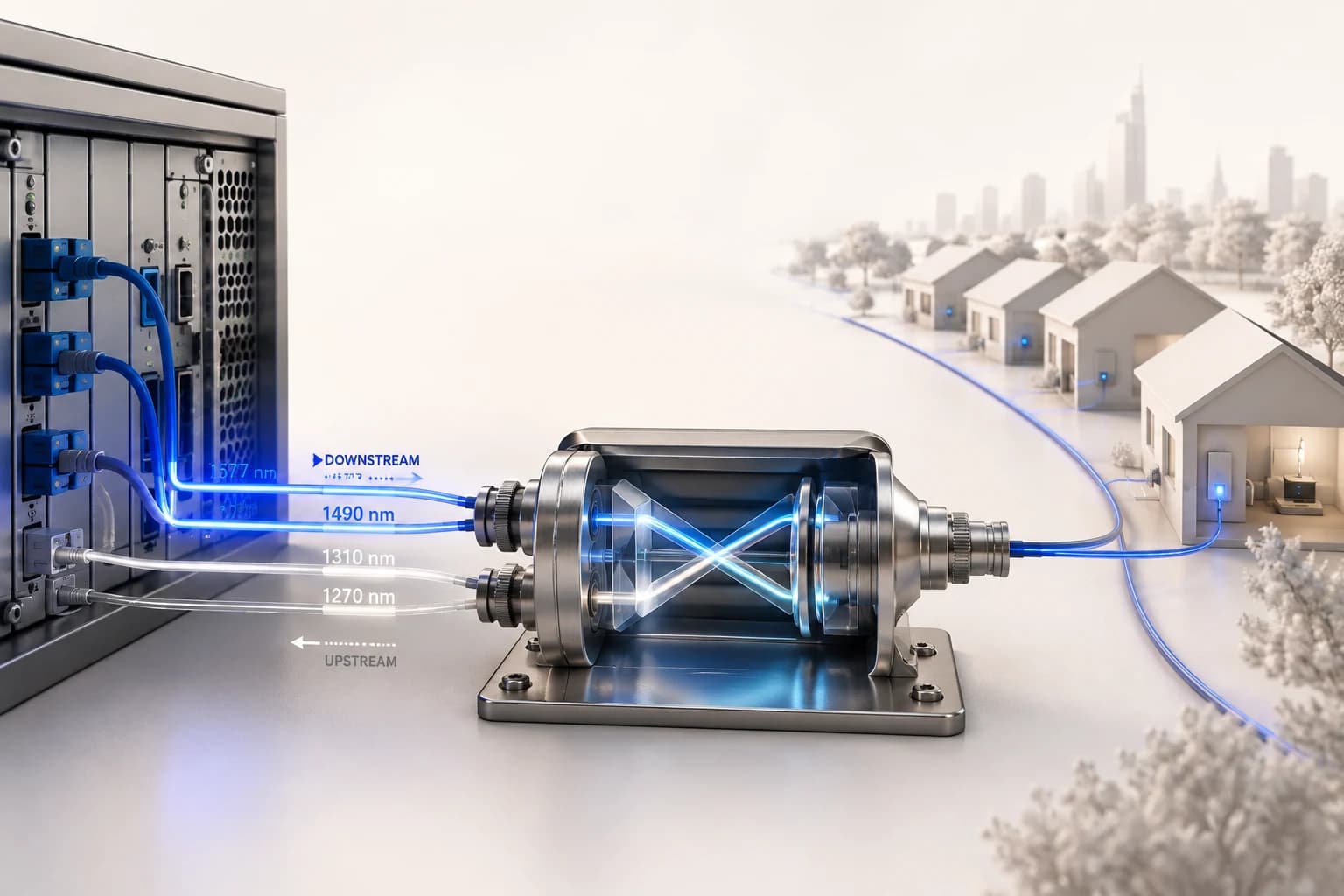
As covered in the wavelength plan lesson, GPON and XGS-PON use different wavelengths in both directions. A passive filter can therefore combine and separate them.
That component sits at the OLT side and is called a coexistence element, or WDM1r in the standards. It:
- Combines GPON downstream (1490 nm) and XGS-PON downstream (1577 nm) onto the shared feeder
- Separates GPON upstream (1310 nm) from XGS-PON upstream (1270 nm) coming back
- Passes the RF video overlay at 1550 nm if present
Downstream, every ONU receives everything and ignores what is not on its wavelength — the same filtering principle as the broadcast behaviour covered in the PON lesson, one level up.
What It Costs You
The coexistence element is passive, but it is not free in budget terms. Insertion loss is typically around 1 dB in each direction.
That number lands directly on a budget that, as covered in the power budget lesson, is usually dominated by split loss and may already be tight after years of repair splices.
The practical consequence: check the budget before ordering the equipment. A plant running at 1.5 dB of margin cannot absorb a 1 dB coexistence element and remain safe. Options at that point are reducing the split ratio, shortening the path, or replacing degraded connectors to reclaim margin.
The Migration Sequence
A sequence that avoids surprises:
1. Survey and measure. End-to-end loss at both generations' wavelengths, reflectance on all connectors, actual split ratio, real distances. As covered in the previous lesson, measure rather than trusting the design.
2. Reclaim margin first. Before adding anything, clean and re-terminate marginal connectors, and replace any splices that measured poorly at acceptance. This is cheap and it often recovers more than the coexistence element will consume.
3. Install the coexistence element and the new OLT ports with no subscribers on them. Verify that existing GPON service is unaffected — this is the step people rush, and it is the one that causes mass outages.
4. Migrate a small pilot group. A handful of subscribers, ideally at varying distances including the furthest, since the far end has the least margin.
5. Measure the pilot group at the new wavelengths and confirm received power is comfortably inside the window, not just barely inside.
6. Migrate in batches, keeping the ability to roll a subscriber back to GPON if their ONU or path misbehaves.
7. Reclaim the GPON ports once a tree is fully migrated.
What Goes Wrong
Insufficient margin discovered mid-migration. Because the survey was done on paper. The result is a partially migrated tree and an unplanned plant project.
Reflections that were tolerable become intolerable. Higher-rate systems are less forgiving. A connector that passed at GPON may fail at XGS-PON, which is why step 1 includes reflectance and not just loss.
Furthest subscribers fail while nearby ones work. Predictable, and the reason the pilot group should deliberately include the far end.
Video overlay disturbed. If RF video at 1550 nm is present, the coexistence element must pass it correctly. Verify video specifically, because subscribers notice it immediately and it is not covered by data testing.
Differential distance violations. As covered in the registration lesson, PON systems specify a maximum difference between nearest and furthest ONU. Changing which subscribers are on which port during migration can breach it.
Documentation During Migration
A tree in mid-migration is the most confusing state a network can be in: two generations, two OLT ports, subscribers split between them.
Minimum records to keep current:
- Which subscribers are on which generation, updated as you go
- Measured received power per subscriber after migration
- Remaining margin per path after the coexistence element was added
- Which GPON ports are still in service and which are reclaimable
Without this, a fault during migration takes far longer to diagnose because nobody can say which system a given subscriber should be on.
Summary
- Coexistence lets two PON generations share one fiber, with subscribers migrating individually.
- The coexistence element is passive but costs roughly 1 dB each way — check the budget before ordering.
- Reclaim margin by cleaning and re-terminating before you spend it on the new element.
- Verify existing service is unaffected before migrating anyone, then pilot with subscribers at the far end.
- Reflections, video overlay and differential distance are the constraints that bite during migration.
- Keep per-subscriber generation and margin records current while the tree is mixed.