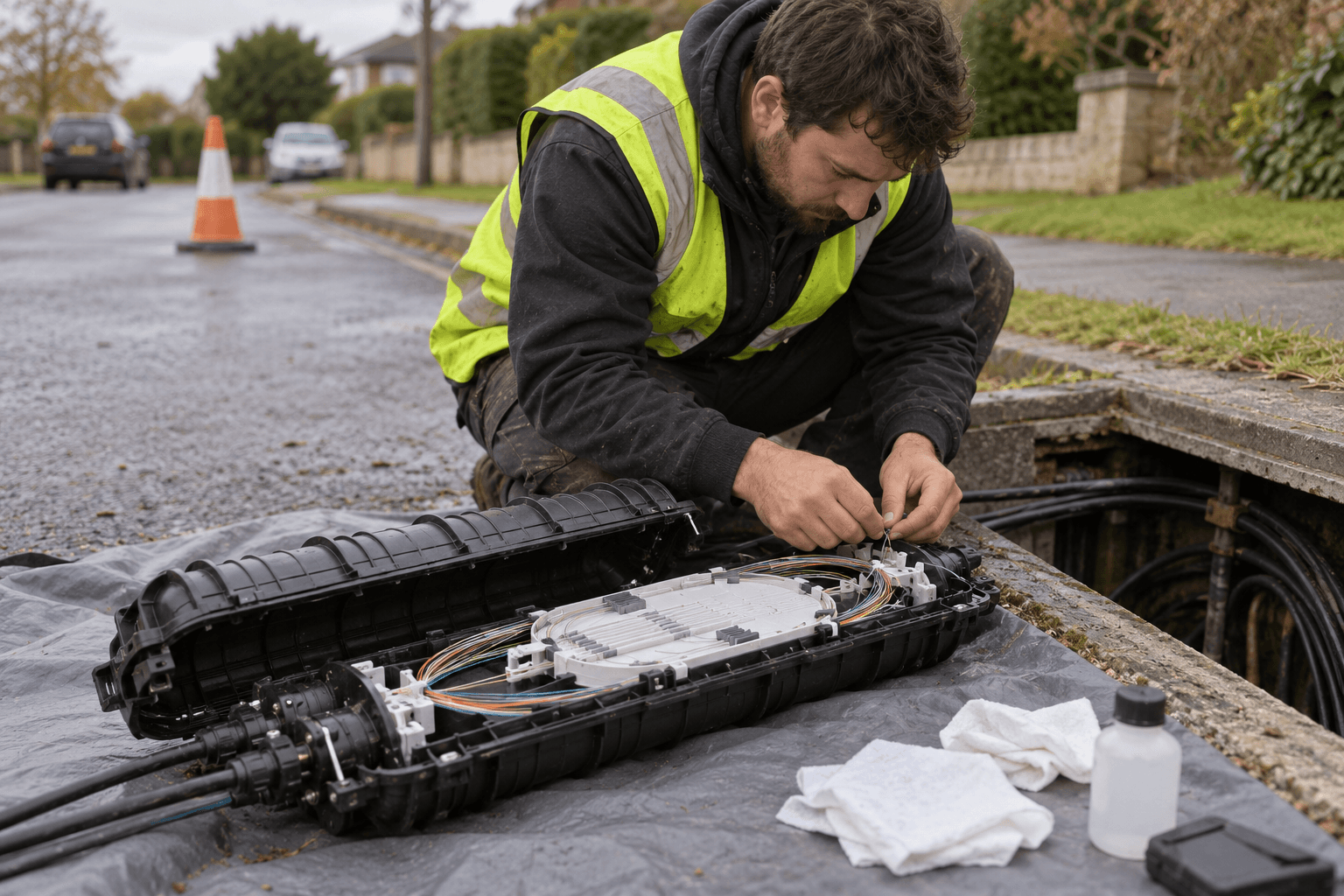
A closure that passed its first pressure test can still leak on the third visit. First sealing happens with fresh parts and a prepared work area. Re-entry happens months or years later, often in a wet handhole, and the crew has to reach a splice tray without disturbing fibers that already carry traffic. Waterproof design and work instructions should cover both moments.
This is not a substitute for any product's datasheet or acceptance criteria. How many times a gasket may be reused, the bolt order, the torque, and the test pressure all differ by product, and the manufacturer's installation procedure decides. What follows are the questions that keep appearing across manufacturer documents, arranged as a re-entry checklist.
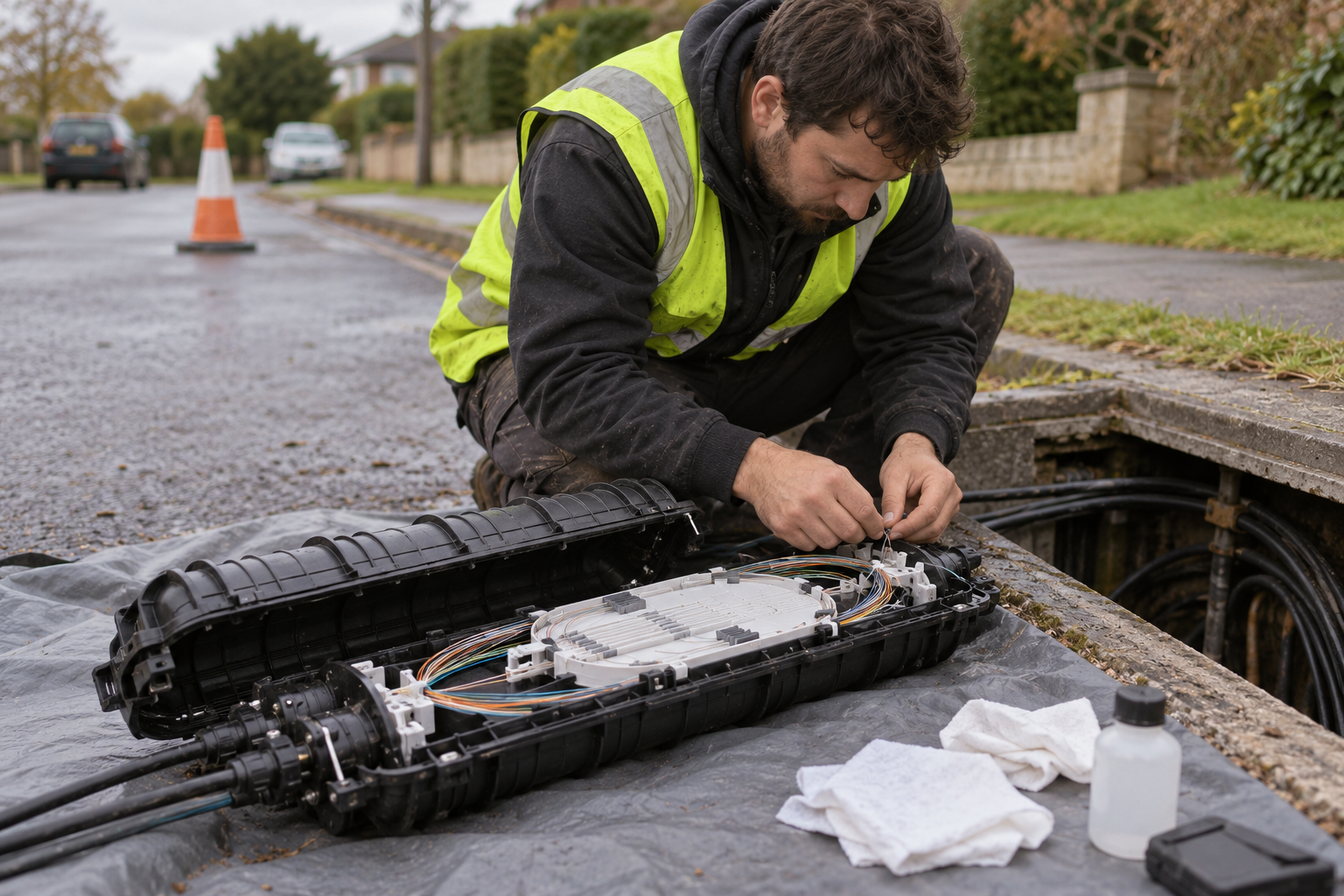 A closure cover set aside next to an open handholeView original
Generated image. Not a specific site or product.
1. First sealing and re-entry start from different conditions
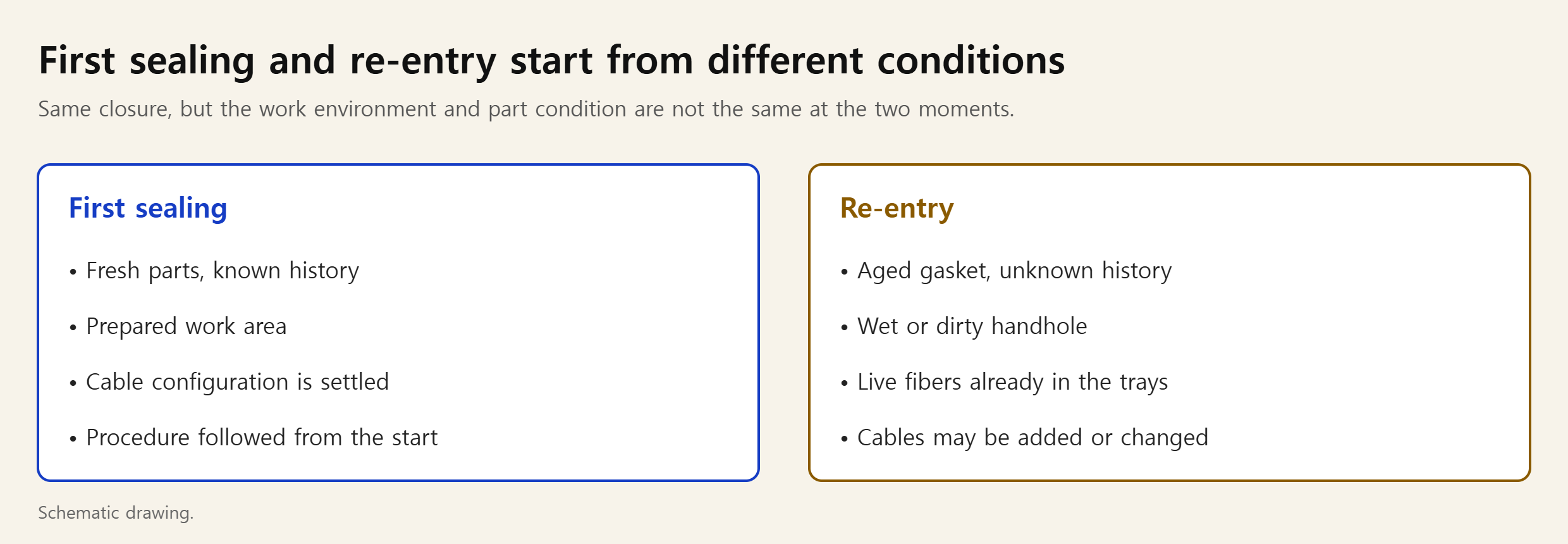 Comparison of first sealing and re-entry conditionsView original
Schematic drawing by the author. It does not depict a specific product or site.
At first sealing, the history of every part is known and the procedure can be followed from the start. At re-entry, the gasket has already been compressed at least once, the work area may be wet or dirty, and cables are sometimes being added or changed during the same visit. The Fiber Optic Association (FOA) notes that underground closures left for long periods can get very dirty, which makes entry for repairs difficult. A waterproofing review that looks only at first sealing leaves these conditions out.
2. The gasket has a history
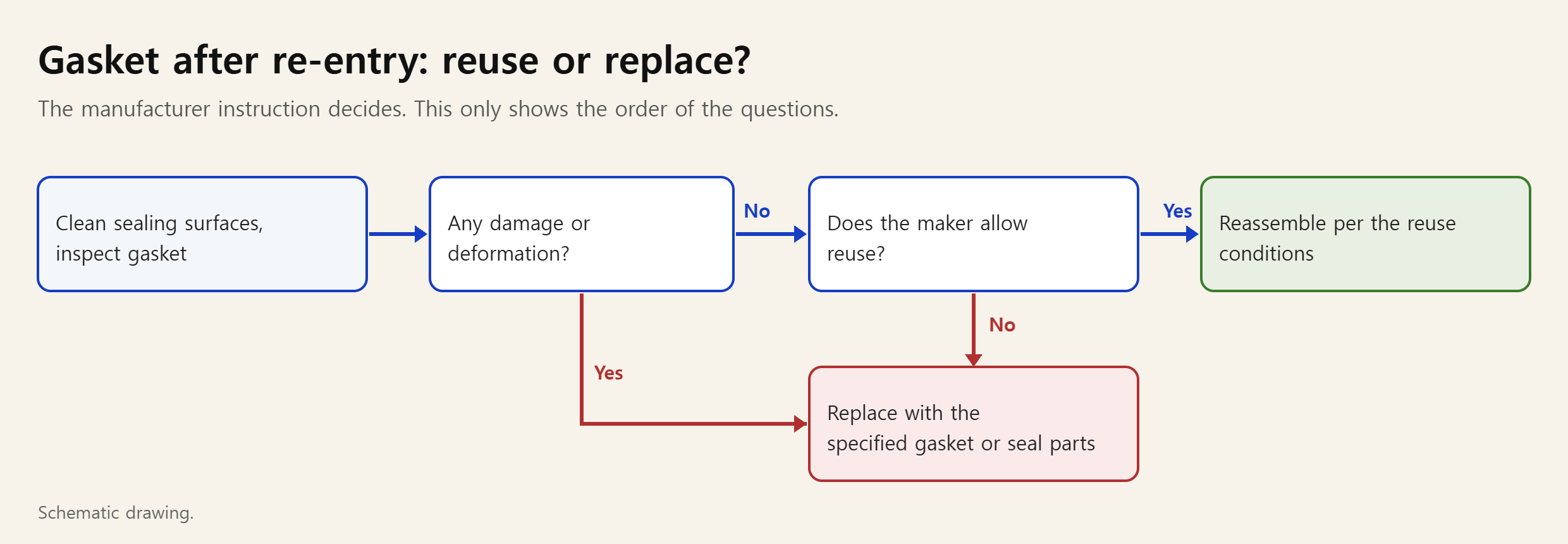 Order of questions for reusing or replacing a gasketView original
Schematic drawing by the author. The manufacturer's instruction decides.
Corning describes its 2178 closure family as a gasket-sealed design that is reusable and easy to re-enter. Even so, the same company's installation procedure says to reapply silicone grease to the gasket when resealing, to keep the sealing surfaces clean, and warns that leakage can occur if the specified materials and steps are not followed. A damaged gasket is replaced with a gasket kit.
The RLH Industries user guide for a 48-fiber inline closure sets a different rule. If all seals are undamaged after opening, the cover may be reattached and the bolts tightened. Otherwise the closure has to be replaced. The same guide states a re-entry performance condition for that product, but that number belongs to that closure and cannot be carried over to another.
Three questions come out of the two documents. Is the sealing element in this closure a reusable part or a replacement part? What damage standard does the crew apply in the field? Is the replacement part in the truck? Knowing the answers before opening makes decisions in the handhole faster.
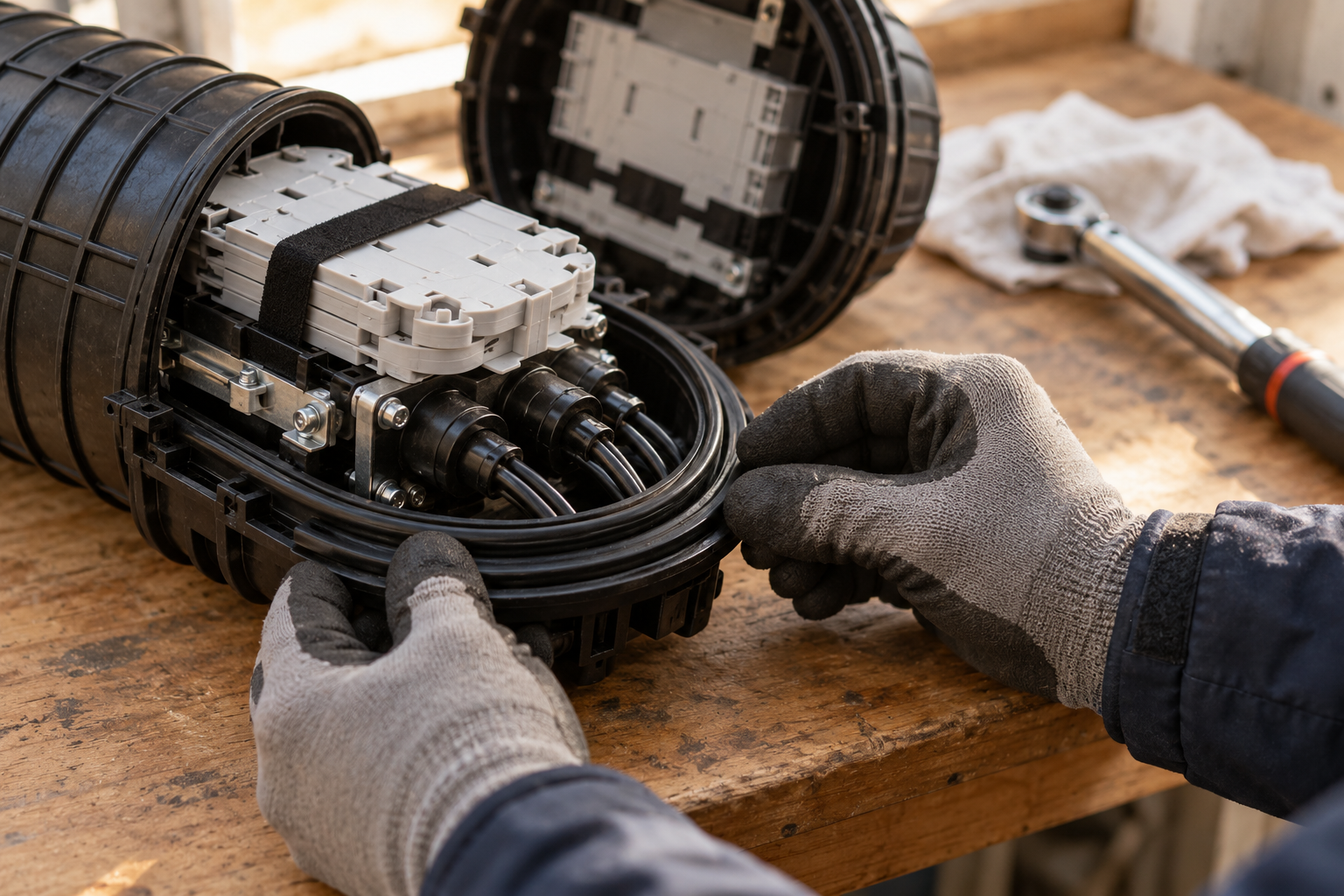 Inspecting a gasket on a workbenchView original
Generated image. Not a specific site or product.
3. Opening is a fiber risk as well as a water risk
Watching only the seal misses something. FOA explains that fibers are often broken as trays and closures are assembled or re-entered for troubleshooting and repair. Tray covers can pinch fibers, and such a break can sit too close to a splice for an OTDR to separate it from a bad splice. Finding it may take a visual fault locator.
So a closure that opens easily is not necessarily a closure that re-enters well. Part of re-entry quality is whether the crew can reach what it needs without moving trays, close the covers without pinching fibers, and follow a sequence that leaves working circuits alone. Corning's procedure also tells the installer to keep the largest possible bend radius for buffer tubes and transition tubes inside the closure.
4. Sealing is a sequence
Corning's procedure specifies tightening the cover bolts in a shown sequence and finishing to a stated torque, and says leakage may occur if the procedure is not followed. The RLH guide asks for the bolts to be tightened again ten minutes after the cover goes on. That looks like an allowance for the gasket to settle, but the interval is that product's instruction and should not be moved to another closure.
Testing follows the same logic. FOA says sealed closures may need pressure testing and that the manufacturer's inflation pressures and procedures should be checked. Corning's procedure limits the maximum test pressure, tells the crew to release the pressure afterward, and permits only clean, dry air or nitrogen. Nothing in these documents suggests that a higher pressure makes a better test. The point is to use the stated value and method.
5. A five-step re-entry sealing check
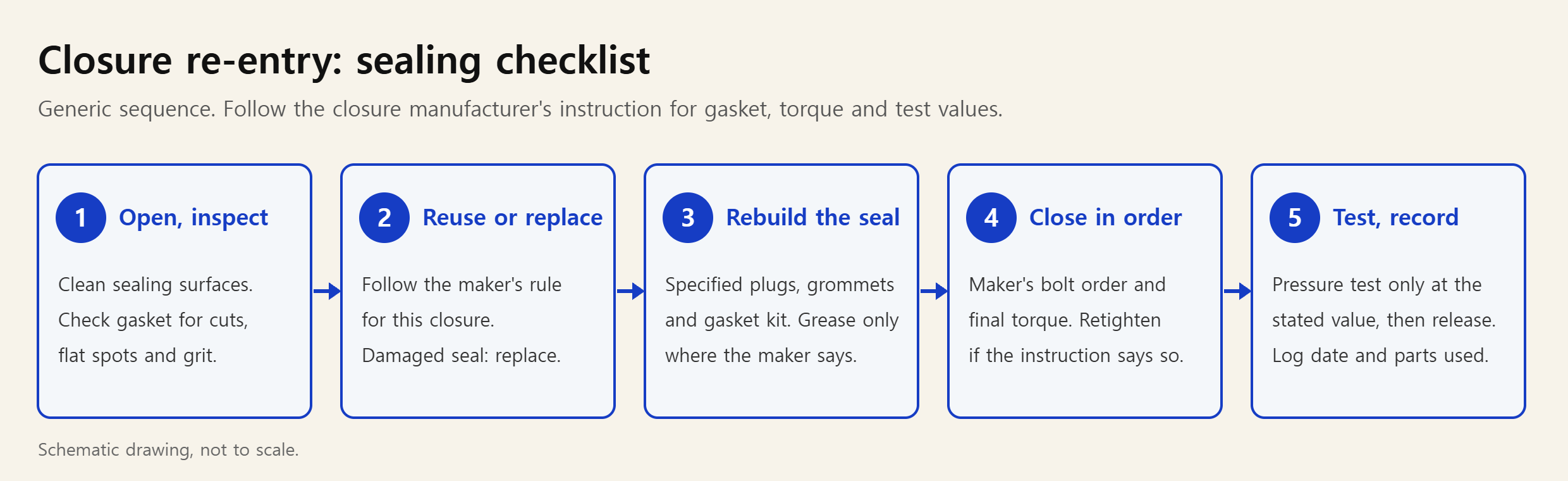 Five-step re-entry sealing checklistView original
Schematic drawing by the author. Follow the manufacturer for values and detail.
- Open and inspect. Clean the sealing surfaces and look for cuts, flat spots, and grit on the gasket. Cleaning here is about getting the information needed for a decision, not about making a result look good.
- Decide to reuse or replace. Check whether the maker allows reuse under the current conditions and whether the damage meets its replacement standard.
- Rebuild the seal. Use the specified plugs, grommets, and gasket kit. Apply grease only where the maker says to.
- Close in order. Follow the maker's bolt sequence and final torque, and retighten if the instruction requires it.
- Test and record. If the procedure calls for a pressure test, use only the stated pressure and release it afterward. Log the date and the parts replaced.
6. A record the next crew can use
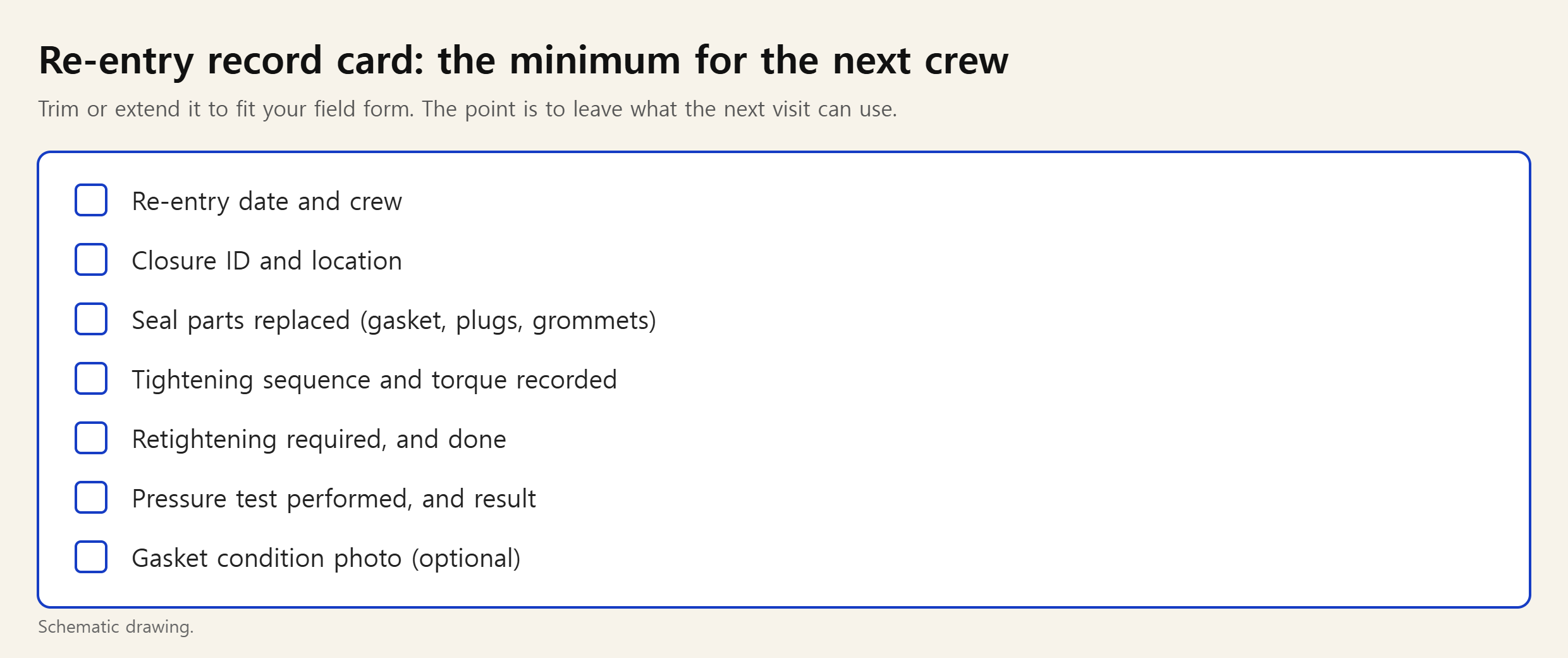 Example re-entry record cardView original
Schematic drawing by the author. Trim or extend it to fit your field form.
Without a record, the next visitor cannot tell how many times the gasket has been compressed or who replaced which part. The fields above are a minimum. A photo of the gasket condition helps the next decision. Put the record where crews actually look, whether that is the closure label or the asset system.
7. What designers should ask
A pressure test result does not settle the question of watertightness. Ask how many openings the seal is expected to survive, what condition it must be in afterward, and how a field crew can confirm and record that condition. First sealing gets the attention, but re-entry is where the design is really tested.
Manufacturer and industry documents consulted
The facts in this article were checked against the public documents below. Please confirm product-specific values in the relevant version of each document. No drawings or photographs from these documents are reproduced here, and every diagram is the author's own schematic.
- Corning, Fiber Optic Splice Closure 2178-L/S Series with Gasket, Standard Recommended Procedure 78-8130-1910-2, Issue 9 (August 2019): PDF
- Corning, Fiber Closures family brochure CRR-912-AEN (2021): PDF
- RLH Industries, RLH-OFSC-48-1 Splice Closure User Guide: PDF
- The Fiber Optic Association, Fiber Optic Splice Closures: web page