An image file made by typing a few prompts into an AI tool is unlikely to qualify for copyright registration. Korea's registration guide for generative AI works and the U.S. Copyright Office report read in the same direction: protection follows the creative contribution a person made. Your own drawing fed into the tool, edits you make to the output, and a creative selection and arrangement of several outputs are the places where that contribution can show up. If you sell digital products, the first job is to record which part of each file is yours.
Based on public materials checked on October 30, 2026. The sources are the registration guide for generative AI works that Korea's Ministry of Culture, Sports and Tourism and the Korea Copyright Commission issued in June 2025, a press release for the 42nd meeting of Korea's National Intellectual Property Commission (distributed October 8, 2026), and the Library of Congress summary of the U.S. Copyright Office report "Copyright and Artificial Intelligence, Part 2: Copyrightability" (released January 29, 2025). I read the U.S. report through that summary and excerpts, not in full. This is not legal advice and it describes no particular seller. The tables and the record card below are DMS.Labs proposals built from those materials. They are not forms issued by any agency or required by law. The Korean sources are in Korean, and the links go to the original documents.
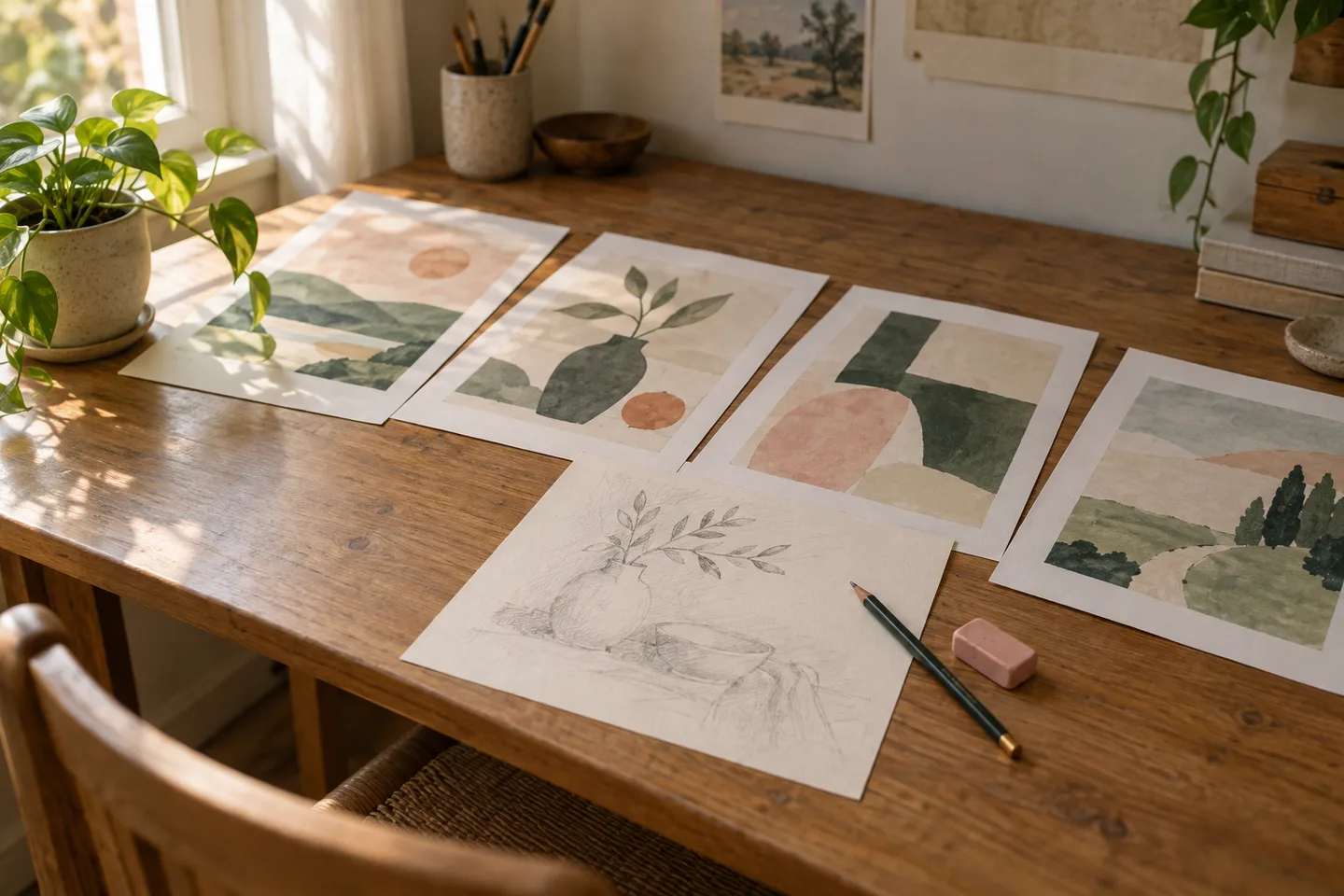
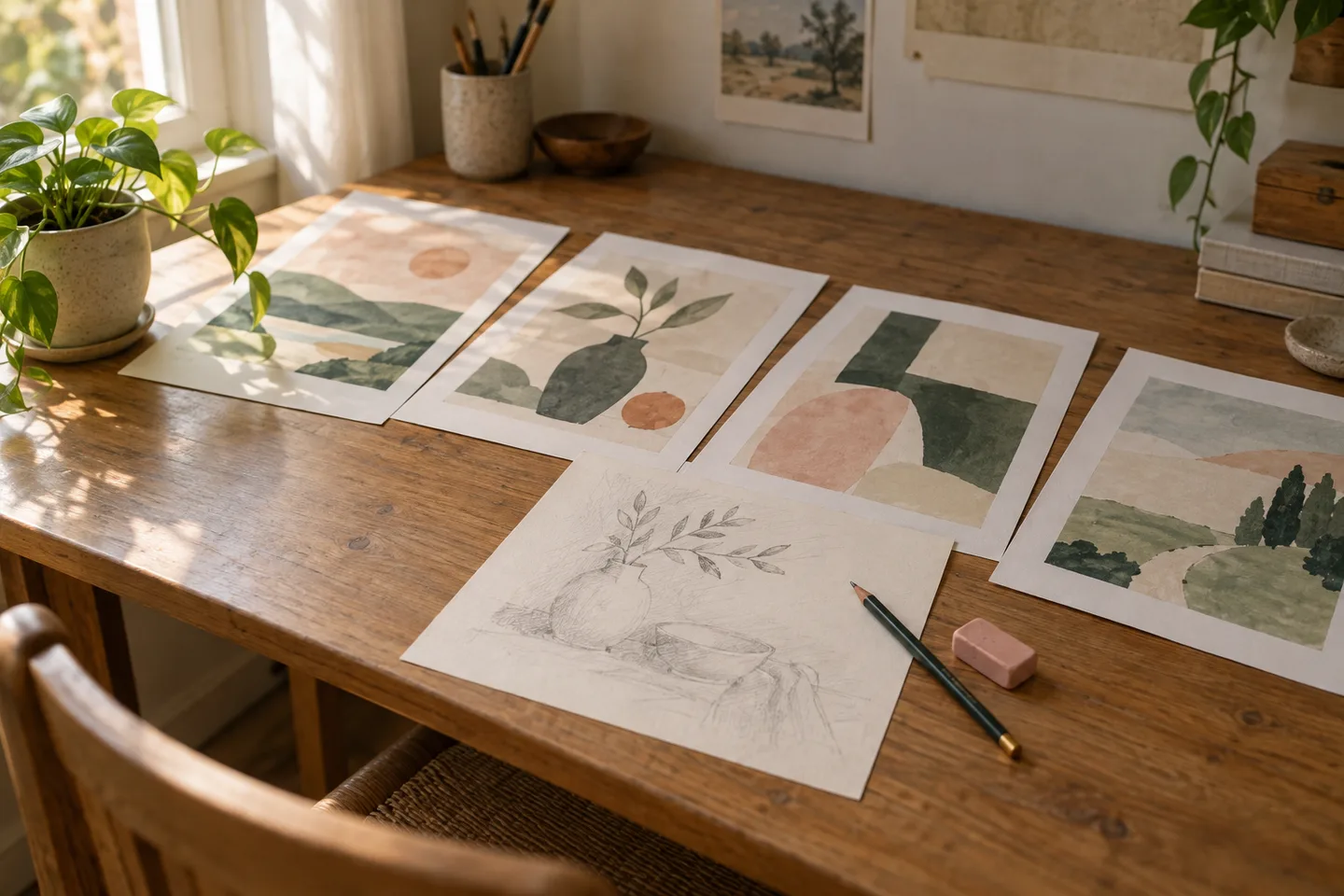 Printed illustration proofs laid out on a desk next to one hand-drawn pencil sketchView original
Is a product made from prompts alone my own work?
Probably not, and both documents point that way. The Korean guide splits generative AI results into two groups. If a person made a creative contribution to some part of the result, it is a "generative AI-assisted work." If not, it is a "generative AI output." The FAQ says an output is not a work under Korean copyright law because it is hard to call it an expression of a person's thoughts or feelings, so the output itself cannot be registered.
On prompts, the October 8 press release is more direct. Summarizing the guide as reported to the commission by the culture ministry, it says that simply entering a prompt is hard to describe as having control and predictability, so it is unlikely to count as a creative contribution. The U.S. Copyright Office likewise concluded that, with the generally available technology of today, prompts alone do not give a user enough control to be the author of the output.
The Korean guide defines controllability as whether the creator decides what to express and can steer the method and process of expression, and predictability as whether the creator can make the result come out as intended. A tool that returns something different every time you type the same sentence is hard to square with either test. That sentence is my reading of the guide's definitions applied to repeated prompting, not a statement from the guide.
The guide also covers authorship. The person who actually creates a work is its author, and someone who supplied an idea, or who commissioned the work and paid for it, is hard to treat as an author. One could read this to mean that paying a subscription fee for a tool does not by itself make you the author of its output, but that is my interpretation.
What kind of work counts as a human contribution?
The Korean guide gives three examples. First, the user inputs their own work and its creativity appears in the result. Second, the user modifies, adds to, or removes parts of an output, and the added work is creative. Third, the user selects and arranges outputs, or composes them, with creativity; in that case the selection and arrangement can be registered as a compilation, not the outputs themselves. For gaining control and predictability, the guide names inpainting (regenerating a chosen part of an image so it matches its surroundings) to adjust positions and add visual elements, and supplying a sketch drawn by a person.
The U.S. report sorts human contribution into three kinds: prompts, expressive inputs that can be perceived in the output, and modifications or arrangements of the output. It concludes that AI output can be protected only where a human author has determined sufficient expressive elements, and that whether the contribution is enough is decided case by case. It also confirms that using AI as an aid in the creative process does not by itself bar copyright.
Laid out in the order a seller works, the two documents look like this. The two countries' laws differ, so the table only lines up each document's own wording.
Scroll horizontally to view a wide table.
| What the person did | Korean guide and press release | U.S. report summary |
|---|---|---|
| Entered prompts only | Described as unlikely to count as a creative contribution | With current technology, prompts alone do not give sufficient control |
| Fed in their own drawing or writing | May count if that work's creativity appears in the result | May be protected where a human-authored work is perceptible in the output |
| Edited and added to the output | The added part, if it is creative | Creative modifications can be protected |
| Selected and arranged several outputs | Compilation, if the selection and arrangement are creative | Creative arrangements can be protected |
| Reach of protection | The parts with a human contribution | The expressive elements a human determined |
The press release also cites a Korean registration example. "府(부)," registered in 2024 by the Korea Copyright Commission, covers an image made with generative AI, where outputs that matched the artist's sketch were selected, arranged, and modified. In that case a human input, the artist's sketch, came first.
Does registering a copyright make protection certain?
No. The guide explains that copyright arises when the work is created, so protection does not depend on registration. Registering gives you a presumption of authorship, effect against third parties for transfers of rights, and, if you registered before an infringement, a claim to statutory damages of up to 10 million won per work (up to 50 million won for infringement for profit or with intent).
The registration authority, the Korea Copyright Commission, does only a formal review. It looks at the application and the submitted copy and decides whether it is legally obvious that the thing is not a work. It does not examine how much the person actually contributed or how far protection extends. So registration is not a finding that the contribution was enough. The final decision comes from a court if a dispute arises, and the effect of registration covers only the parts with a human contribution.
Truthful filing matters too. The guide warns that registering an AI output as if a person had created it can be punished as false registration. Article 136(2)(2) of the Copyright Act, quoted in the guide, sets imprisonment of up to three years or a fine of up to 30 million won for registering falsely. If you register, describe accurately in the application which parts are your own work.
The press release also mentions a coming change. The culture ministry said it is pursuing, within this year, a "generative AI use information statement" that would state the human contribution when an AI-assisted work is registered. That is a plan under way, and I could not confirm whether it has taken effect.
What should you keep on file for a product you sell?
I suggest one contribution record per product file. The record has one purpose: letting you explain your own work later without relying on memory. No registration or dispute process requires it. Five columns are enough.
Scroll horizontally to view a wide table.
| Column | What to write | Where it comes from |
|---|---|---|
| File and tool | File name, AI tool used, date generated | DMS.Labs proposal |
| What I put in | Original pencil sketch or original text I wrote | First example in the Korean guide |
| What I picked and dropped | How many outputs, how many kept, by what criteria | Third example in the Korean guide |
| What I changed | Where and how I edited, saved screens of the work | Second example in the Korean guide |
| Prompt text | Whether any wording tried to make the result resemble a specific work or lyric | Korean guide on preventing disputes |
Here is a hypothetical. A solo seller sells Notion budget templates. This is an invented situation, not a real seller or case. Suppose she generates 24 cover illustrations from prompts alone and bundles them as they came out. Her record would hold only the prompt sentences and the generation dates. Suppose instead she draws three pencil sketches first and feeds them in, picks six of the results, regenerates parts of them to fix problems, and arranges the six in an order she chose. Her record would then hold photos of the sketches, her selection criteria, and the editing screens. The second route does not guarantee registration, but it gives her something to explain.
 An open notebook and pen beside a few printed proofs with small tags on a window-side deskView original
Where no copyright exists, others copying the same file would be hard to stop on copyright grounds. That is my own extension of the guide's conclusion to a selling situation, and other routes such as license terms or unfair competition law are outside this article. If a listing says "hand-drawn" or something similar, I suggest checking that the wording matches your record first.
What if the result looks like someone else's work?
The guide on preventing disputes says infringement is judged by the same standard whether the result is an AI-assisted work or a plain output. There are two tests: whether the user knew an existing work and built the result on it (access), and whether the creative expression in the result is similar to the existing work (substantial similarity). When examining access, one factor is whether the prompt included a specific work or a proper noun such as its title. The guide tells users to avoid wording that steers the result toward matching or resembling a particular novel or song lyric. That is why the record card has a column for the prompt text.
This article does not cover what each AI service's terms say about commercial use of outputs, or what rules a sales platform sets for AI-made products. I did not check either. Open those terms separately before you sell.
What to read next
How to create images and video with generative AI tools is covered on the DMS.Labs generative AI education page (education/gen-ai), which is provided in Korean. Whether labeling duties apply when you put AI-made content in front of customers is in Does Korea's AI Basic Act Cover Your Company?, and a checklist for digital products that suddenly stop selling is in Why Pretty Digital Products Stopped Selling. If you are considering bringing AI tools into your work or product making, describe your situation on the contact page.
Sources
Checked on October 30, 2026. Laws and guides can change. The two photos in this article are AI-generated illustrations, not records of real work.
- Ministry of Culture, Sports and Tourism and Korea Copyright Commission, Guide to Copyright Registration for Generative AI-Assisted Works (June 2025, in Korean): web page
- Same bodies, Guide to Preventing Copyright Disputes Caused by Generative AI Outputs (June 2025, in Korean), read in excerpt: web page
- National Intellectual Property Commission, press release on its 42nd meeting (distributed October 8, 2026, in Korean), posted on Policy Briefing: web page
- U.S. Copyright Office, Copyright and Artificial Intelligence, Part 2: Copyrightability (January 2025): web page
- Library of Congress, Copyright Office Releases Part 2 of Artificial Intelligence Report (January 29, 2025): web page