
Before checking the to-do list, check whether the entrance to your first task is open.
We often mistake the day for a planning problem.
We believe execution will follow if we set priorities, create checklists and color-code the calendar.
But the moment a day breaks down actually comes much earlier.
Before even starting, we open a messenger, add browser tabs, get up to send just one reply—and when we sit down again, the center of focus is already gone.
The problem is not a lack of willpower.
It is the absence of starting conditions.
We have decided what to do today, but not how to begin.
Noise enters through that gap.
Today’s topic is therefore surprisingly simple.
Create entry rules for the 20 minutes before the first task.
I call this the first-task gate.
Its purpose is not to create a productivity superstition.
Nor is it to control the entire day perfectly.
It simply protects the quality of the first 1 hour, preserving the remaining hours in a chain.
 Abstract control screen with a minimal desk, closed notification panel and checklist cards, no peopleView original
Gate 1: Stop Incoming Information and Fix Today’s One Sentence
The most common beginning of a slipping day is “let’s just open it.”
We check email first, look into chats first and skim yesterday’s unread notifications.
It looks like gathering information, but is closer to a warm-up for scattering judgment.
The first rule of the first-task gate is:
- No external input for 20 minutes before starting work
- Fix today’s essential deliverable in one sentence
- Display that sentence at the top of the screen
For example, “write a proposal” is not a deliverable.
“Complete a 2-page draft comparing options A and B” is.
“Work on content” is not a deliverable either.
“Complete 1 draft with an introduction, development and conclusion” is.
Fixing one sentence has an advantage.
You see the form that must be finished, rather than simply the work to do.
A visible form creates criteria, and criteria make starting faster.
Many people entrust starting to emotion.
They immerse themselves when the mood rises and postpone when it fades.
But emotion does not take responsibility for work order.
Starting belongs to conditions rather than feelings.
Gate 2: Follow Completion Criteria for the First 40 Minutes and Delay Quality Judgments
The second factor that ruins a first task is premature self-evaluation.
After one paragraph we think it is poor; after one sentence we conclude the direction is wrong.
And we slip into revision mode.
Revision is important, but excessive revision at the beginning cuts the flow.
The first-40-minute rule should be this simple.
- Prioritize structural completion over sentence quality
- Prioritize a flow without gaps over perfect phrasing
- Review only once, after the timer ends
The key is making first rather than doing well immediately.
What good makers share is not genius inspiration, but the basic stamina to push a draft through to the end.
During the first 40 minutes, you can prohibit sentences such as:
- “This phrasing is low quality”
- “Will this be enough?”
- “Wouldn’t another approach be better?”
These look like quality-improvement questions, but often lead to avoiding completion.
An obsession with quality without finishing is delay, not diligence.
 Abstract diagram with a one-way line and staged checkpoints, no peopleView original
Gate 3: Use a Return Sentence Immediately When Interrupted
Distractions arrive however well we prepare.
Important messages come in, unexpected checks arise, and anxiety surfaces internally too.
The problem is the delay in returning afterward, not the distraction itself.
So decide on return sentences in advance.
- “I’m in my first work block now. I’ll check at 10:40.”
- “I’ve seen the request. I’ll handle it in order after finishing the current task.”
- “I’m leaving a note and returning to the main task.”
A return sentence is not a device for persuading someone else.
It is a handle for regaining my own workflow.
People working in teams especially can mistake instant replies for diligence.
But diligence means delivering the promised result on time rather than reacting quickly.
Tool placement also matters for a quick return.
- Use only one place for capture notes
- Do not let temporary tasks accumulate to 3 or more
- Move ideas that arise during work immediately to a “Later” section
The more you put things outside your head instead of holding them there, the faster you return to the work window.
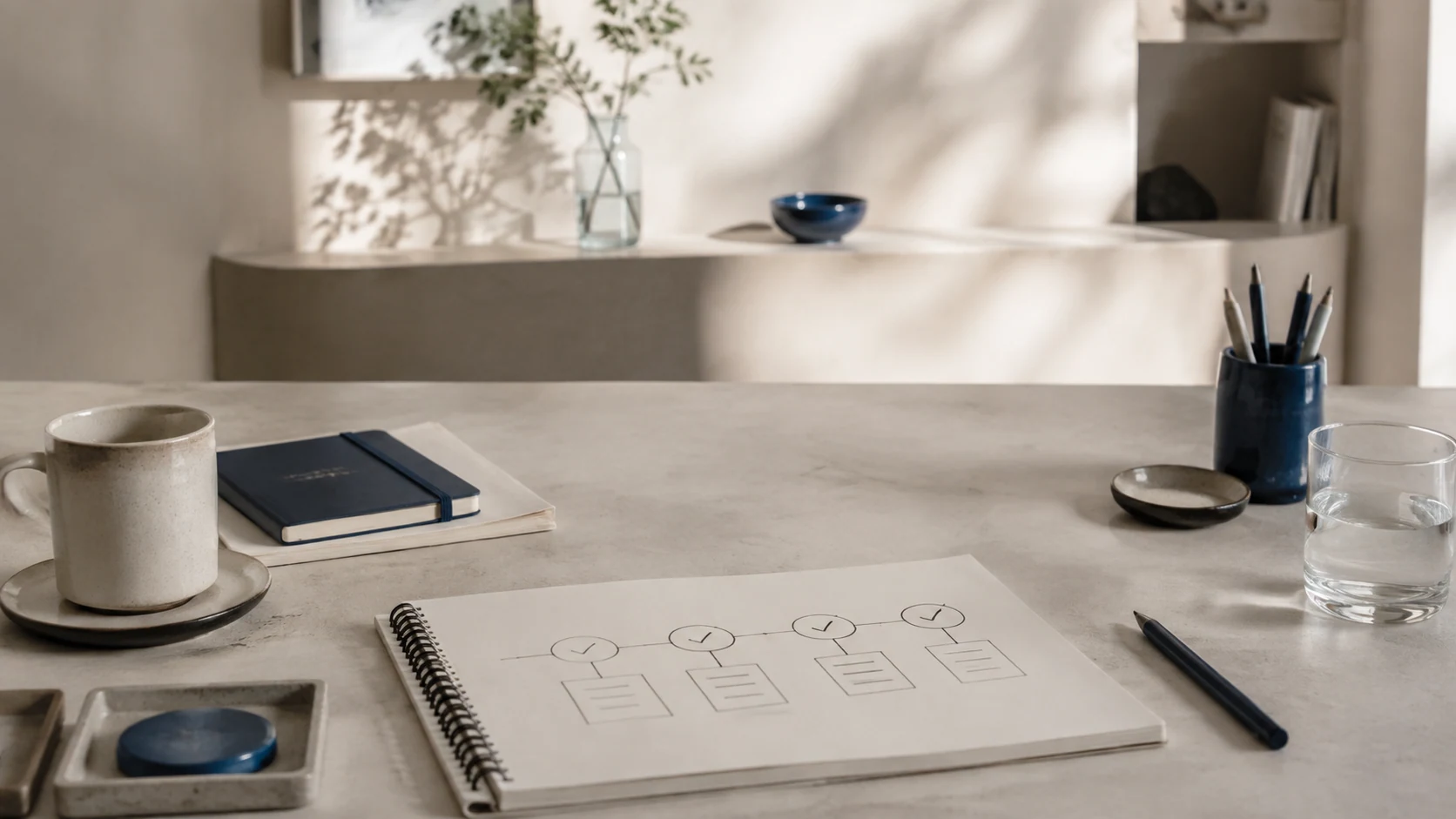
Apply It Today: The 20-Minute First-Task Gate Checklist
Tonight or tomorrow morning, follow this sequence exactly just once.
- Write the first task’s deliverable in one sentence.
- Start a 20-minute timer and close input channels.
- Close every tab outside the work window and keep only 3 necessary resources.
- Push through for 40 minutes with structural completion as the only goal.
- Afterward, spend only 10 minutes checking quality and revising.
This routine is not grand.
But its effect grows noticeably with repetition.
The work is similar yet fatigue decreases; the hours are the same yet an output remains.
Above all, there is less self-blame that “my start was stolen again today.”
We cannot control a whole day.
Variables always arise, and predictions often fail.
Even so, there is a period we can protect.
Just 20 minutes at the entrance to the first task.
Put a gatekeeper at that door and the day wavers a little less.
That small steadiness extends into the next task, the next decision and the next evening.
A routine is ultimately boundary design to prevent wasted energy, rather than a technique for managing time.
What today’s self must decide for tomorrow is not a grand goal.
It is a short agreement about “what not to do before the first task.”
 Futuristic dashboard with an organized work board and limited input-channel icons, no peopleView original