
Decide what you will check first before the AI's answer arrives, and write it as one line. For example: "If the AI gives me a number or a date, I will find that number in the source first." Psychologists call this an implementation intention. A 2025 meta-analysis of 642 tests found an average benefit, and it also gave reasons to expect less at work and in the field. The AI-checking lines in this article are proposals DMS.Labs built from that research, not results we measured.
Based on public sources checked on November 3, 2026. I read the full 33-page author manuscript of "The when and how of planning" by Paschal Sheeran, Olivia Listrom, and Peter M. Gollwitzer (European Review of Social Psychology, volume 36, issue 1, 2025; online March 27, 2024). For the 2024 workplace-habit study by Trenz and colleagues in the Journal of Occupational and Organizational Psychology, I read the abstract and parts of the text (background and limitations). I know Gollwitzer and Sheeran's first meta-analysis from 2006 only through what the newer paper cites. Neither paper studies checking AI answers.
 An index card with two handwritten lines and a pencil on a window-side desk beside a closed laptopView original
What is an if-then plan?
It is one situation joined to one action. The paper gives the format as "If (opportunity/obstacle) arises, then I will (respond in this way)!" A resolution such as "I will check AI answers carefully" is a goal. An implementation intention attaches the goal to a moment and a first move.
It also differs from a schedule. The meta-analysis separates plans that list when, where, and what, without linking the situation to the action, and calls them schedule-format plans. "At 3 p.m. I review the summary" is a schedule. "When the AI hands me a summary, I match the numbers first" is contingent. An AI answers at no fixed hour, so the arrival of the answer is a better trigger than the clock. That last point is my reading, not the paper's.
How large was the effect?
Across all 642 tests the sample-weighted average effect size (d) was 0.36, with a 95% confidence interval of 0.33 to 0.40. The d value is the difference between planners and non-planners divided by the standard deviation, and 0.2 is usually read as small and 0.5 as medium. The authors say estimating a population effect was not the aim of the paper. By outcome, behavior change averaged 0.27 (301 tests) and cognitive performance 0.47.
Three facts make that number harder to take at face value.
The first is publication bias. The authors report that small studies with positive results are overrepresented, and the bias is substantial by their threshold. A trim-and-fill correction left d at 0.35, almost unchanged. A robust Bayesian meta-analysis, which handles bias more strictly, gave 0.15 (95% interval 0.08 to 0.22). The same analysis found extreme evidence that an effect exists, so the result says the effect may be small, not that it is absent.
The second is the gap between lab and field. Lab tests averaged 0.49 (325 tests) and field tests 0.27 (317). The third is that workplace samples averaged 0.26 across 23 tests, below the overall mean. A plan you use on the job is better expected near that figure than near 0.36.
How did if-then plans compare with schedules?
Contingent plans beat schedule plans: d was 0.43 for 373 contingent tests and 0.29 for 269 schedule tests. Tests in which people rehearsed the plan at least once averaged 0.45, against 0.33 without rehearsal, and the number of rehearsals made no difference.
Tests in which the plan was recorded averaged 0.31 against 0.44 for those that did not record it. I would not read that as writing a plan down being harmful. Studies that asked for a written record may have been designed differently, and this analysis does not separate those differences. It is also no evidence that writing the plan down creates the benefit. So the suggestions below put memorizing the line and saying it aloud once first, and use a written note only as a record of what you checked.
The number of plans showed no steady direction. Single-plan tests were the most common, 478 of them, with d at 0.41. The research does not say how many plans you need. I suggest starting with the one moment you hit most often.
Which moment should go in the "if" slot?
Transitions between stages of a task were the most reliable cues. Plans tied to starting a new phase, finishing an earlier one, or the moment of responding were all effective, with d from 0.49 to 0.64. Plans keyed to having to make a decision, being asked a particular question, or hitting a setback ranged from 0.31 to 0.44. Naming only a time gave 0.25; naming a time and a place together gave 0.46. Adding how or for how long to act on top of the time and place was lower, at 0.24.
The arrival of an AI answer is a stage change from finishing the request to starting the check. So the "if" slot is better filled with the shape of the answer than with the clock: does it contain a number, does it propose an action, is this the second unsatisfying try.
For the "then" slot, the paper's category of cognitive procedures is a useful reference. These plans fix where to direct attention or what to revisit before choosing. Across 48 tests they averaged 0.48, and the subtypes ranged from 0.36 to 1.34. Keep the "then" part short and concrete.
The table below is this article's proposal. These lines have not been tested in research, so treat them as a starting point to reword for your own work.
Scroll horizontally to view a wide table.
| If | Then | Note to keep after checking |
|---|---|---|
| The AI answer contains a number, date, or amount | Find that figure in the source and match it first | Where in the source it matched |
| The AI proposes an action such as sending, deleting, or paying | Show it to the person who approves before acting | Who approved it, and when |
| A second request still does not satisfy me | Reopen the material I supplied before writing a new question | What I changed in the input |
Does it work if you do not want to check?
It reads as working less well. Effects were larger when the intention behind the goal was strong or matched the person's own values. That comparison covered only 8 tests, so the sample is small, but d was 0.79. For voting and vaccination, by contrast, no effect was found, and both confidence intervals included zero. The authors suggest these behaviors may be a matter of low motivation more than a lack of planning.
Applied to checking AI answers, it goes like this. If someone already feels a check is needed, a one-line plan may help them start. If they see no need, memorizing the line is unlikely to change anything. This is my own link between those results and the AI case. In training, that means talking first about which tasks would be costly if wrong, and only then writing the line. Acceptance Tests for an AI Skill, which sets pass criteria before looking at results, sits one step earlier than this.
Did it work in a workplace?
Partly, and the reading needs care. Trenz and colleagues asked 72 employees to build one new habit at work over 10 workdays, with two assessments a day. Half also received a program on using implementation intentions correctly. On days when people used implementation intentions at the start of the workday, the new behavior occurred more often, more frequent behavior raised automaticity, and the effect was still visible in a follow-up survey.
But the program did not increase how often participants used implementation intentions each day. The authors acknowledge this in their limitations and cite other work showing that people differ in how readily they form such plans, and that the tendency stays fairly stable. Because the intervention did not work as intended, the analysis rests on a correlational design. It shows that habit grew on days when plans were used. It does not establish that the plans created the habit. Together with the workplace average of 0.26, the fair summary is that the approach is worth a light trial at work, but it is hard to promise a large change.
What does it look like in a hypothetical scene?
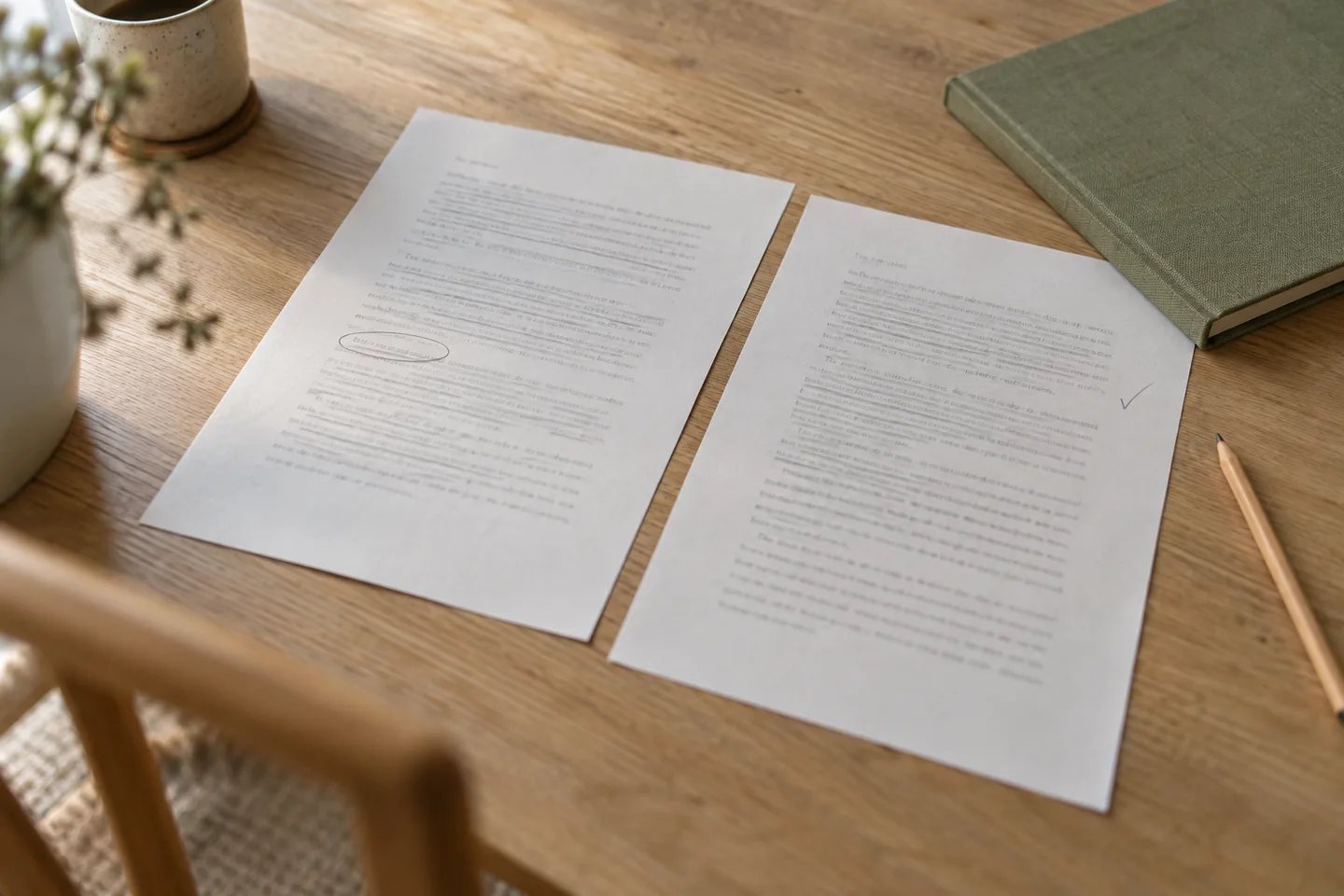 Two printed pages side by side on a wooden table, one line circled in pencil on the left page and a check mark in the margin of the right pageView original
Imagine a solo instructor who hands the draft of a course notice to an AI. This is not a real case, only an illustration. When the draft arrives, the instructor tends to start with whether it reads well. A smooth draft feels checked, and the wrong date or time in the schedule section may only surface after the notice has gone out.
If the same instructor had settled on "when the draft notice arrives, I match the date, time, and place against my schedule file first," the first move changes. The schedule file opens before the question of how it reads. What changes is the order of the first five minutes, not the quality of the draft. It also connects to explaining without the material, covered in the previous installment, Recall Before You Reread. The instructor can first write the schedule from memory and then match it against the file.
My Judgment Before the AI Answer was an exercise in writing your judgment down before seeing the answer. This article is about the first move once the answer has arrived. Used together, they give an order: record your own judgment before you look, then match the numbers when the answer comes.
What can you try this week?
Pick the one moment you meet most often. Take a row from the table, reword it for your own work, and say it aloud once. Plans that were rehearsed showed larger effects in the research. After a week, look back at only two things: how many times the plan actually fired, and whether the "if" part was too vague to notice.
It is also worth stating what this article could not confirm. Neither paper tested checking AI answers, so I cannot say the effect sizes above hold in this setting. Effect sizes varied widely across tests, and the authors acknowledge bias and limits on generality. In what I read, I found no evidence that planners catch more AI errors. The table and the instructor scene are DMS.Labs proposals and assumptions, not customer cases or field measurements.
What to read next
Training in using generative AI tools at work is on the DMS.Labs generative AI education page (education/gen-ai), which is provided in Korean. How to decide which tasks to hand to AI and where a person checks is also covered in Acceptance Tests for an AI Skill. If you are considering AI training for your team, describe your situation on the contact page.
Sources
Checked on November 3, 2026. The two photos in this article are AI-generated illustrations, not records of real work.
- Paschal Sheeran, Olivia Listrom, Peter M. Gollwitzer, "The when and how of planning: Meta-analysis of the scope and components of implementation intentions in 642 tests," European Review of Social Psychology 36(1), 162-194, 2025: publisher abstract page; author manuscript I read: University of Konstanz repository
- Trenz et al., "Promoting new habits at work through implementation intentions," Journal of Occupational and Organizational Psychology, 2024: publisher page