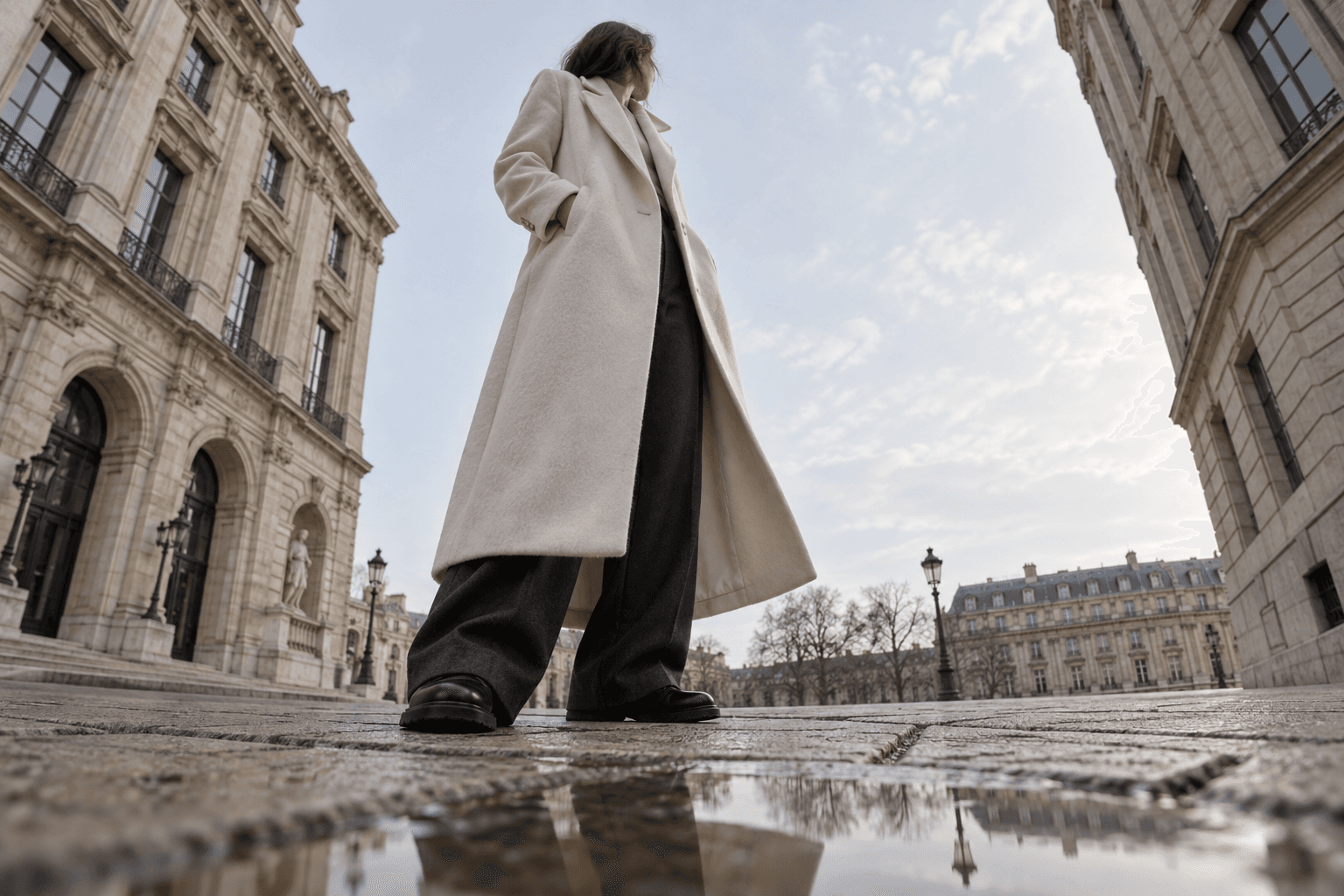
Say you ask for a photo of a standing person seen from below. The prompt contains "low angle," yet the result is an ordinary eye-level picture. The person is a little larger in frame, and the ground and the sky look exactly as they would at standing height. Before adding "even lower," state where the camera actually is.
A camera position does not travel in a single adjective. You have to say roughly how high above the ground it sits, what is close to the lens, and what appears behind and above the subject. This guide covers four elements that produce a low viewpoint. No special commands are involved; ordinary sentences work.
Scope of this guide
Creator Jessica (@aistudio.jessica) posted a reel on September 4, 2026, and its public caption lists six short labels for fashion-editorial viewpoints, one of them a view from close to the ground looking up. The creator offered a 50-item collection through comment requests and later noted that sharing had closed. We did not receive or reproduce that collection. The elements, templates and correction lines below are independently written examples inspired by the idea of fixing the viewpoint first.
OpenAI's image prompting guide tells writers to be specific about composition and framing, and to separate what to change from what to preserve when editing. This guide applies those points to camera height. The same document cautions against treating camera specifications as an exact physical simulation.
The same kind of scene at two heights
The two images below were made on the same day with the same approach, changing only the camera height in the prompt. They are not identical scenes. The plaza, the coat colour and the sky were requested similarly, but the buildings and the pose came out differently. Treat the pair as an illustration of how the elements read, not as a controlled experiment.
First, the eye-level version. The horizon sits at the middle of the frame, the subject stands in the middle distance, and the sky fills roughly the upper third.
Create a photorealistic fashion editorial photograph for a tutorial about camera height in prompts. Horizontal 3:2 composition. Eye-level view at standing height: the same kind of scene as a quiet pale stone plaza, an anonymous model in a long ivory wool coat and dark trousers standing in the middle distance, face turned away, with ordinary buildings in the background and a normal horizon at the middle of the frame. Soft overcast daylight. Restrained natural film-photographic colour. No text, no lettering, no logo, no watermark, no collage. Fictional staged visual, not an actual field photograph.
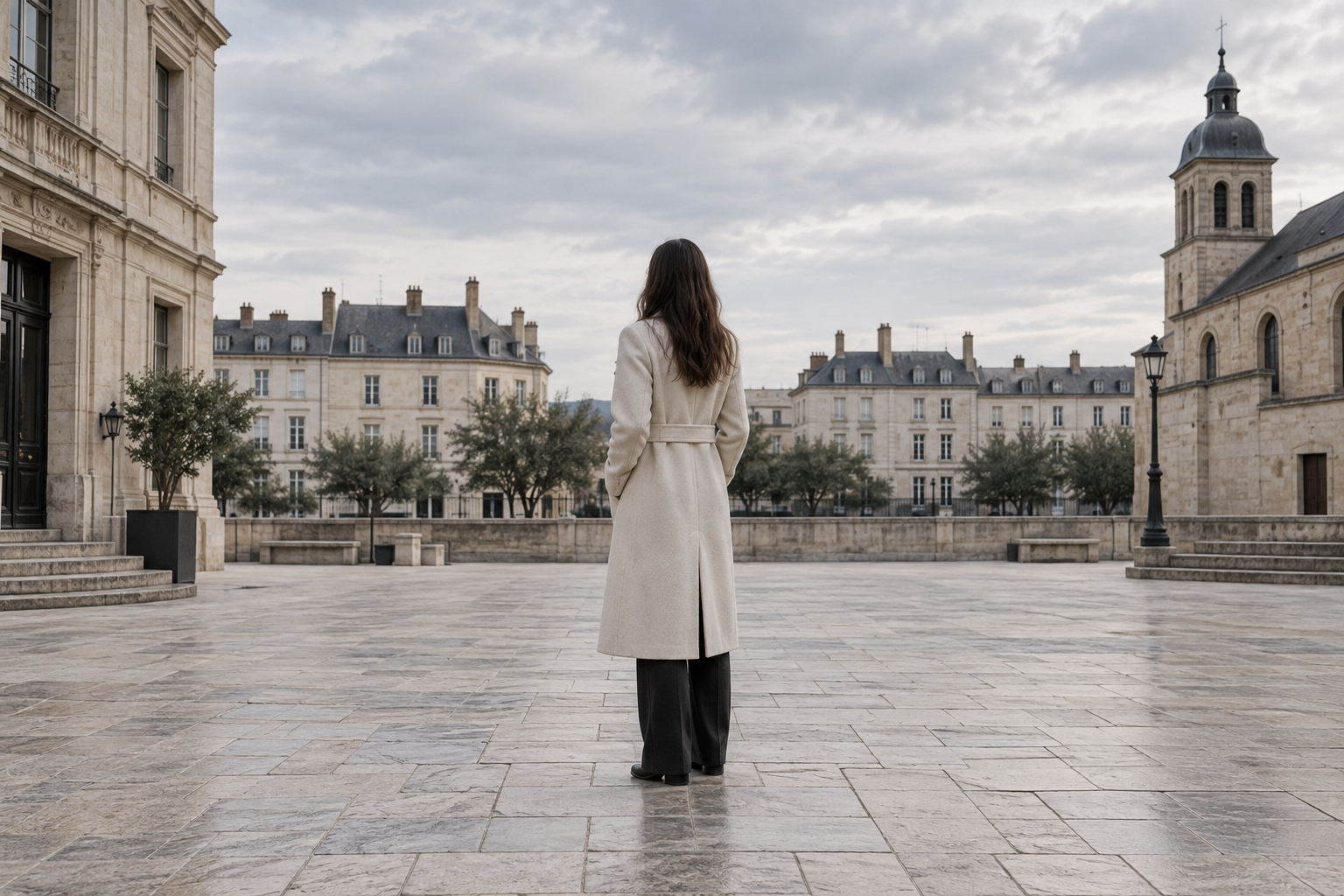 The eye-level comparison scene: the back of a person standing in a plaza, with the horizon at the centre of the frame.View original
Next, the ground-level version. The prompt below is the sentence actually entered for this image. With the lens near the pavement, paving joints and a puddle sit in front, the subject rises tall above them, and building edges lean inward.
Create a photorealistic fashion editorial photograph for a tutorial about camera height in prompts. Vertical-friendly horizontal 3:2 composition. Worm's-eye view: the camera lies almost on the ground, pointing up at a tall anonymous model in a long ivory wool coat and dark trousers who stands on pale stone paving in a quiet plaza. The model's face is turned away and partly hidden, so no identifiable portrait. Foreground: a few paving joints and one small puddle very close to the lens. Behind and above the model: a clear pale sky and two tall building edges leaning inward. Soft overcast daylight. Restrained natural film-photographic colour. No text, no lettering, no logo, no watermark, no collage. Fictional staged visual, not an actual field photograph.
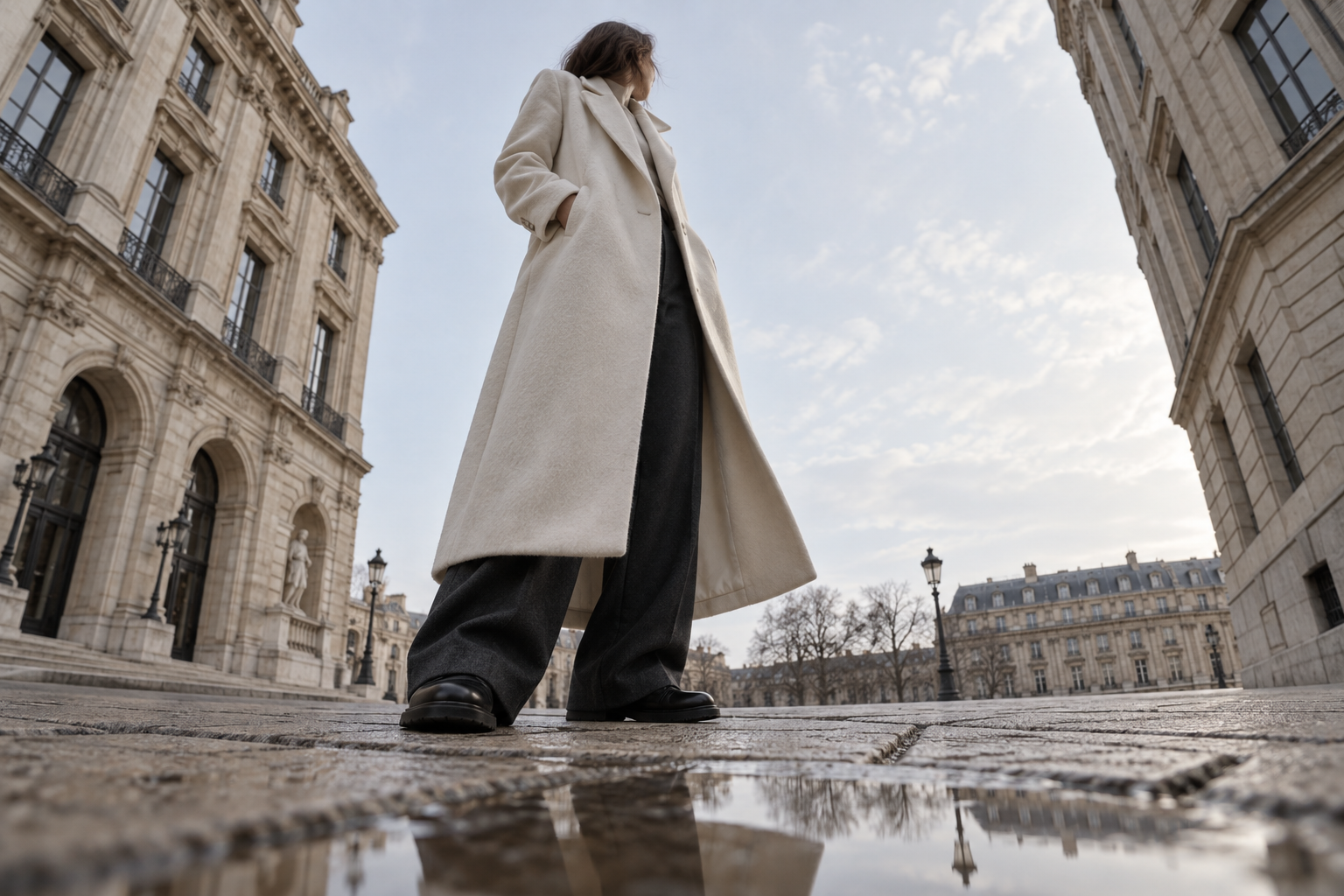 The cover scene, shot from near the ground looking up: a puddle in front, a tall figure and inward-leaning buildings.View original
Side by side, the angle is not the only thing that changed. The horizon dropped toward the bottom of the frame, the sky widened, and the subject's legs became a line that divides the image. What the prompts actually changed was the camera height, the foreground object and the background above.
Four elements of a low viewpoint
Decide these four things before you write the prompt.
- Camera height: say how far above the ground the camera sits, in words that show position, such as "almost on the ground" or "at knee height."
- Foreground object: something close to the lens that will look large, such as paving joints, a puddle or the tip of a shoe.
- Sky and building lines: what appears above the subject. Decide whether the sky is wide and whether building edges lean inward.
- Subject handling: if the face does not matter, show the person from behind or in part to lighten the composition.
Describe height as a position
"Low angle" is closer to a mood than to a location. "A camera placed on the ground, tilted upward" or "about 20 cm above the ground, looking slightly up" gives both position and direction, and results tend to be clearer. Numbers are not measurements. Use them to signal a rough step.
A foreground object builds depth
A low-angle image often looks flat because nothing sits near the lens. A textured floor or a puddle in front makes the distance to the subject readable. One foreground object is steadier than several, which tend to cover the person.
Say what is above
In an upward view, the area behind and above the subject takes up much of the frame. If you do not say whether the sky is clear, cloudy or crossed by building edges, the model fills that space on its own. Inward-leaning building lines come from perspective, so if you want them, write "the building edges lean inward."
Lighten the subject
A low view is a difficult angle for faces. Showing the coat, the shoes and the line of a step is steadier than a close face. The examples here use an anonymous figure with the face turned away. It is safer not to ask for a likeness of a real person.
A variation with a large foreground
The third scene applies the same method to boots and a coat hem. The shoes sit large near the lens, potted plants in the middle ground, and sky in the distance. No face appears in the frame.
Create a photorealistic fashion editorial photograph for a tutorial about camera height in prompts. Horizontal 3:2 composition. Low camera about 20 cm above the ground, looking slightly upward. In the sharp foreground at the bottom of the frame sit the model's polished black leather boots and the hem of a long olive trench coat, large in frame. In the middle ground a few green potted plants on a stone step, slightly softer. In the distance a pale sky with thin clouds. The anonymous model is cropped at the torso, no face visible. Late afternoon soft daylight. Restrained natural film-photographic colour. No text, no lettering, no logo, no watermark, no collage. Fictional staged visual, not an actual field photograph.
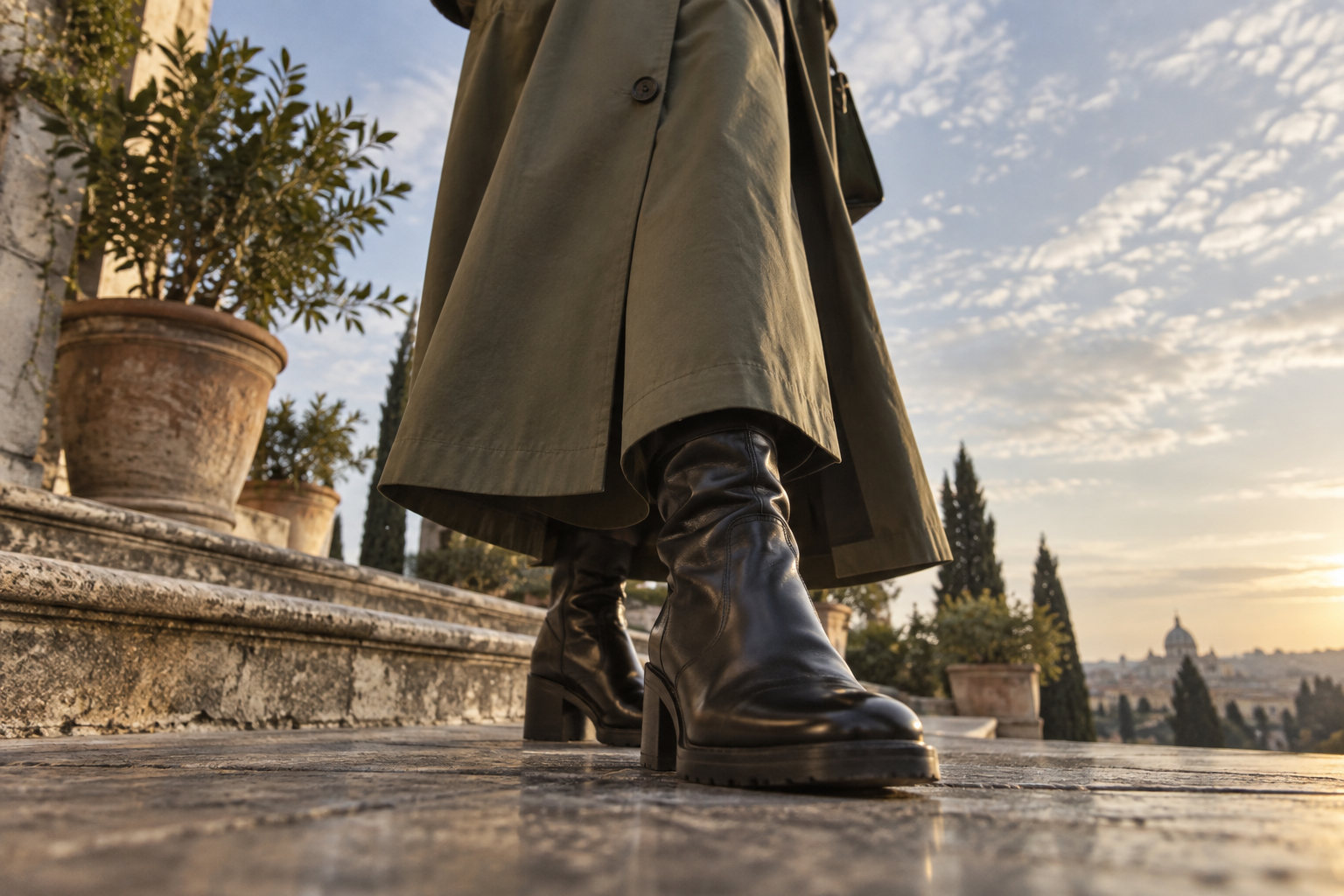 A low scene with boots and a coat hem large near the lens, with potted plants and sky behind.View original
In this output the boot tip is sharpest, and the plants and sky recede. The coat hem falling over the boot looks natural, but we did not run a test that isolates which phrase produced which effect. Entering the same sentence again can change the composition and details.
A template you can copy
Fill in the brackets and enter it in English. You can follow the same order in Korean, but we did not test a Korean version of this template.
Create a photorealistic photograph of [subject and clothing] in [place, time and weather]. Horizontal 3:2 composition. The camera is [height, for example 20 cm above the ground] pointing [slightly / steeply] upward. In the foreground, very close to the lens, there is [one foreground object]. The subject stands in the middle ground, [face turned away / cropped at the torso]. Behind and above the subject: [sky and building edges]. Keep [light and colour mood]. No text, no logo, no duplicated people, no collage.
Steps for building one
- Write the scene and clothing in one line, including place, time and weather.
- State the camera height as a position. Use numbers only as a rough step.
- Choose one foreground object that should look large.
- Say what appears behind and above the subject.
- Decide whether the face shows, and say how it stays hidden if not.
- Add the ban on text, logos and duplicated people at the end.
After generating, check in order: did the horizon drop, is the foreground object near the lens, does the background above match your intent, and do the face or hands look off? Fix only the item that missed.
Correction lines for when it goes wrong
- It came out at eye level: "Keep the person, clothing and lighting. Lower the camera to about 20 cm above the ground, tilted upward. Change nothing else."
- The foreground looks empty: "Add one large wet paving area at the bottom of the frame, close to the lens. Do not cover the person."
- The person is too distorted: "Keep natural body proportions and do not stretch the legs."
- The sky feels cramped: "Widen the sky behind the person and push the buildings to the edges."
- The face looks odd: "Turn the face away so it is not visible and focus on the coat and shoes."
- The person doubled: "There is one person. Remove the duplicate."
Always add what to keep. If that line is missing, other parts may change while you fix one.
Know the limits
This method does not guarantee a low viewpoint. The same prompt can give different results, and at very low angles proportions often go wrong. The distance between the foreground object and the person can also drift. Do not use staged images like these when you need to verify real proportions of a garment or product.
When you publish a result that looks like a real photograph, make clear it is staged. Scenes with people need extra care so they are not mistaken for a photo of a particular person. Services update, and the same sentence may behave differently later.
Recheck at the output size
A low view that looks striking on the generation screen can turn the foreground object into a smudge when scaled down to a card. Check whether the foreground takes too much of the bottom edge and whether it is still recognizable on a phone screen.
When you put a horizontal image into a vertical card, look at where the subject is cut. If the boot tip or the coat hem leaves the frame, the cue that this is a low view disappears. Asking again for a vertical composition is better than squeezing the whole original into a narrow area.
Finally, look with fresh eyes. If a viewer must read the caption to know the shot is low, make the foreground object or the sky area clearer. This check is about how well the image communicates, not an exact measurement.
One image to try today
Pick a single garment, preferably one with long lines such as a coat or dress. Place the camera near the ground, put one object in front of the lens, and write what the sky behind the subject looks like. When the result arrives, check the horizon, the foreground object and the background above, one at a time. If you want it to look lower, reread where the camera sits instead of adding more words.