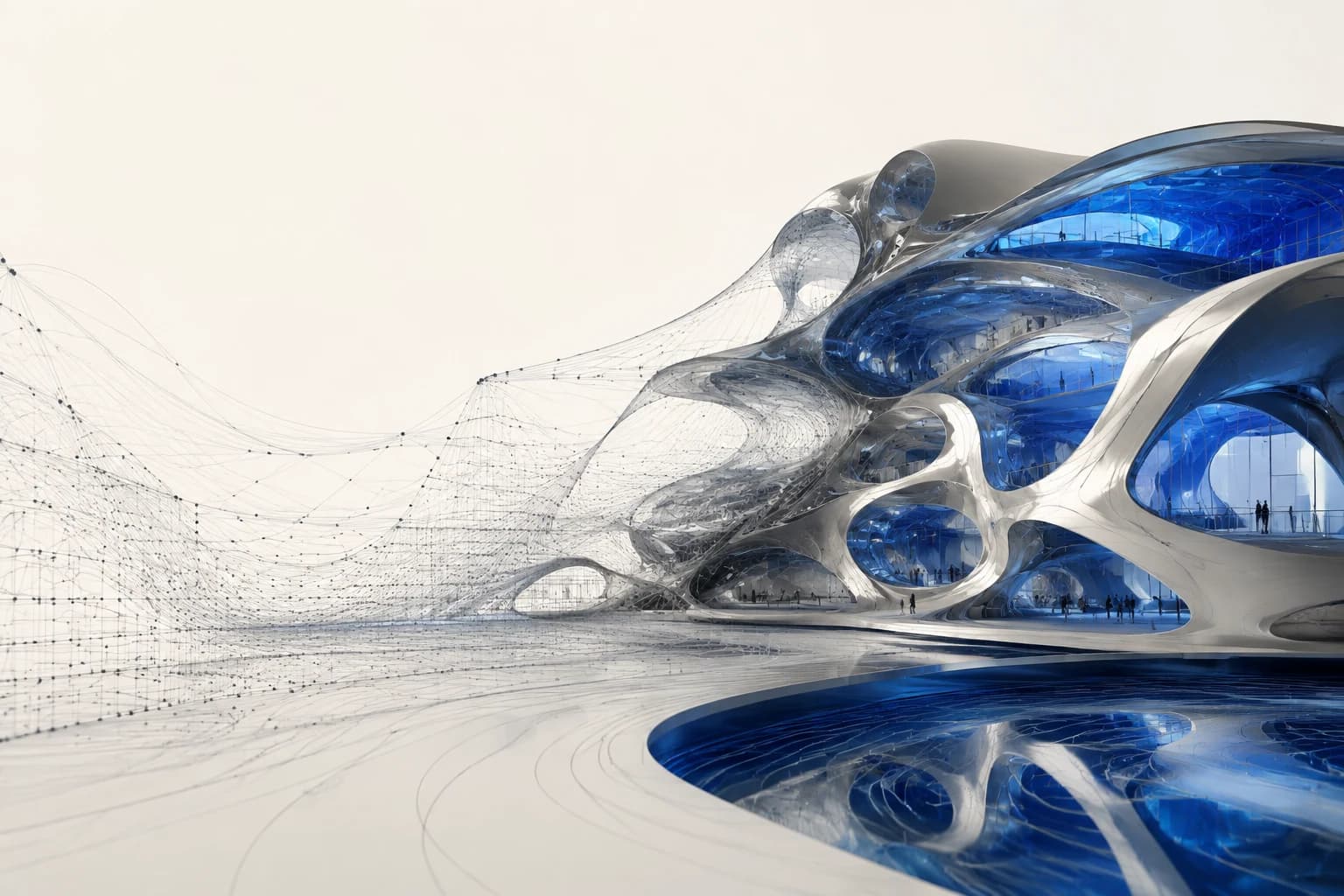
Architecture was humanity's oldest 'hardware' industry. From the pyramids of ancient Egypt to modern skyscrapers, it meant stacking stone, timber, steel and glass against the absolute physical law of gravity. A space emerged from an architect's intuition, an artisan's touch and the sweat of countless workers. In the 21st century, however, a new tool called AI is drawing architecture into the realm of 'software.' If Zaha Hadid's flowing curves were products of parametric design, we are now entering an era of 'Generative Architecture,' in which AI independently proposes and optimizes structures and even simulates entire cities.
1. Form Follows Data
The modernist architectural master Louis Sullivan declared, "Form follows function." For the past 100 years, this proposition served as a constitution for modern architecture in pursuit of efficiency and rationality. In the AI era, however, architectural form is no longer subordinate to function. Today, form follows data.
Fine-grained terrain data for a site, wind directions and speeds over the past 50 years, seasonal changes in sunlight, noise levels on nearby roads, and even future residents' biological rhythms and behavioral patterns: billions of these data points enter an AI engine. The algorithm then instantly produces thousands or tens of thousands of optimized designs that a human architect could not reach in a lifetime of deliberation. The architect is no longer an artist sketching on blank paper. They must become a 'design conductor,' asking the right questions of the vast computational apparatus called AI and adjusting its parameters.
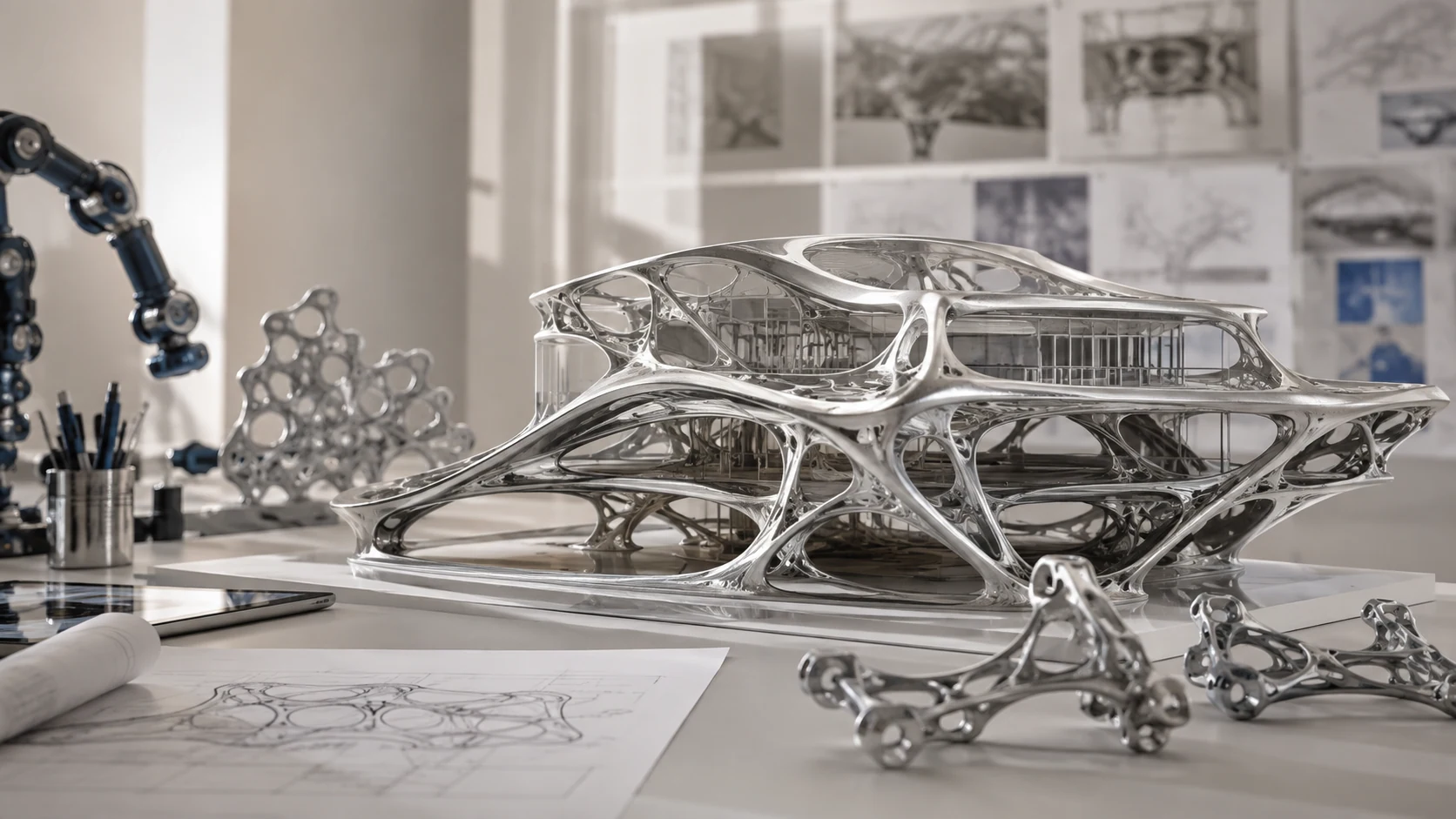
Have you seen the spacecraft components designed jointly by Autodesk and NASA? They are strange and beautiful, like the bones of an alien or the skeleton of a deep-sea creature. They are the result of "Topology Optimization." To achieve the objective of "supporting the maximum load with the minimum weight," AI removes unnecessary material and reinforces areas where forces concentrate. Interestingly, the resulting forms look remarkably like the organic structures nature has produced through hundreds of millions of years of evolution. The modernist dogma of straight lines and right angles has broken. AI proposes architecture in the form of "Biomimicry": structures that use less energy, circulate air better and offer greater structural strength.
2. Urban Digital Twins and Simulation
Generative architecture extends beyond individual buildings to the entire city, or mega structure. The central concept here is the 'Digital Twin.' This digital mirror world, which replicates a real physical city as its perfect twin in virtual space, is more than 3D modeling. It is a living organism through which real-time data flows.
Singapore’s "Virtual Singapore" project has already reached the stage of simulating the whole city to control traffic flows and manage energy. AI runs endless "What-if" simulations on this digital twin. "If a 50-story high-rise were built here, how would it alter wind paths and intensify the urban heat island effect?" "Would underground infrastructure remain safe if sea levels rose 1 meter in 2050?" "Where would the most efficient quarantine zone be during an epidemic?"
Architects can now become seers of the future. Whereas past urban planning depended on politicians' intuition or statistical inference, future planning shifts toward simulation-based evidence. We are stacking data, rather than bricks, to code a city's future. This perspective views the city as a vast operating system (OS), with the architect becoming the systems engineer who optimizes it.
"Nature is the most perfect architecture. Nature wastes nothing, and every form has a reason. AI is a teacher that shows us nature’s approach to design: the algorithm of Growth." - Neri Oxman, Professor at the MIT Media Lab
3. The Birth of Personalized Space: The Age of Mass Customization
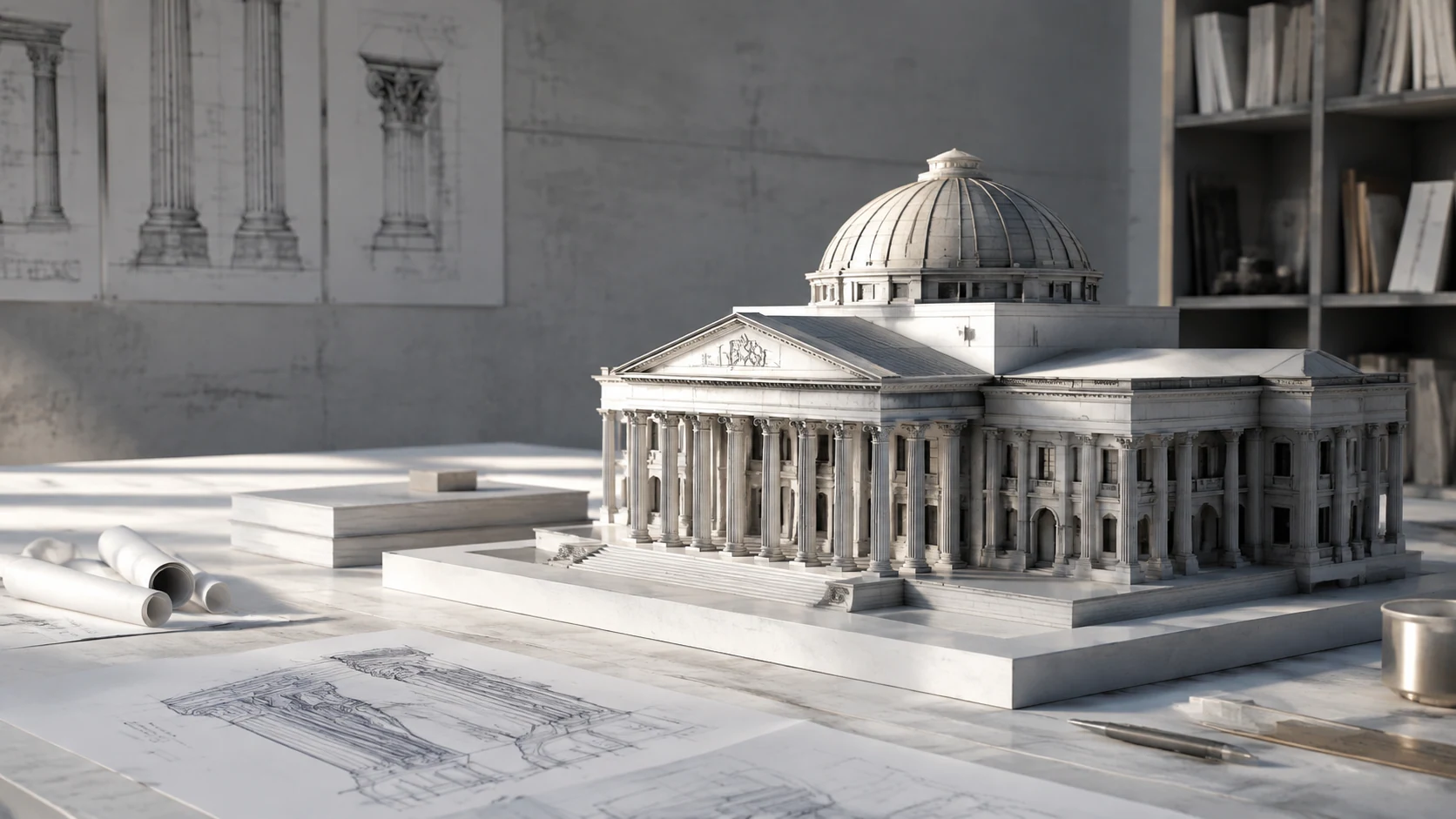
Twentieth-century architecture, especially housing, was a history of standardization and mass production. The apartment as a 'machine for living' envisioned by Le Corbusier was efficient but uniform. We all had to squeeze our lives into spaces with identical floor plans, ceiling heights and window sizes. Generative AI, however, has opened the way to 'Mass Customization,' enabling extreme personalization while preserving the efficiency of mass production.
Traditional Process
- Standardized Blueprint
- Mass Production
- Human Adaptation
AI-Driven Process
- Data Input (Lifestyle)
- Generative Design
- Robotic Fabrication
Future homebuyers will enter their lifestyle data instead of choosing from floor plans. "I enjoy yoga in the morning sun, mostly work from home, and need a dark space for watching films in the evening." AI analyzes these natural-language requirements and generates a home with fully personalized structure, daylighting, sound insulation and materials. The design data is then sent directly to robotic arms and 3D printers for immediate on-site fabrication. Architecture becomes a platform responsive to its users rather than fixed real estate.
Beyond that lies the era of 'adaptable architecture.' Building materials embedded with shape-memory alloys and smart sensors change form in real time under AI control. Walls move to expand the living room for a party, and the bedroom contracts into a cozy space for sleeping. Space becomes a breathing organism that interacts with its inhabitants rather than a static backdrop.
Conclusion: Designing for Coexistence, Redefining Humanism
Will AI replace architects? The question has grown tired and stale. The camera did not replace painters; it freed them from the obligation to reproduce appearances and opened the realms of expression and abstraction. AI will likewise release architects from the labor of repetitive drafting, code compliance checks and structural calculations.
The architect's role now moves beyond 'What should we build?' to the philosophical question of 'Why should we build it?' What kinds of spaces support sustainable coexistence in a climate crisis? What should an inclusive city for marginalized people look like? How should the metaverse connect with physical space? These are deeply human, humanistic challenges that computation alone cannot resolve.
We hold a tool of limitless technological possibility in our hands. The future we sculpt with it now depends on our will, not an algorithm. Generative architecture is more than a tool for efficiency. It is our most powerful instrument for building a new ecosystem in which people, nature and technology coexist in harmony.