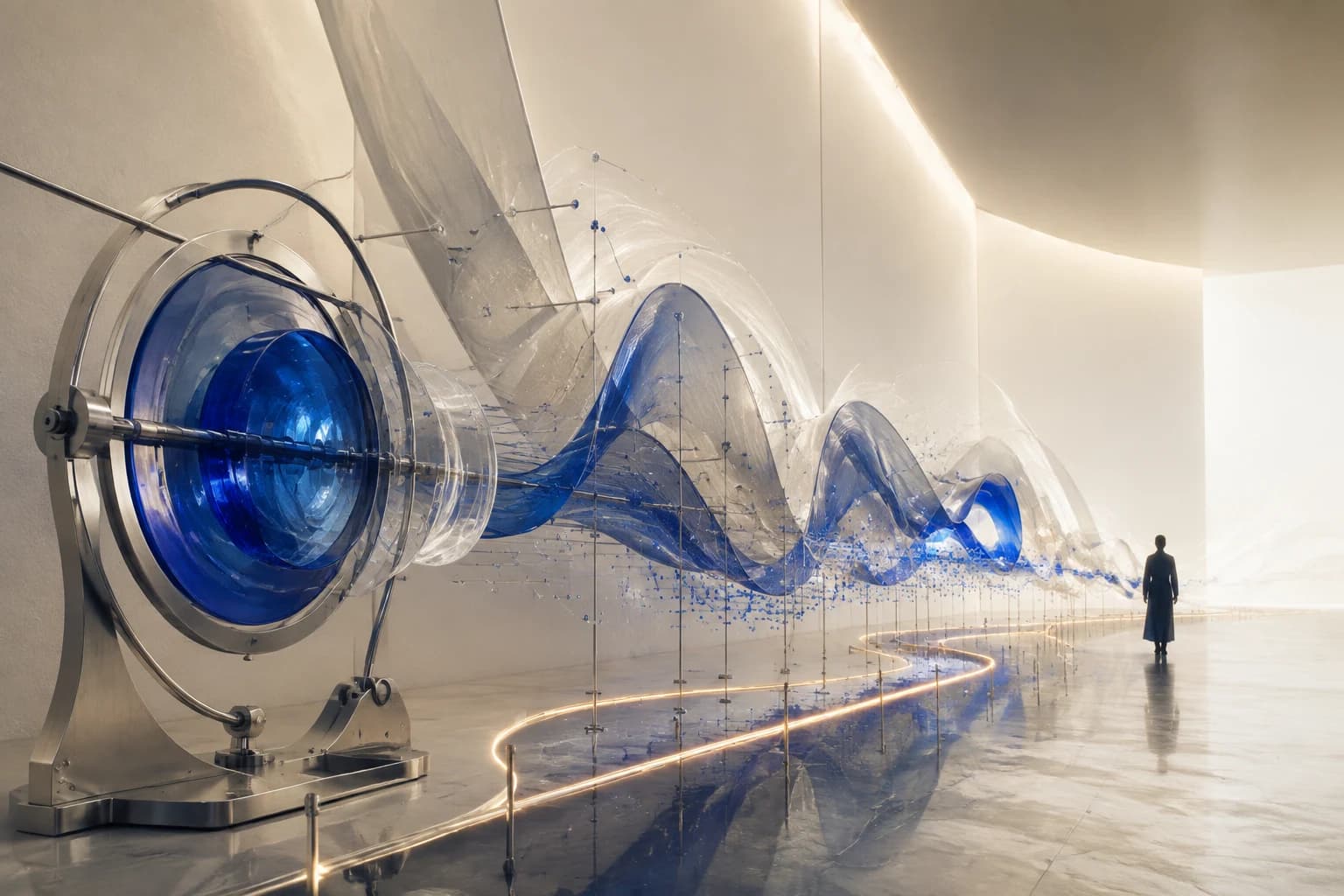
These days, what I remember after an exhibition is often my body’s response rather than the artwork’s title. Some spaces slow my breathing as soon as I enter; others feel strangely tense despite their bright colors. We often call this difference atmosphere, but more precisely it comes from different ways of editing sensation. As generative AI enters artistic production pipelines, creators are beginning to design visitors’ rhythms of staying, movements of the gaze, and cycles of immersion and departure before perfecting a single image. Beyond what an artwork shows, what it makes people feel—and in what sequence—has become a central design parameter.
1. The unit of generative art has changed: from output to experience sequence
 Sensory waveforms in a generative spaceView original
The competitive strength of generative art once largely meant producing sophisticated images quickly. Model parameters, prompt syntax, and upscaling quality were almost everything. As technology became more widely accessible, the quality gap rapidly narrowed, and most work reached a level audiences found sufficiently plausible. From that point, the difference came from the resolution of the experience, not the resolution of the output.
The resolution of an experience is the ability to design even how emotion is modulated during a visitor’s ten-minute stay. The first thirty seconds should create unfamiliarity; the second minute, a desire to explore; the fifth, the recall of personal memories; and the ending, a sensory landing that safely returns the visitor to reality. This sequence does not happen by chance. Low-frequency sound density, light direction, repeating textures, the spacing of text, and even the curvature of the visitor route must work together.
Generative tools are powerful at precisely this point because they can simulate dozens of versions of sensory variables while preserving the same narrative. Creators no longer search for one correct image. They test different sensory scores for different audiences: high-brightness, low-density compositions for short attention spans, or low-saturation arrangements with long aftereffects for contemplative visitors. The artwork becomes a system that generates different experiences under different conditions, rather than a fixed object.
2. Sensory Score as a practical working language
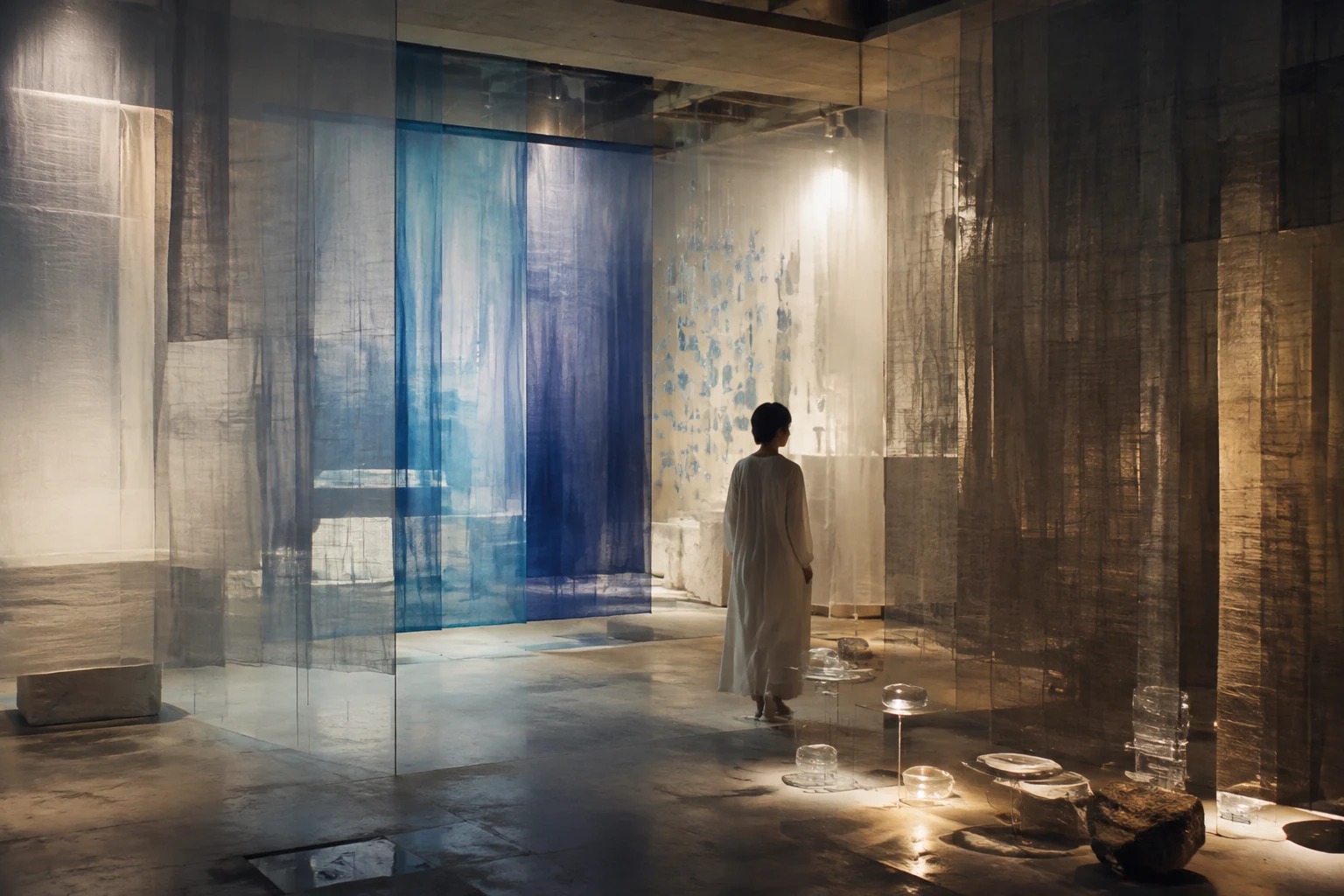 A design drawing of multiple layers and sensory signalsView original
One of the most useful concepts in practice is the sensory score. Just as a musical score records changes in sound and intensity over time, a sensory score records stimulus density and transition rules along an exhibition timeline. For example:
- 0:00–1:00: Low visual information, high contrast, and motivation to explore
- 1:00–3:00: Add subtle repeating patterns and create a point where the gaze can settle
- 3:00–6:00: Expand the spatial character of sound and extend dwell time
- 6:00–8:00: Minimize text interventions and leave room for personal interpretation
- After 8:00: Gradually reduce stimulus intensity and ease departure fatigue
The important thing is not to stimulate strongly, but to stay within the audience’s cognitive bandwidth. Sensory overcrowding can look intense for a moment yet leave little memory, because the brain loses room to process it. Conversely, a well-designed sensory score lingers without any forceful scene. Visitors say not “I saw something spectacular,” but “The rhythm stayed with me after I left.”
In generative systems, the feedback loop also becomes part of the work. Incorporating audience-flow data—dwell time, revisited locations, and exit points—into the next exhibition version makes the work a learning structure rather than a one-time output. Ethical standards are needed too. The data collected and its purpose must be clearly limited so they do not encroach on visitors’ freedom of interpretation. Good sensory design combines sophistication with restraint.
3. Future advantage lies in orchestration, not technology
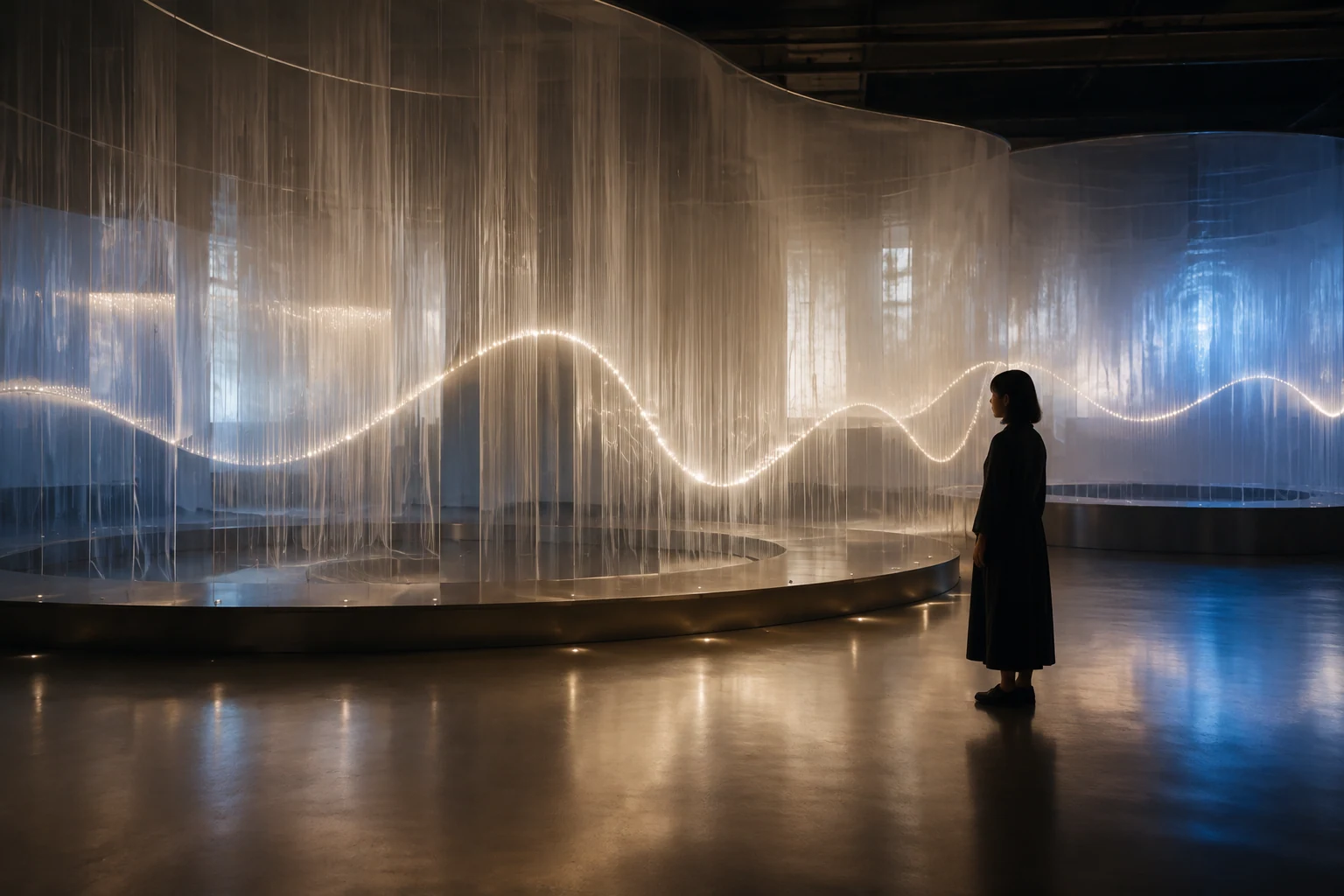 A visualization of resonance structures and changes of paceView original
Within the next two or three years, the visual quality of generative models will become difficult to use as a differentiator. Anyone will be able to make polished visual outputs, and the market will naturally move from asking what was made to how it was made to work. The creator’s role shifts from maker to orchestrator.
An orchestrator watches three things at once: narrative density, the sensory curve, and the audience’s capacity to recover. Even a good narrative accumulates fatigue if the sensory curve is steep; even delicate sensations raise exit rates if there is no recovery interval. When these elements are balanced, however, the same material can produce a completely different degree of immersion.
Across exhibitions, branding, and education, one shared change is the rising importance of changing states rather than delivering explanations. Brand exhibitions shift emotional states instead of explaining product specifications; educational content focuses on stabilizing a learning state rather than listing knowledge. Art is the frontline industry experimenting with this transition first. Discussions of future art should therefore begin with how to measure, protect, and expand audience states, rather than with the newest version of a generative model.
Finally, the purpose of a sensory score is not to control visitors. It is to help them avoid becoming lost while protecting freedom of interpretation. A good generative space does not impose a correct answer. It lets visitors leave with slightly finer resolution in their own emotions. That small change keeps working long after the artwork ends. What is needed now is more sophisticated pacing, not more spectacular stimulation. The blueprint for future art is ultimately completed through the craft of handling that pacing.