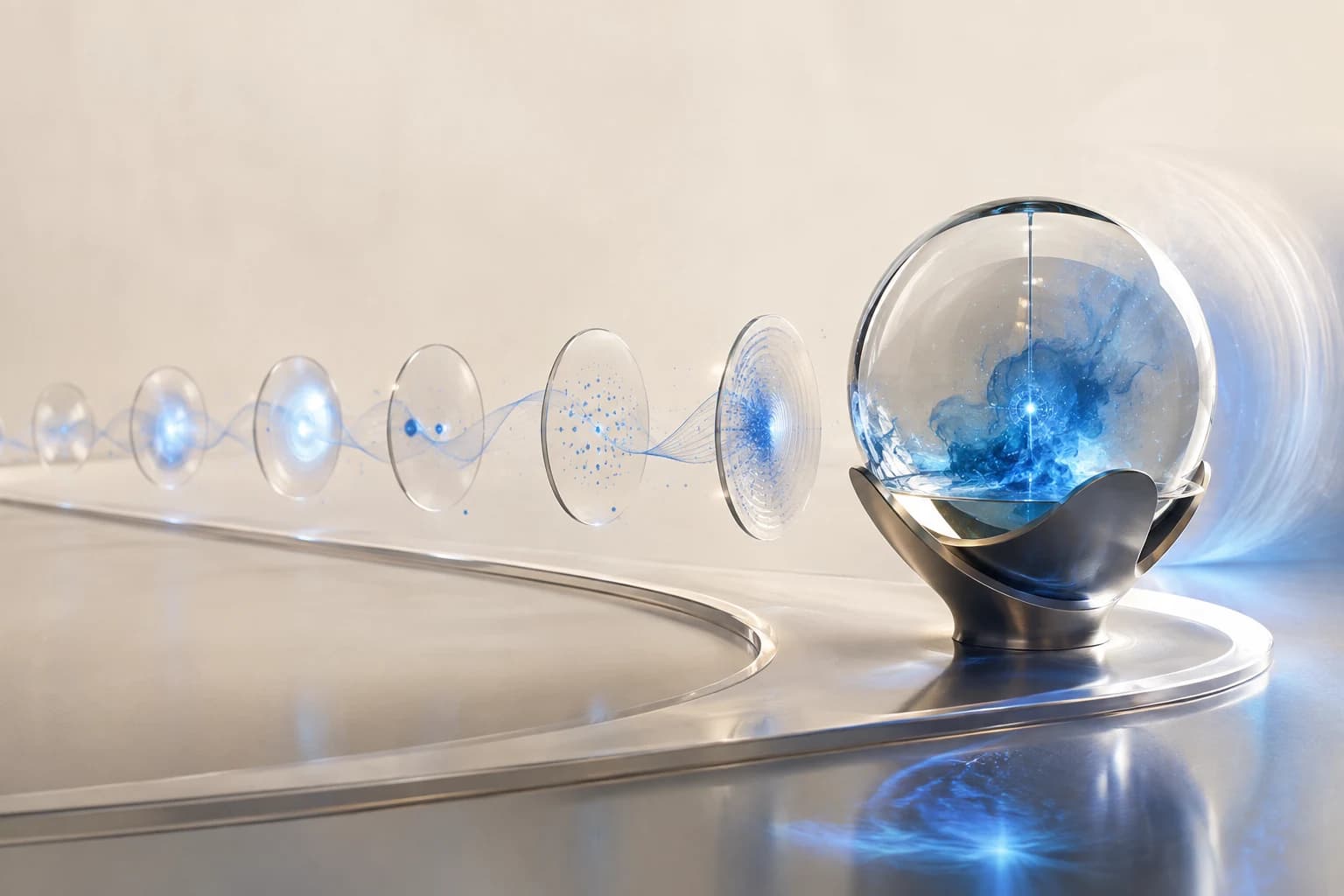
Most competition among generative services today revolves around who can show the result faster. Press a button and text appears immediately; images arrive in seconds; video drafts accumulate rapidly. In terms of speed, this is clearly a better era. Yet the persistence of an experience does not necessarily improve proportionally. We too often see quickly delivered results quickly forgotten. Conversely, interfaces that carefully stage the moments before and immediately after completion remain in memory longer, even when the result itself is of similar quality.
From a future-arts perspective, this difference is structural rather than simply a matter of taste. People do not consume only results. They predict while waiting, compare at arrival, and re-edit meaning afterward. The time an interface must handle is therefore not just the period before generation completes, but the full sequence of anticipation, arrival, and afterglow. This article outlines principles of rhythm design that strengthen memory’s afterglow in generative environments. The central idea is straightforward. It does not ask you to abandon speed, but to add a sensory layer atop a fast system.
1. The limits of immediacy: memory quality breaks down before output quality
 First scene of the memory-afterglow interfaceView original
Product teams usually assume reducing average response time improves the experience. That is true. The problem is what comes next. When every scene is flattened into an immediate response, users remember only “that came out quickly” rather than what they received. Immediacy reduces friction, but also reduces interpretive space. When that space disappears from generative content, appreciation contracts into consumption, and consumption soon leads to fatigue.
The problem is especially clear in creative tools. The moment a user enters a prompt, an expected scene already forms in their mind. If the interface offers no way to handle that expectation, the result ends in a binary judgment: right or wrong. The improvement loop becomes crude. It gets harder to explain dissatisfaction; revisions continue without gaining substance. Generation volume rises while satisfaction stagnates.
Future-arts design therefore looks at KPIs somewhat differently. Alongside response time, it examines memory-based signals such as revisit intervals, reuse patterns, result-saving rates, and the proportion edited before sharing. It assumes that a result repeatedly retrieved has more value than one merely delivered quickly. With that shift, an interface becomes a rhythmic device circulating emotion and interpretation, rather than a simple output pipeline.
2. Design anticipation: do not leave waiting time blank
 Second scene of the memory-afterglow interfaceView original
Anticipation is the short period after input is completed and before the result arrives. Most services show only a loading spinner and stop there. Yet these few seconds can create a large difference in experience quality. A good anticipation interval hints sensorially at the direction of the result without showing the answer in advance.
Text generation might show subtly different rhythmic animations based on sentence length, emotional tone, and the selected style. Image generation might first offer an abstract layer suggesting color-temperature distribution or composition. Music generation might visualize the skeleton of tempo and dynamics, preparing the eyes for what will arrive before the ears hear it. The point is honest clues, not exaggerated staging. Spectacle unrelated to the actual result distorts expectations and increases disappointment.
Consistency matters more than length in anticipation. Whether the interval lasts two or five seconds, trust requires the same grammar for communicating what the system is doing. Constantly changing rhythms may briefly surprise, but reduce usability. Interfaces that survive repeated use have a reproducible sensory grammar rather than fashionable effects.
3. Design after arrival: retaining a result matters more than showing it
 Third scene of the memory-afterglow interfaceView original
Most services treat the moment immediately after a result arrives as the finish line. From the perspective of memory, however, it is closer to the beginning. Users immediately start comparing internally: how well the result matches expectations, what is unfamiliar or interesting, and what to change next. If the interface offers no support, even a good result quickly disappears.
An interface that leaves an afterglow designs the thirty seconds after the result. First, a summary of why it was generated that way: briefly present the key factors behind the scene to improve reproducibility. Second, a variation guide: propose three adjustment axes—composition, density, and tone—instead of vague regeneration, accelerating the improvement loop. Third, a memory anchor: save a one-line note written by the user alongside the result so its context can later be restored.
Together, these elements let users accumulate results as a creative record rather than consume them once. Long-term platform advantage comes less from getting someone to visit once and generate a lot than from bringing them back to create more precisely. This is why rhythm design matters in future arts. Rhythm is not a device for lengthening appreciation time; it is an operational structure that allows learning and creation to accumulate.
Finally, ethical standards must be clear. Rhythm design must not become a technique for manipulating users into staying. Deliberate delays or excessive effects may increase short-term metrics while eroding trust. Good rhythm respects the user’s sense of time. It makes people wait only when there is a reason, and after arrival helps clarify the next action. With this principle, an interface grows beyond a generation window into a creative environment where memories accumulate.
The next competition in the generative era will therefore not be decided solely by larger models. It is likely to depend on which teams understand users’ memory structures better and design anticipation, arrival, and afterglow more honestly. Speed has become the default. Rhythm now creates the difference. That rhythm is not a question of technology, but of how finely we attend to human experience.