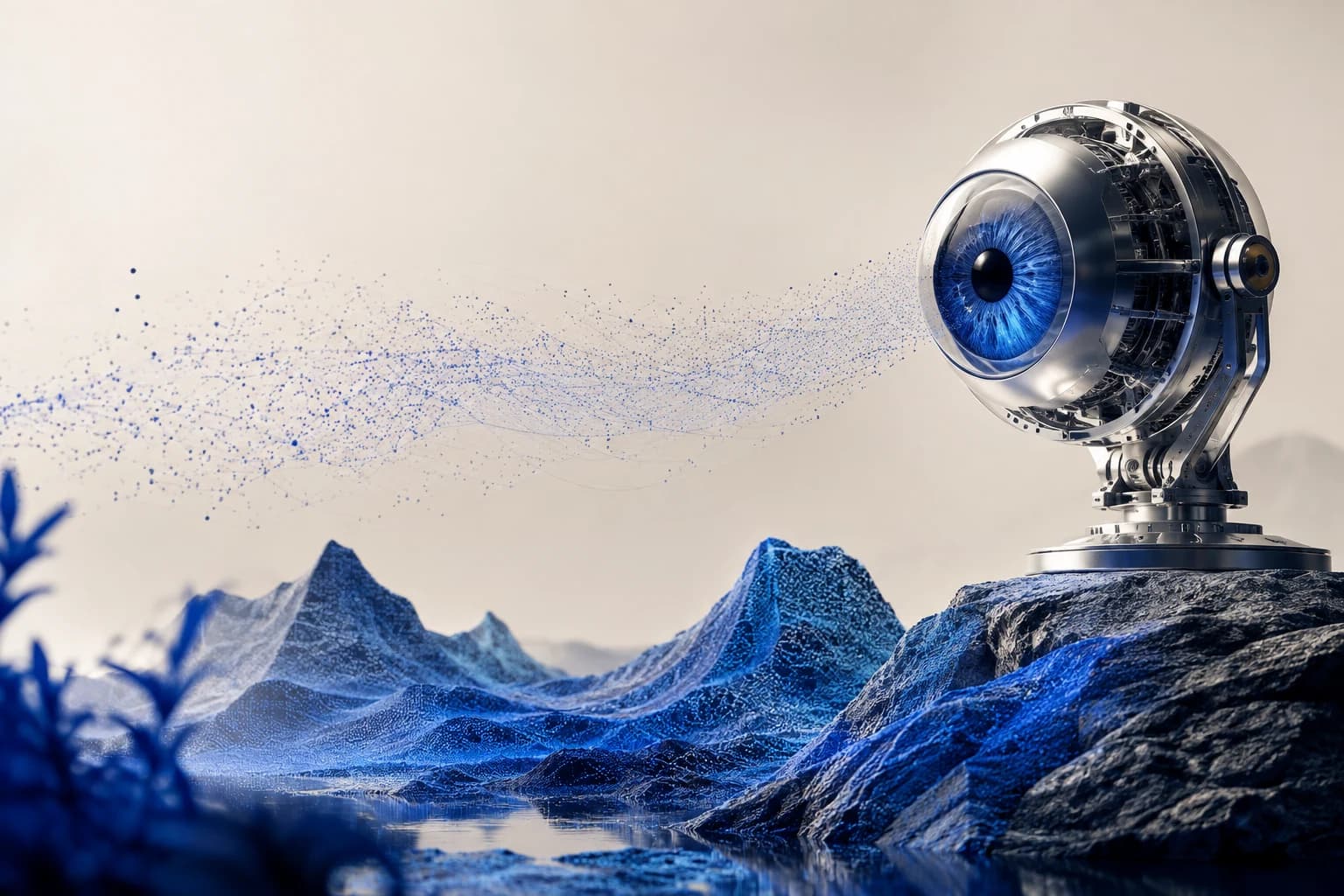
Human vision is a product of evolutionary biology. For millions of years, we optimized our visual systems to identify predators on the African savanna and find ripe fruit hidden in bushes. Our eyes selectively accept information necessary for survival, and the brain interprets it subjectively through filters of emotion and memory.
AI, or Machine Vision, has an entirely different origin. It emerged through Matrix Multiplication and probability distributions on silicon chips. Stripped of survival instinct, this cold eye gazes at aspects of the world humans can never see. It does not seek meaning. It relentlessly investigates only patterns and structures.
1. Truth beyond pixels: deconstruction and reconstruction
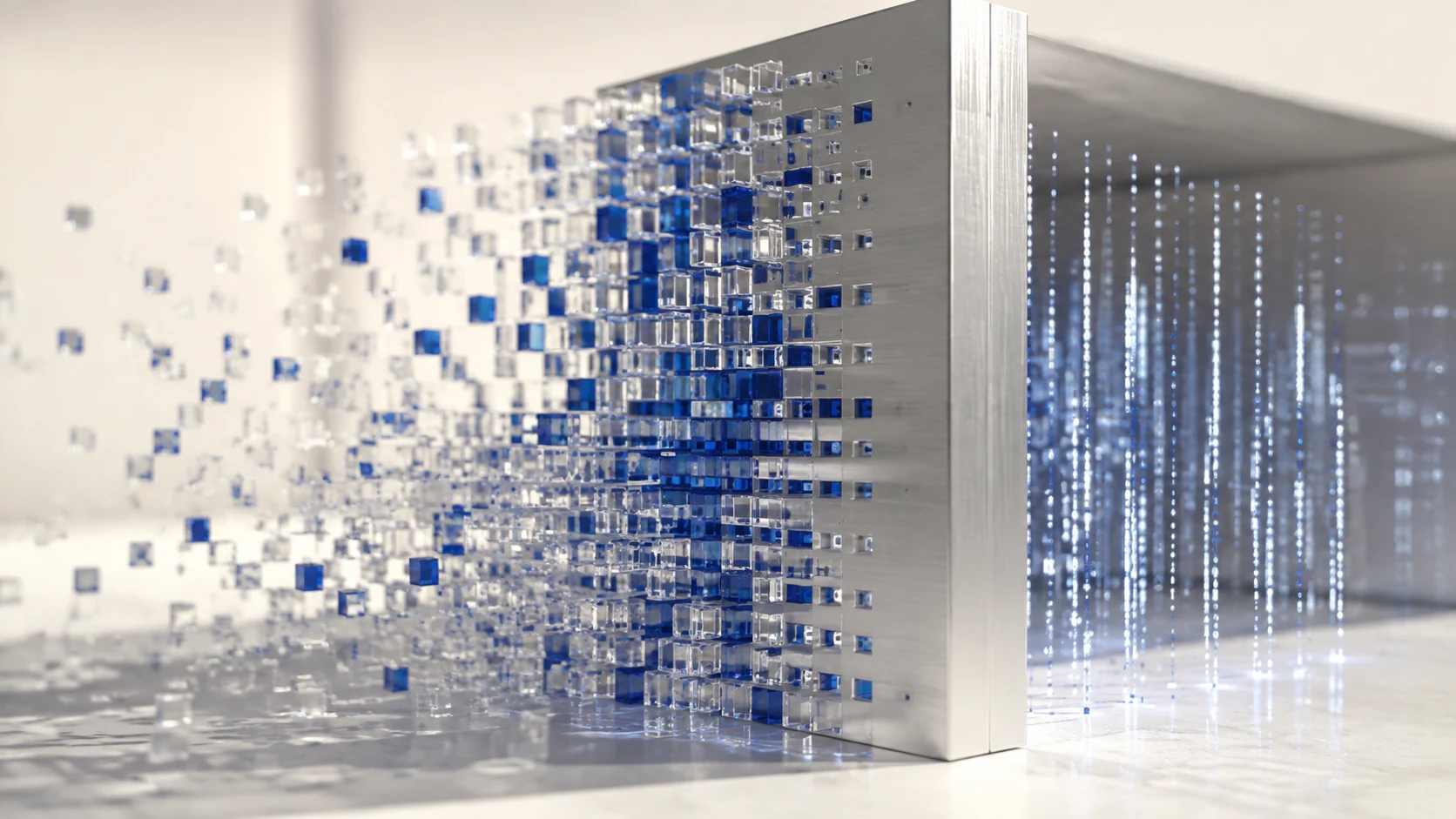
When we see an apple, the brain immediately evokes the Gestalt of a round red fruit. This happens too quickly for us to notice the mechanism. For computer vision, however, an apple is merely a collection of hundreds of thousands of pixels with RGB values of [255, 0, 0].
Early convolutional neural networks (CNNs) decomposed subjects into thousands of pieces to understand images, much like the Cubist painter Picasso. The first layer finds lines and edges, the second recognizes textures and patterns, and deeper layers combine complex shapes such as eyes, noses, and wheels. Remember Google’s Deep Dream images born from this process? Those bizarre, psychedelic images with countless repeated dog eyes and noses paradoxically document a machine’s desperate effort to understand the world. They were not failed attempts at clumsily imitating human vision, but manifestations of a distinct aesthetic perspective only a machine could have: Algorithmic Hallucination.
Machines analyze subjects into components instead of feeling them as wholes. This reductionist vision captures details humans miss through emotion or prejudice. The Next Rembrandt project’s pixel-level analysis and mathematical reproduction of subtle brushstroke rhythms, or the discovery of ancient-site traces invisible to the naked eye in satellite images, demonstrates this. The machine eye does not know meaning, but grasps essential structure perfectly.
2. Data bias and the reorganization of visual power
“To see is to hold power.” French philosopher Michel Foucault explained the relationship between gaze and power through the Panopticon. In the AI era, visual power has become more covert and powerful. Facial-recognition AI in one billion CCTV cameras across the world’s cities identifies wanted people in crowds in 0.1 seconds. China’s Tianwang (天網) system tracks the movements of 1.4 billion people in real time. Algorithms now possess the omniscient perspective once reserved for God.
Yet this machine eye is not fair. Its training Dataset is a miniature of human society. An AI trained on an ImageNet dominated by white male data may fail to recognize Black women’s faces or commit the appalling ethical error of misclassifying them as gorillas. This is not merely a technical bug. It is a new form of racism called Algorithmic Bias. The machine eye reflects the prejudices of the people who curated the data, indeed amplifying them.
Artists resisting this probe computer vision’s vulnerabilities. Adam Harvey’s CV Dazzle project neutralizes facial-recognition algorithms with geometric, unconventional makeup and hairstyles. It reverses the way machines identify people—contrasts such as eye positions and shading along the nose—to appear as nonhuman data noise to the machine eye. This digital Camouflage resists surveillance society while artistically exposing the gap between machine and human seeing.
3. Transcendent vision: making Invisibility visible
AI now exceeds the limits of human vision. LiDAR sensors in autonomous vehicles perceive distances as three-dimensional Point Cloud data even in pitch darkness. Hyperspectral cameras on agricultural drones show fruit sugar content and forest health through colors at wavelengths humans cannot see. This is no longer the passive concept of Seeing. It is active Sensing and higher-dimensional Interpreting.
This Augmented Vision expands art’s horizons. Media artists such as Refik Anadol feed urban wind, temperature, noise, and Wi-Fi signal data into AI, transforming it into dancing fluid-dynamic sculptures. Visualizing invisible data flows reveals the city’s hidden rhythms and breathing, which surround us daily without our awareness. This is a new synesthetic experience machines give to humans.
In astrophysics, AI also played a decisive role in reconstructing an image of a black hole. Through Interpolation and connection of the incomplete, faint data collected by a virtual Earth-sized telescope (EHT), it completed humanity’s first black-hole photograph. We have become beings unable to properly see even the universe’s depths without machine assistance. The machine eye no longer replaces the human eye; it becomes a telescope extending it to the edge of the universe and a microscope penetrating the atomic world.
“Seeing with machines means escaping the prison of an anthropocentric gaze. It opens a door to an objective and cold, yet infinitely expanded world of Non-human beauty.”