
The greatest risk facing AI product teams today is not "the model is poor." Quite the opposite: there are too many available models, and the best choice changes with each request, destabilizing operations. What is needed is an inference tower that arbitrates speed, quality and cost in real time, rather than a single-model strategy.
Adding an AI feature to a product used to be simple: select the model that performs best, refine the prompt and retry on failure. As a service grows, this approach quickly reaches its limits. Even apparently identical questions differ in user context, input length, required precision, latency tolerance and budget. Accuracy may come first in a long-document summary, while a single second determines perceived quality in a real-time guidance chat. High-consequence functions such as internal operations automation require caution; ideation can use inexpensive exploration more aggressively. From an operational standpoint, "Which model is best?" eventually becomes the wrong question. The right one is, "Which model combination makes economic sense for this request right now?"
Without making this transition properly, an organization falls into one of two extremes. First, fear of unreliable quality endlessly increases expensive-model use until margins collapse. Second, cost pressure leads to insisting on cheap models and losing users’ trust. Both end in the same place over time: users leave and the team stays trapped in firefighting. What is needed is not following model-replacement news but a structure that absorbs per-request decisions into the system. I call it an "inference arbitration tower."
1. Document Decision Policies Before Building the Router
Many teams build a model router first. Without fixing policies before writing code, however, the router becomes a pile of temporary conditionals. First document four dimensions: latency limits, quality thresholds, per-request cost ceilings and fallback priorities on failure. Put numbers in writing: "Customer-service live responses must not exceed p95 2.8 seconds," "Financial and legal summaries must have an evidence-omission rate below 3%," or "General productivity features must cost no more than ₩45 in inference per request." Abstract principles carry no weight when disputes arise.
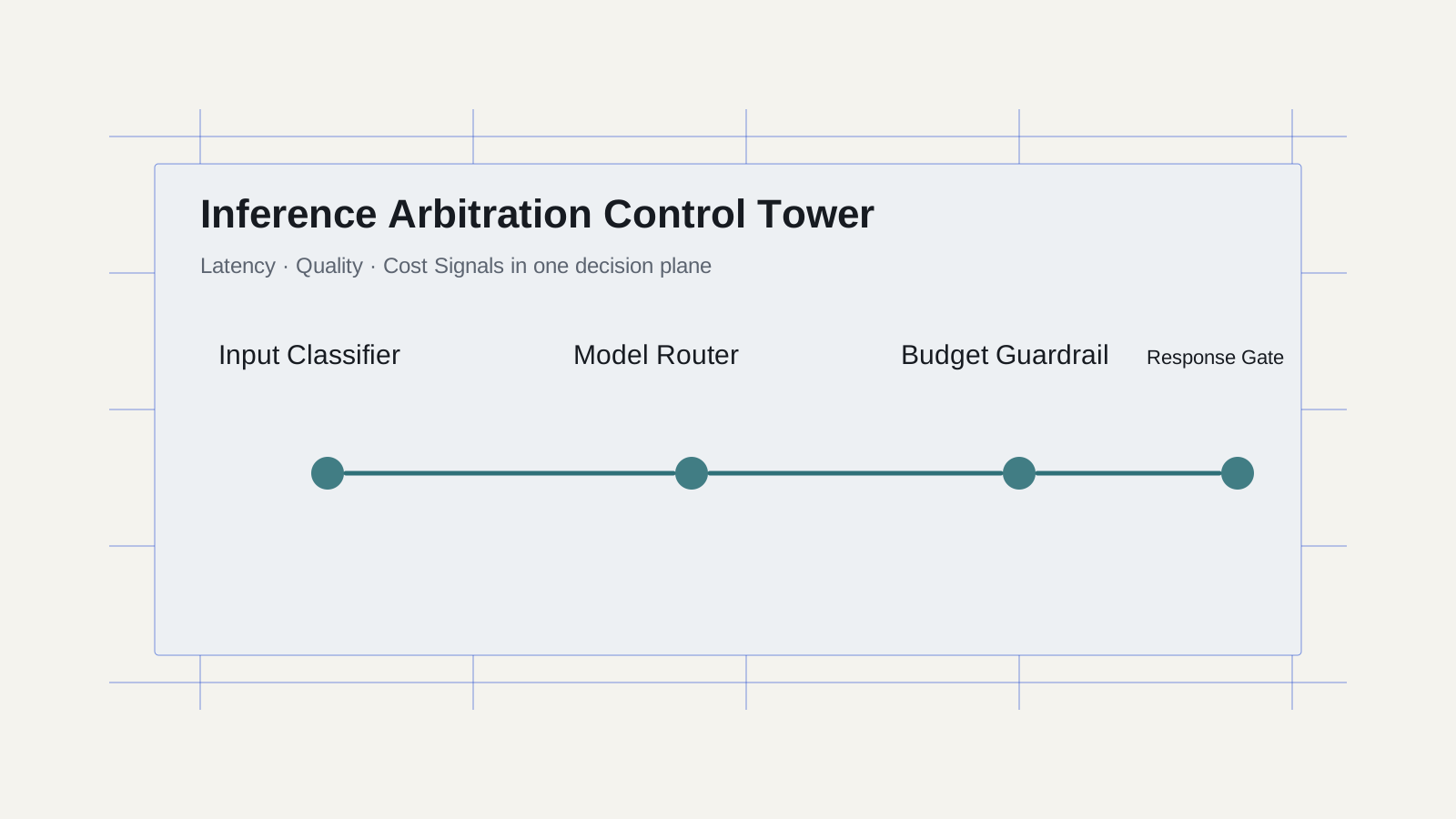 Inference arbitration control tower mapView original
The reason for this policy document is simple. Model performance changes, prices shift and traffic patterns fluctuate. If every decision relies on "this model feels better this time," operational quality depends on the team’s condition. With a policy, the criteria remain stable even when models change. Operational stability comes from repeatable decision criteria rather than speed in adopting the latest model.
It is also important to write down "exception approval boundaries." Specify when a per-request cost ceiling may be exceeded—for example, a key customer’s contractual SLA, a temporary workaround during recovery, or a safety investigation—so operators do not make guilt-driven decisions in the middle of the night. These psychological costs accumulate particularly easily in small teams.
2. Split Requests into Tiers and Build a Latency-Budget Ladder
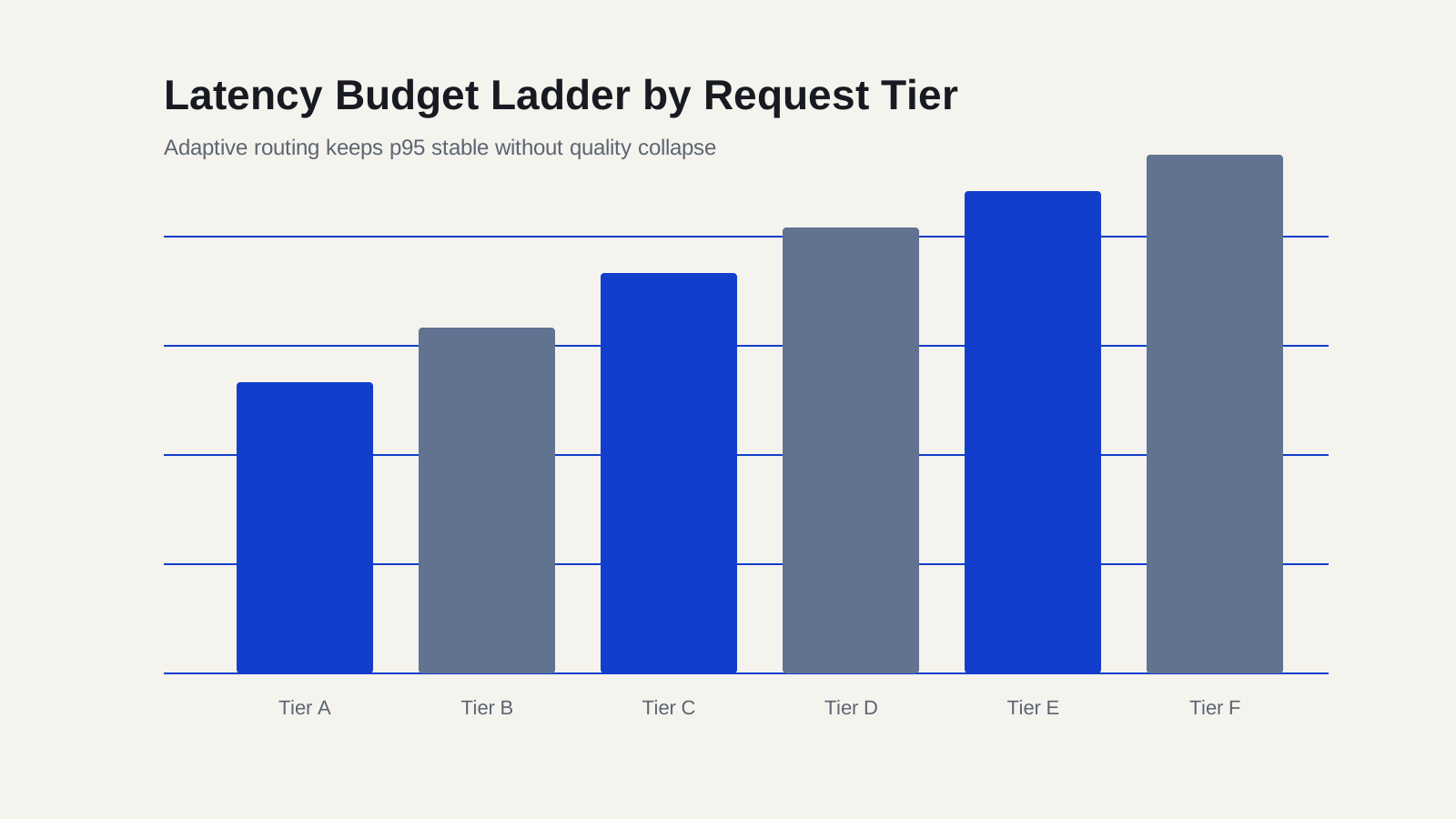
The moment every request enters the same pipeline, costs and latency worsen together. Classify requests by difficulty and sensitivity into tiers. For example, define six tiers from A to F, with A for "short real-time responses" and F for "high-precision long-form reasoning." Give each its own model family, maximum tokens, retries, timeouts and cache policy. The crucial point is that tier classification need not be 100% perfect. Even 70–80% accuracy immediately improves operating costs.
 Latency budget ladder by request tierView original
In practice, keeping tier-classification inputs minimal helps. Initially, domain, input length, user plan and risk keywords are enough. Add correction rules based on past failure patterns, such as "raise this type by one tier." Too many features complicate the classifier, reduce explainability during operation and make debugging harder. A small team’s philosophy should be "resilience over sophistication."
Watch for one trap when designing the latency-budget ladder. Decisions based on average latency miss real user complaints. Perceived quality depends more on tail latency (p95/p99) than the average. Tier-level KPIs and alerts must therefore center on tail latency. That is how you stop trust-destroying patterns such as "usually fast, but occasionally unbearably slow" early.
3. Use a Quality-Regression Firewall to Combine Rollout Speed with Safety
Even good routing leaves operations afraid of every deployment if nothing prevents quality regressions. A quality-regression firewall is needed. Its structure is simple: (1) a canary input set, (2) an evaluation matrix and (3) a promotion gate. Test a new model or prompt combination on the canary set first and promote it to full traffic only when it meets the criteria. Evaluate evidence preservation, prohibited-policy violation rates and format compliance alongside answer accuracy.
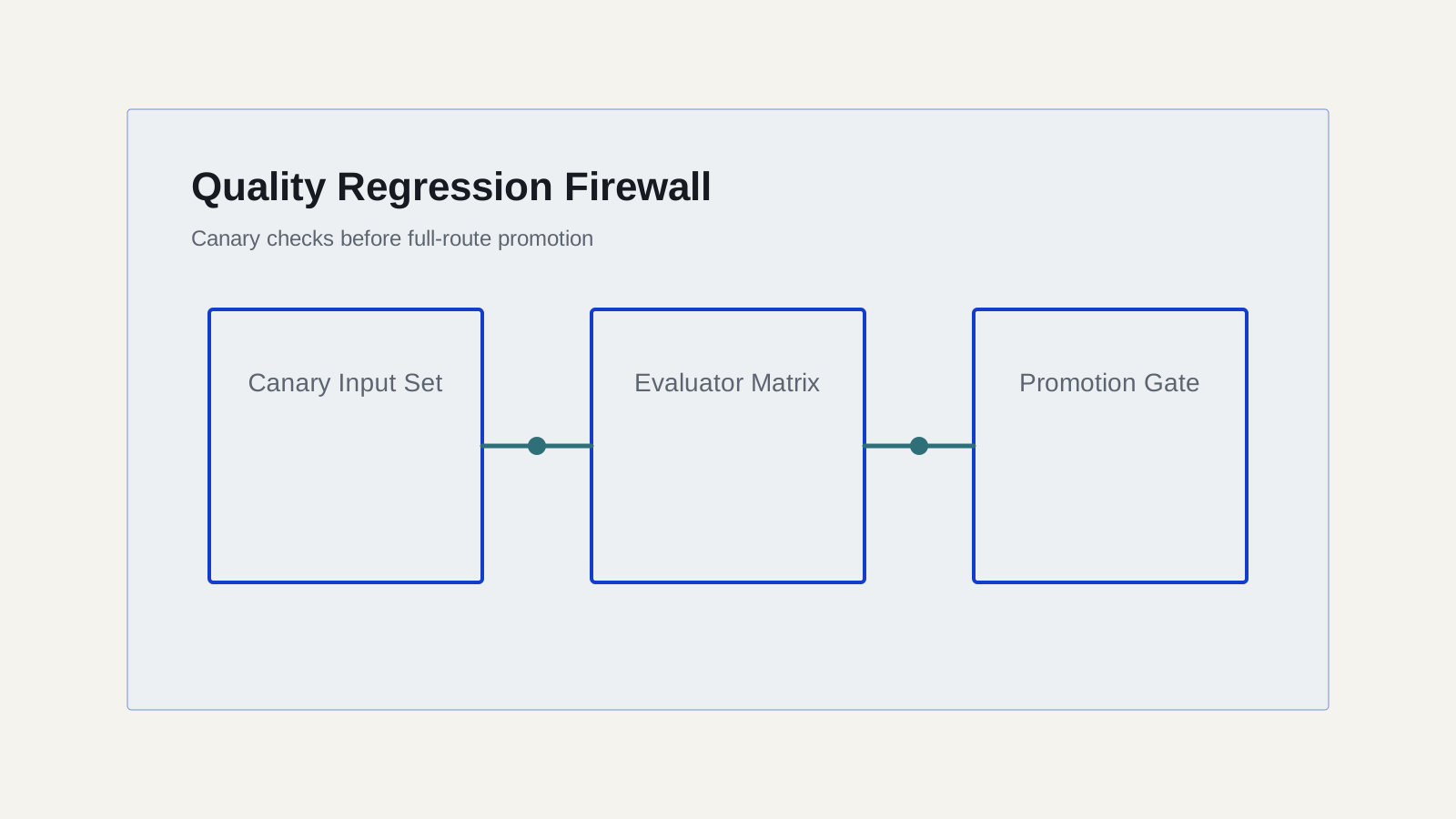 Quality regression firewall boardView original
For this firewall to work, evaluation inputs must resemble the actual operating distribution. Overly clean samples collapse in production. Mix "frequently failing inputs," "edge cases," "long and complex inputs," and "safety-sensitive inputs" in defined proportions. Using only domains the team knows well creates an illusion through overfitting. Deliberately include rough, incomplete sentences from real user language habits.
Automate the promotion gate, but expand traffic in stages. Move through 5% → 20% → 50% → 100%, checking changes in quality, cost and latency at every stage to greatly reduce the blast radius. The most practical way for a small team to achieve speed and safety together is frequent small deployments rather than bold ones.
4. Operational Metrics Should Read Like a Bill
A good dashboard immediately shows "where money is leaking now," rather than merely presenting attractive charts. I recommend placing at least these four measures on one screen.
- Request volume and success rate by tier
- p95 latency by tier
- Average inference cost per request and total-cost trend
- Fallback frequency and satisfaction after fallback (or follow-up question rate)
Seeing all four together takes you beyond "costs increased" to "which tier increased and why." Separate metrics create more meetings and slower conclusions. Readable together, they turn an operations meeting into a decision-making meeting.
It also matters to develop the habit of reading data from a month-end reconciliation perspective. Daily charts alone encourage oversensitivity to noise; monthly totals alone reveal warning signs too late. A weekly rolling window alongside month-to-date totals captures abnormal spikes and structural trends together. For a small team without a data team, operational insight comes from choosing the right time scales rather than complex models.
5. The Real Advantage Comes from Operating Rhythm, Not the Model
Differentiation in a multimodel era does not mean "we connected the best model first." Everyone has access to similar models. The real gap opens in operating rhythm. Teams that assess economics and quality with every input, adjust routing immediately when signs appear and validate regression risks in small pieces are the ones that endure.
The rhythm described here is simple: a 15-minute review every morning, a weekly tier-policy check and a monthly canary-set refresh. Repeatable rituals must accumulate before a system can shed its dependence on individuals. With fewer people, "Can anyone arrive at the same decision?" matters more than "Who is on call today?"
The minimum starting unit is clear. First, define six request tiers and give latency budgets numbers. Second, align router conditions one-to-one with the policy document. Third, begin with just 30 canary inputs to establish a quality firewall. Fix these three within a week, and next month’s inference costs and recovery speed will change noticeably. The multimodel era needs a stronger arbitration system rather than a more expensive model.