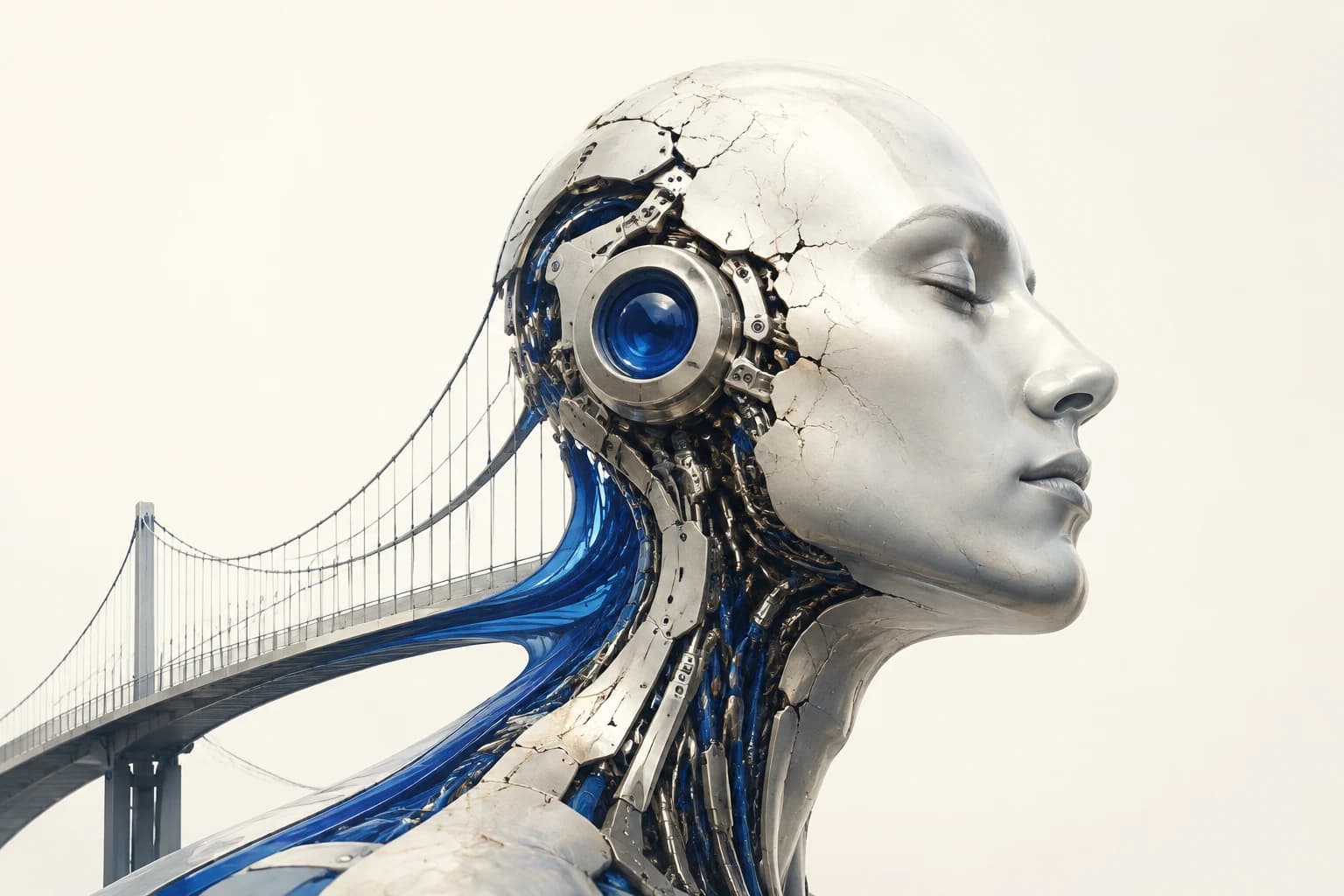
In <Thus Spoke Zarathustra>, Friedrich Nietzsche described humanity as "a rope stretched between the animal and the Übermensch." In the twenty-first century, this rope is becoming a bridge from carbon-based flesh to an expanded, silicon-based existence. Posthumanism is more than a science-fiction game imagining something after humanity. It is the dismantling of human-centered humanism and an urgent philosophical inquiry into a new mode of existence in which technology and biology converge.
1. The Body at Dusk: Cyborgs Become Reality
Elon Musk’s Neuralink aims to connect the human brain and computers at ultra-high bandwidth. Once it becomes widespread, we will abandon language, that inefficient compression protocol.
Consider this: can the words "I love you" convey 100% of your feelings? Language always creates misunderstanding. But if brains connect directly, we could transmit emotions themselves as raw data. Imagine searching Wikipedia with thought alone and downloading complex mathematical formulas to understand them. Here, the body ceases to be a sacred vessel for the mind and becomes outdated, replaceable hardware—a shell.
Prosthetic legs and arms designed to overcome disability have already moved into the realm of functional augmentation: carbon-fiber legs faster than Olympic runners, artificial eyes with zoom that see farther than an eagle. We may gradually come to regard our aging, illness-prone natural bodies as inconvenient and inefficient. As feminist philosopher Donna Haraway said, we are already cyborgs who use smartphones twenty-four hours a day as though they were parts of our bodies. The wires simply have not yet entered our skin.
2. Mind Uploading: The Algorithm of Eternal Life and the Ship of Theseus
If the body disappears entirely, where do ‘I’ exist? Mind uploading is the concept of scanning human consciousness—the brain’s connectome, or neural wiring map—and copying it into digital space. If every memory, personality trait, habit and pattern of thought were backed up as an AI model, you could live forever on a metaverse server after your body died.
But the Ship of Theseus paradox arises here. If every plank in a wooden ship is replaced one by one, is it still the original ship? If your brain cells are replaced individually with silicon chips until you become 100% machine, can you say your soul still inhabits it? Or is it merely a philosophical zombie that possesses your memories and performs a perfect imitation of you?
In a world where death is a change to offline status rather than the end of existence, humanity’s religions and ethics will be shaken to their foundations. Heaven and hell might become service tiers determined by server capacity and subscription plans, rather than promises of an afterlife.
"If in the past we had to give up God to become human,
in the future we will have to give up being human to become gods." - Yuval Harari, <Homo Deus>
3. Merging with AI: The Birth of a Hive Mind
The final destination of posthumanism might be the disappearance of the individual. We believe the self called ‘I’ exists independently, but that may be an illusion created by the brain. If brains become networked and AI superintelligence merges with us, the boundary between ‘you’ and ‘me’ blurs.
My thoughts become yours, and all of humanity’s knowledge is shared in real time through the cloud: an immense sea of consciousness. Like ants or bees, we might become part of a vast hive mind. Would it be a homogenized dystopia like the Borg in Star Trek? Or a utopia of complete empathy in which war and violence disappear because we experience another’s suffering as our own?
What is certain is that the age of Homo sapiens as a solitary individual is drawing to a close. We are no longer alone. We are connected, in the literal sense.
Conclusion: Seeing Dawn in the Twilight of Humanism
Technological posthumanism is frightening. It seems to mean losing the humanity we have defended for thousands of years. But we cannot refuse evolution. Homo sapiens has been master of the Earth for only 300,000 years. Even dinosaurs lived for 160 million years before going extinct. No dominant species lasts forever.
Our task is not to preserve the human form of the past stubbornly, but to ask again what makes us truly valuable. Machines are better at logic, calculation and memory. What, then, remains? Love, compassion, creativity, and the sublimity that arises from awareness of our own finitude. Perhaps these limitations, which AI may never possess, are precisely the final inheritance we must protect to the end of the posthuman age.
Humans becoming machines, and machines becoming human. In the sunset along that blurred boundary, we await the dawn of a new species with an excitement tinged with fear.