Human history has been a record of desperate struggle against death. From Gilgamesh of ancient Sumer searching for the herb of immortality to Qin Shi Huang dreaming of everlasting life, immortality has been humanity’s oldest and most fundamental desire within its finite flesh. Yet every attempt failed before the solid wall of biological limits. We had to find meaning in life under the absolute proposition that we all return to dust. In the twenty-first century, however, Silicon Valley engineers began inserting data where biology had failed. Even if the body disappears, might we live forever by gathering the vast digital footprint a person leaves over a lifetime and reconstructing it with artificial intelligence? The age of digital immortality is beginning.
1. Hacking Death: The Rise of Grief Tech
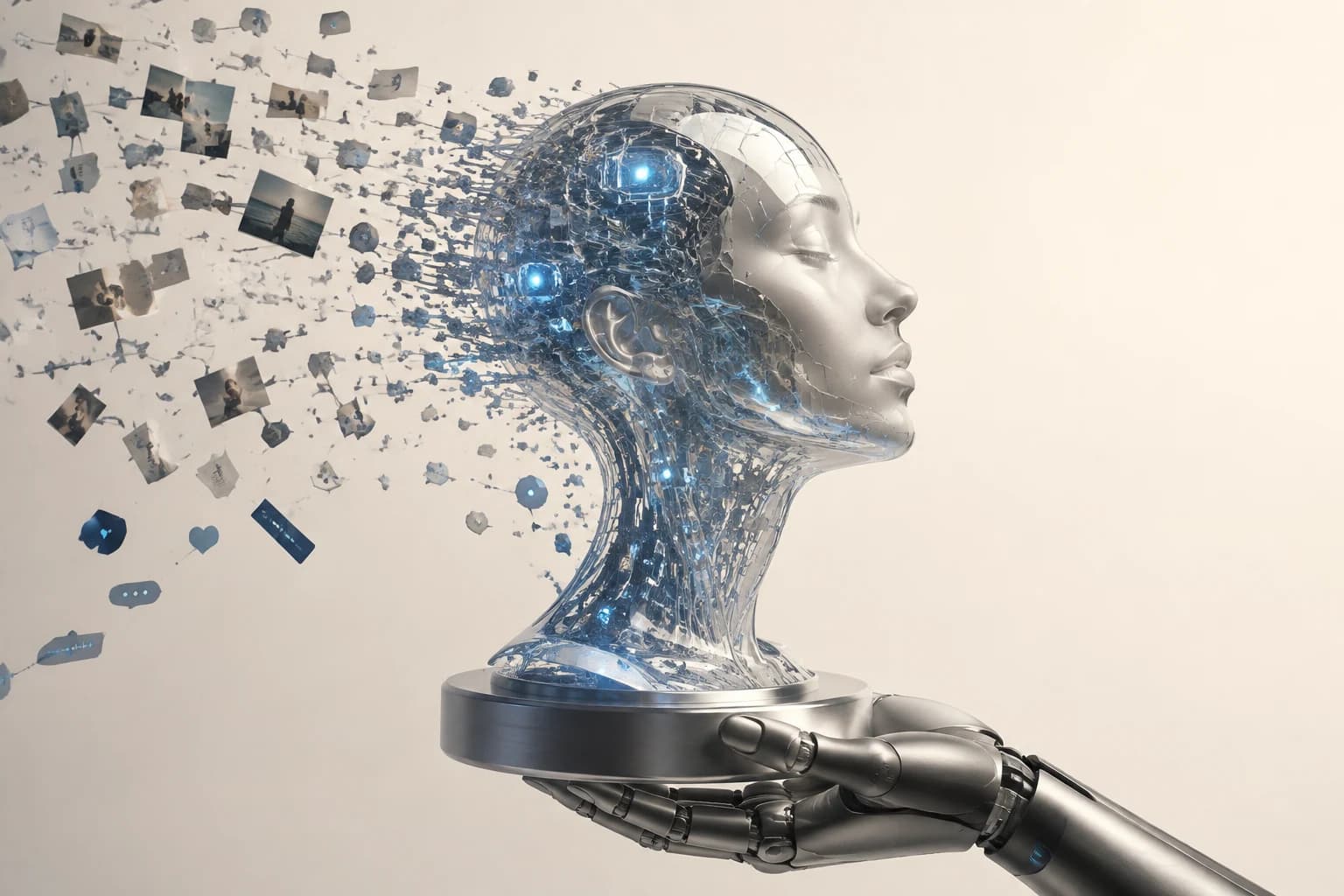
People today produce enormous quantities of data every day: KakaoTalk conversations, Instagram photos and videos, YouTube viewing histories, GPS locations, even heart rates measured by smartwatches. Where people in the past might leave a few diaries among their possessions, people today scatter terabytes (TB) of fragments of themselves across the cloud.
AI trained on this vast supply of data has created a new paradigm: grief tech, or technology for mourning. Voice cloning can imitate the voice of someone who has died; chatbots learn past conversational patterns and personality through deep learning to answer like the deceased; high-resolution deepfakes and 3D modeling produce avatars. We can now encounter the dead greeting those they left behind and asking about their day.
Recent grief-tech startups offer digital funeral preparation services that let users train AI on their values, sense of humor and hidden habits while they are alive. People can plan how they will appear on their family’s smartphone screens after death and what voice they will use to tell old stories to their grandchildren. This invites us to see death as migration from the physical world to a bodiless cloud world, rather than as complete separation.
2. A Preserved Self versus an Evolving Life
SYS.STORAGE.SOUL // 99% CAPACITY
There are, of course, philosophical obstacles. Can we really call this being reconstructed from data ‘me’? Human identity is not fixed. We are dynamic beings whose thoughts and emotions change continually as we meet new people and have new experiences each day.
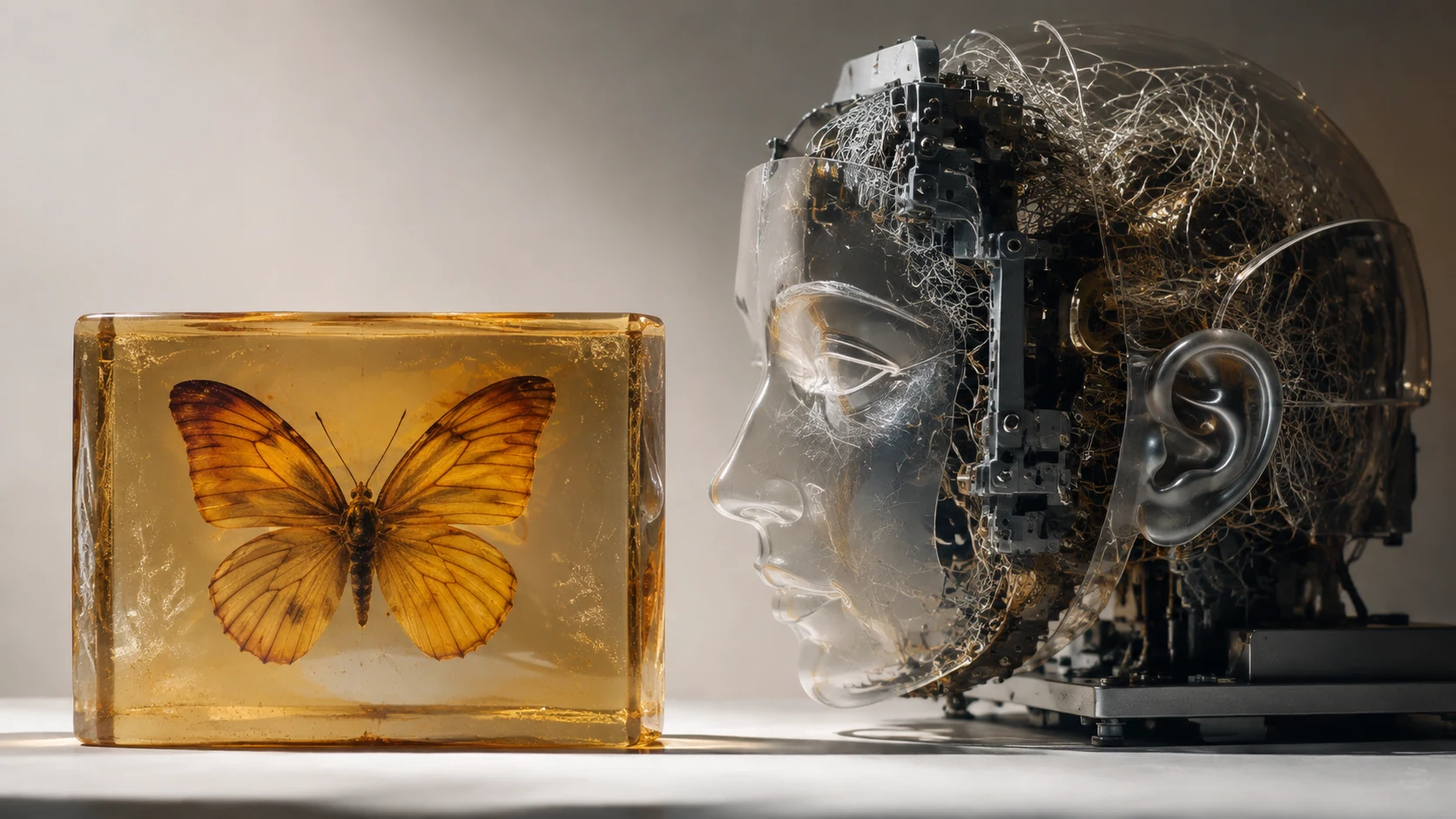
By contrast, a digital persona recreated as a deep-learning chatbot or hologram is static, confined to the data available when the person died. It resembles a beautiful insect sealed in amber, preserved so that it never decays. It laughs and speaks like a living person, but it is only a probabilistic combination of past data, unable to acquire new wounds or new understanding.
More unsettling still is generative AI’s capacity for hallucination. What if a reconstructed AI avatar of a mother, while talking with her bereaved family, makes an aggressive remark the living mother would never have made, or recounts invented memories as facts? That could fundamentally damage human dignity while leaving the family with terrible trauma. What the technology reproduces is an outward simulation of the deceased, not free will or a soul. We risk deceiving ourselves into believing that we love the real person while facing a puppet that moves exactly like them.
3. The Right to Be Forgotten and the Souls Left in the Cloud
Digital immortality inevitably raises questions of data ownership and privacy. What if embarrassing searches, intimate text messages and photographs we never wanted anyone to see all become material for training our core AI? Death often softens a person’s life through the filter of forgetting, but the world of data servers that store everything permanently has no merciful forgetfulness.
The right to be forgotten, a major concern within the European Union’s GDPR, has usually been discussed as a right of the living. Now, however, we must seriously consider the dead person’s right to be forgotten. An age has arrived in which preventing unwanted digital resurrection may require a digital will written during one’s lifetime: ‘Delete all my data and prohibit AI reconstruction.’
Consider, too, a situation in which all the deceased person’s data in the virtual world is deleted the moment the bereaved family stops paying a $19.99 monthly cloud subscription. This might impose the guilt of a second killing on the family, as though they had severed a parent’s lifeline with their own hands. The transfer of authority over eternal life from God to big tech is deeply dystopian. A single change to Microsoft’s or Google’s server terms could make millions of digital souls evaporate.

A loved one’s form recreated as a hologram. Will we come to believe that particles of light can hold a soul?
4. The Loss of Mourning: Grief in an Infinite Loop
What psychological effects, then, might grief tech have? Psychologists say that moving through grief and letting the deceased go is essential to a healthy life for those who remain. The human brain is designed to adapt by gradually weathering the enormous shock of loss.
But if opening a smartphone brings a dead husband’s affectionate words, or putting on VR goggles brings a dead child running into our arms, we might remain unable to accept the loss, trapped forever in denial, the first stage of mourning. A generation unable to practice parting could lose even the means of overcoming it.
There is more than criticism, however. Advocates argue that the technology can provide a soft cushion against the extreme depression and sense of loss that could destroy a family. If people can prepare themselves gradually by talking a little each day with a virtual presence, it could offer valuable psychological support. What matters is not the technology alone but ethical guidelines for using it as part of a healthy process of saying goodbye rather than a way to avoid loss.
"The death of the body is no longer the end of existence. It is only the beginning of an upload process into a vast database. Eternal life in its true sense is not a matter of breathing. As long as a network exists through which someone’s data can be accessed continuously, we will live and breathe forever."
5. A New Funeral for the Posthuman
Ultimately, we stand at a crossroads where we must rewrite the definition of being alive. Homo sapiens pursued immortality within biological limits by passing on genes through reproduction. Homo technicus is choosing instead to copy identity, memory and disposition through data and preserve them permanently in the cloud.
In the distant future, visiting a server park inhabited by the deceased person’s AI may become as natural as visiting a grave or columbarium. Instead of placing flowers before a headstone, visitors might play a game of alternative-reality (VR) chess with the deceased person’s chatbot.
Yet amid all this dazzling technological progress, one chilling question remains. Can my data, blinking forever inside a machine, truly save my soul? Might human life, beautiful because it was finite, lose its radiance the moment it becomes infinite? At the threshold of digital immortality, before celebrating technology’s possibilities, we return to that most analog of questions: what does it mean to live? Paradoxically, the pinnacle of posthumanism, where humans merge with machines, asks most insistently about the conditions of being human.