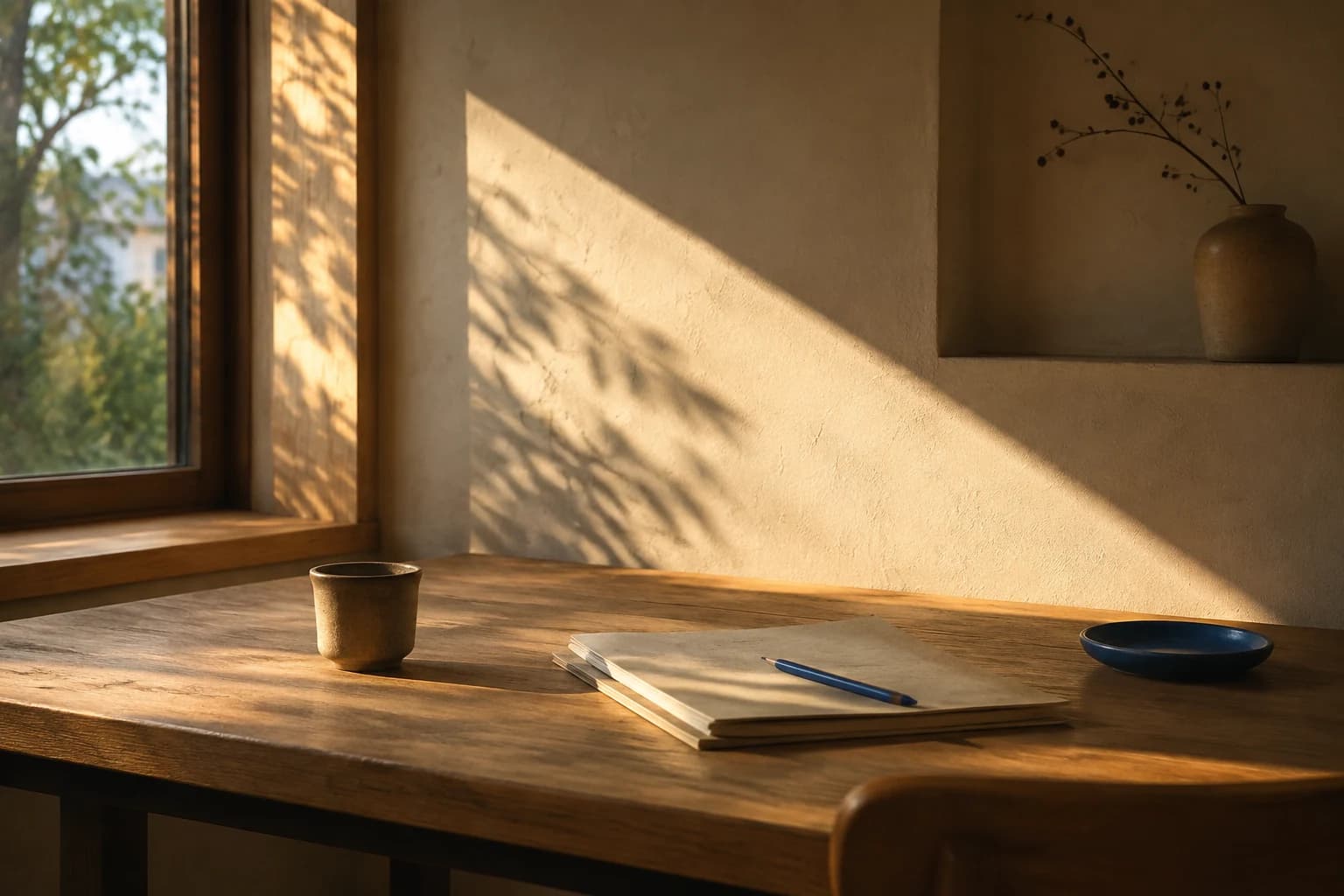
I have rarely noticed the end of summer through temperature. There are hot days in September, and cool ones in August.
I know by the light instead.
Five in the Afternoon
The window is to the left of my desk.
All summer, the five o’clock light stopped at the desk’s left corner. Right where the wood grain began, and no farther. Even if I reached out, I could not touch it. The same line, every day.
Then, one week, the light comes a little farther in.
It crosses the corner. A few days later, it catches the left edge of the keyboard. A few days after that, it rests on the back of the hand I am typing with. It is not even warm, but I can see my hand brighten.
The temperature is unchanged. Only the angle has shifted.
This week comes every year. It is not on the calendar, but it is on my desk.
Color Grows Old First
The angle is not the only thing that changes.
Summer afternoon light is white and flat. It is so strong that the edges of shadows look cut with a knife, and when it reaches the wall, the wall is simply bright. The wall remains a wall.
The light as autumn approaches is different. Yellow, long, and a little slow. It falls on the same wall, yet the wall looks warm. As if the paint had changed color.
They say it is because the thickness of atmosphere the light passes through changes. Even knowing the principle, I see it anew each time.
Knowing a principle and recognizing it must be different things.
After the change, it looks obvious; during those few days of changing, it feels unfamiliar every time.
Sound Falls Away, One Layer at a Time
Around this time, I leave the window open longer. And sounds come in.
Summer evenings sound thick. Cicadas form the bottom layer, outdoor air-conditioning units sit above them, and voices carrying on late pass over the top. About three layers.
After this week, the layers fall away one by one.
The cicadas go quiet first. One evening, I belatedly notice their absence. Then the air-conditioning units run less. People go indoors a little earlier.
What remains is mostly the sound of wind passing through leaves.
Summer is a season of accumulation; these few days are a stretch of subtraction.
You Have to Stay in One Place Long Enough to See It
To notice things like this, you need to be in the same place often. If you are somewhere different every day, you have no basis for comparison.
So this is the sensitivity of someone who does not move around much. That probably is not entirely a good thing. But in this season, it becomes an advantage.
The same window, the same time, the same desk. With only one variable, change becomes clear.
That is also why the notes become short.
9/1   Five o’clock, corner
9/4   Past the corner
9/6   Left of the keyboard
9/9   Back of my hand
One line is enough. Trying to turn it into a full sentence makes me less likely to write it at all.
If I open the notes around this time next year, I can see how many days the timing differs. Having the notes from the year before last is even better. Then I can see how this week shifts a little earlier or later each year.
There Was a Year I Missed It
Last year, I missed this week.
A business trip overlapped with it, and by the time I returned, the light had already reached my elbow. I had not seen it cross over, only the state after it had crossed.
I felt oddly disappointed. It was hardly something momentous to have missed.
Thinking back, that year had no day on which autumn arrived. It was simply autumn before I knew it. Without a beginning, a season becomes mere background.
So this year, from the last week of August, I looked at the desk once each day at five. Several days passed with nothing happening; then, one day, the light crossed the corner.
Recognizing something I had waited for brought a different pleasure from noticing it by chance.
After It Passes
Once this week passes, things become familiar again.
The lower light and thinner sounds soon feel ordinary. Even when the light that rested on my hand reaches all the way to my elbow, I think nothing of it. The surprise lasts only the first few days.
That is why these few days remain unusually vivid.
Change itself is brief; the changed state lasts.
I think this is part of what makes seasons good. Four times a year, they give us a short stretch of unfamiliarity. Only then do we see what usually goes unnoticed. The window that has always been there suddenly looks like a window, and the desk like a desk.
At five today, take a look at how far the light has reached.
This is probably that week.