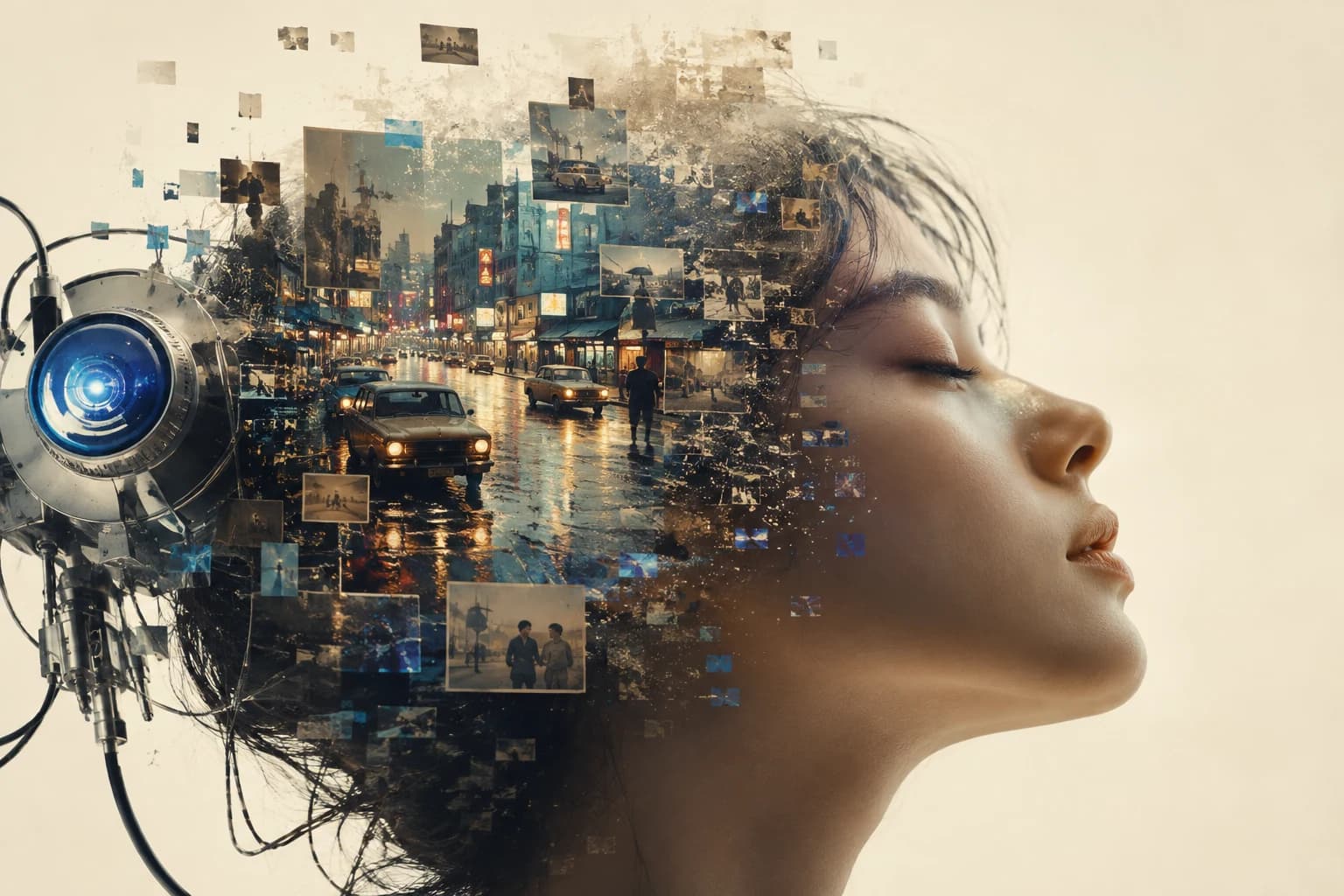
'Anemoia.' This neologism from John Koenig’s Dictionary of Obscure Sorrows means nostalgia for an era one has never experienced. A person born in the 1990s listening to 1970s Japanese city pop and longing for Tokyo’s neon-filled night streets, though never having visited them, is one example. AI has turned this subtle emotion into a mass-producible manufactured commodity.
Open Midjourney or Stable Diffusion. Enter “a rainy scene in 1980s Seoul, warm film grain.” In 10 seconds, AI creates an image you have never actually seen, yet which feels somehow familiar and achingly nostalgic. So vivid and specific are these images that they stimulate the mind as though they were memories of a past life. They are more than photographs. They are Synthetic Memory.
The Mandela Effect & AI Fabrication
The 'Mandela Effect' describes collective public memories diverging from actual history. AI accelerates it. In 2023, when an AI image of Pope Francis in a luxury puffer jacket went viral, countless people believed it was real news. The image took control of memory.
Future children may believe in 'processed history' restored, colorized and upscaled to 4K by AI rather than the blurry black-and-white photographs in textbooks. Fiction that feels more real than fact is overwriting our past. History is becoming the record not of the victors, but of those with better rendering performance.
1. Healing Personal Loss Through Technology: Digital Necromancy
Technology is revolutionizing how we handle death and separation. 'Be Right Back,' an episode of Netflix’s <Black Mirror>, has become reality. Services such as 'Project December' and 'HereAfter AI' train on a deceased person’s texts, emails and voice recordings to provide an AI chatbot, or griefbot, with which people can converse after their death.
Send “Mom, I had a hard day at work,” and an AI preserving your late mother’s manner and personality replies, “My son, you’ve worked hard. Have you eaten?” Technologies such as Deep Nostalgia go further, making a father in a still black-and-white photograph blink and smile. Combined with 3D holograms, we could even sit opposite a deceased person’s digital ghost on the living-room sofa and drink tea.
This is undoubtedly powerful comfort. It may even be salvation for those unable to say goodbye after a sudden loss. Psychologists, however, warn that it can interfere with healthy mourning and cause pathological grief: an inability to release the departed. Death concludes a life. In the digital world, however, death is merely being 'offline' or stopping data updates. Is technology promising immortality a blessing, or the selfish desire of the living who cannot let the dead go?
2. Memories Preserved in Data: Algorithmic Reminiscence
Our brains actively reconstruct memories. Bad memories fade, good ones become idealized. This nostalgic correction is a defense mechanism for mental well-being. Smartphone-era memory is different. Our recollections are embalmed bit by bit on cold SSDs in cloud data centers rather than in the hippocampus. And the authority to summon them belongs to an algorithm, not me.
Google Photos and the iPhone’s “On this day 3 years ago” features unexpectedly put old photos before us. They may show a happy time with an ex-partner or a failure we wanted to forget. Algorithms do not understand human emotion and context. They simply classify clear faces, suitable brightness and recognizable landmarks as “important memories.” Photos AI does not choose—the shaky B-roll shots—vanish into the digital abyss.
This algorithmic curation reshapes identity. Only the glamorous moments suited for social media are recorded as “my life,” while ordinary, dull but sincere days are deleted or archived. In an era when life unrecorded as data goes unremembered, do we remember for ourselves, or are we subjected to remembering by corporate algorithms? Opposite the Right to be Forgotten, a struggle awaits for the right not to be recorded and the right to remember in our own way.
Conclusion: The Beauty of Imperfect Memory
AI promises perfect records and eternal preservation. Yet what makes us human is not memory’s perfection but its imperfection. The wistfulness that remains as colors fade, details blur and only emotion survives turns us into poets and artists.
If every moment were preserved forever as 8K video, could we focus on the present? With a past always available to replay, could we feel the preciousness of this fleeting moment?
Technology is externalizing memory. Outside the brain, memory becomes a commodity that can be manipulated, shared and traded. Within this great current, we must ask: Who owns my memories? And is my past true, or a well-rendered illusion?
"Memory is no longer an intimate personal narrative. It has become a database query result and a subscription-service (SaaS) product. We may find ourselves living in an era when even our own past requires a monthly subscription."