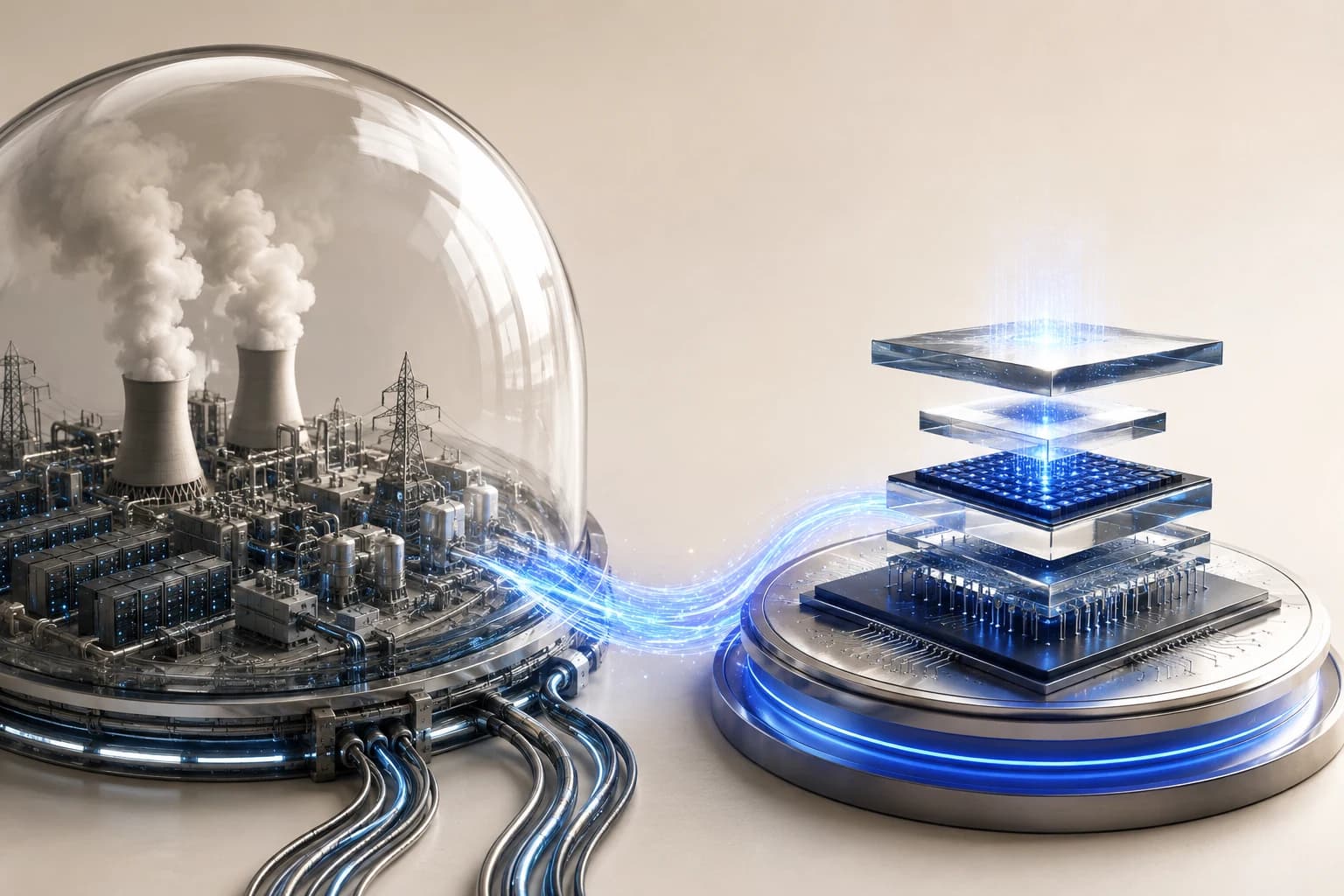
AI in 2025 was a voracious consumer of electricity. Data centers devoured energy while companies measured the thickness of their electricity bills. By 2026, a shared conclusion had emerged: AI has no future without solving this problem. The chip industry entered the most abrupt revolution in its history. This is not a simple specification race, but a paradigm shift overturning architecture itself for energy efficiency.
The Energy Crisis
“The power used to train one modelmatches an entire city’s daily consumption.”
The Solution
“Redesign the architecture.Smarter chips using less power.”
Act I: The Energy Paradox
1) Why does AI consume electricity like food?
As AI models grow more complex, power consumption increases exponentially. It is not simply more Parameters. Matrix operations, memory access, and data transfers during training and inference make electricity demand explode.
For example, GPT-4 training is estimated to have consumed approximately 3,500 MWh. This is comparable to the annual electricity use of 100,000 Korean households. Training a single model consuming as much as a small city annually has become reality. The bigger problem is Inference rather than training. The power used each time a user asks a question cannot be ignored.
2) A chip industry facing physical limits
Traditional GPU architecture can no longer solve this. NVIDIA’s H100 and Blackwell chips perform excellently but have reached limits in power efficiency. Smaller chips with more densely integrated transistors create increasingly serious heat problems. This is the wall of physics. The paradox that smarter chips become hotter is the AI-chip industry’s greatest dilemma.
Act II: The Architecture Revolution
3) The rise of NPUs: specialist chips arrive
The era of general-purpose CPUs and GPUs is drawing to a close. The era of AI-specific NPUs (Neural Processing Units) is here. NPUs dramatically improve efficiency through hardware accelerators specialized for deep learning and by removing unnecessary circuitry. Qualcomm’s Snapdragon NPU, Apple’s Neural Engine, and semiconductor companies’ own NPUs are competing. They claim more than ten times the power efficiency of GPUs.
4) Fusion chips: CPU + GPU + NPU
Intel, AMD, and other major manufacturers are releasing fusion chips that integrate different computing units. An NPU for AI, a GPU for graphics, and a CPU for general computation share one package. This is not merely combining chips. It is a new interconnect architecture minimizing data transfers between units. How little data moves inside the chip becomes the key determinant of power consumption.
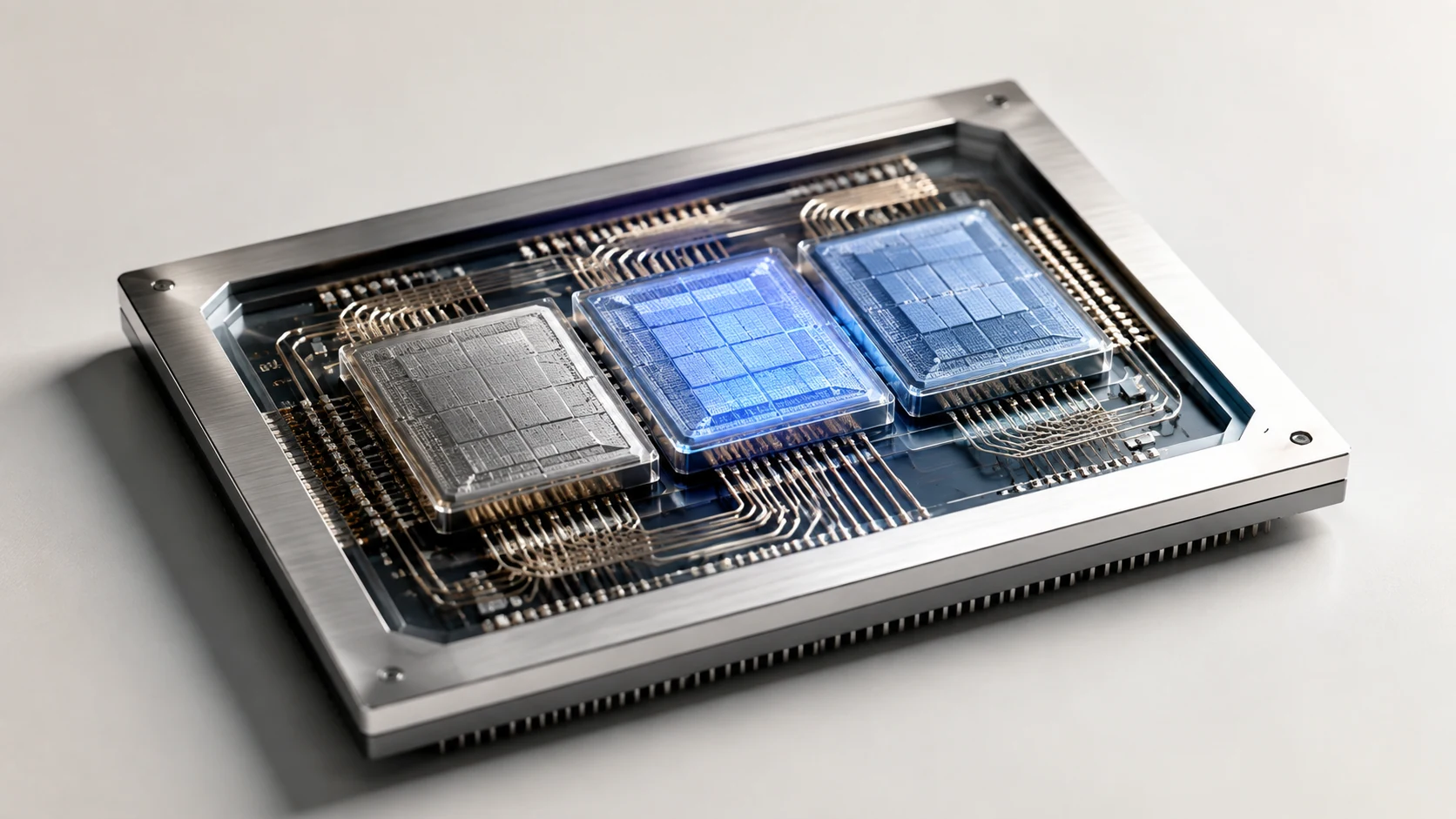
5) 3D nanochips: changing dimensions
The most intuitive way to increase chip performance is adding transistors, but flat 2D space has reached its limits. The semiconductor industry therefore moved beyond the plane. Led by Samsung and TSMC, 3D nanochip technology stacks transistors vertically, like building taller structures. It is a revolutionary technology that increases transistor counts two- to threefold without changing chip area.
Act III: The Energy Strategy
6) Hybrid: combining cloud and edge
Not all computation can go to the cloud. Bandwidth, Latency, and privacy push AI toward the Edge, but edge chips have performance limits. A new architecture therefore emerged: complex training and initial inference in the cloud, real-time computations at the edge. This is more than dividing a network. It is dynamic scaling that deploys lightweight models to the edge and calls the full cloud model only when needed.
7) Where quantum computing meets AI
Quantum computers remain in laboratories, but their intersection with AI is approaching. New paradigms such as quantum-circuit optimization and quantum machine learning are being explored. Although not yet practical, these technologies may address power problems from an entirely different perspective. Quantum computers have the theoretical advantage of substantially higher energy efficiency than traditional chips.
Act IV: Corporate Response
8) Energy-independent data centers
Big Tech is converting its data centers toward energy independence. Microsoft is pursuing nuclear-plant restarts, while Google and Meta invest in directly producing renewable energy. More interesting is heat recycling: circular energy systems use the enormous heat from data centers for urban heating. This is a new model not only for reducing costs but for practicing environmental responsibility (CSR).
9) Software optimization: a revolution without new chips
Software optimization matters as much as hardware innovation. Techniques such as Quantization, Distillation, and Sparse Models reduce model size and power consumption. This is an energy revolution at the software level requiring no new chip. Making models more efficient, rather than merely smarter, is the central task of 2026.
Closing: the victory of physics
AI’s future depends on physics. Smarter algorithms alone cannot overcome the limits of model growth. Only energy-efficient hardware combined with optimized software can advance AI to its next stage. The chip industry in 2026 is not a simple specification competition. It is a fierce revolution over how to overcome the physical constraints of power, heat, and data transfer.
Smarter AI using less power. That is the new goal launched by the chip industry.