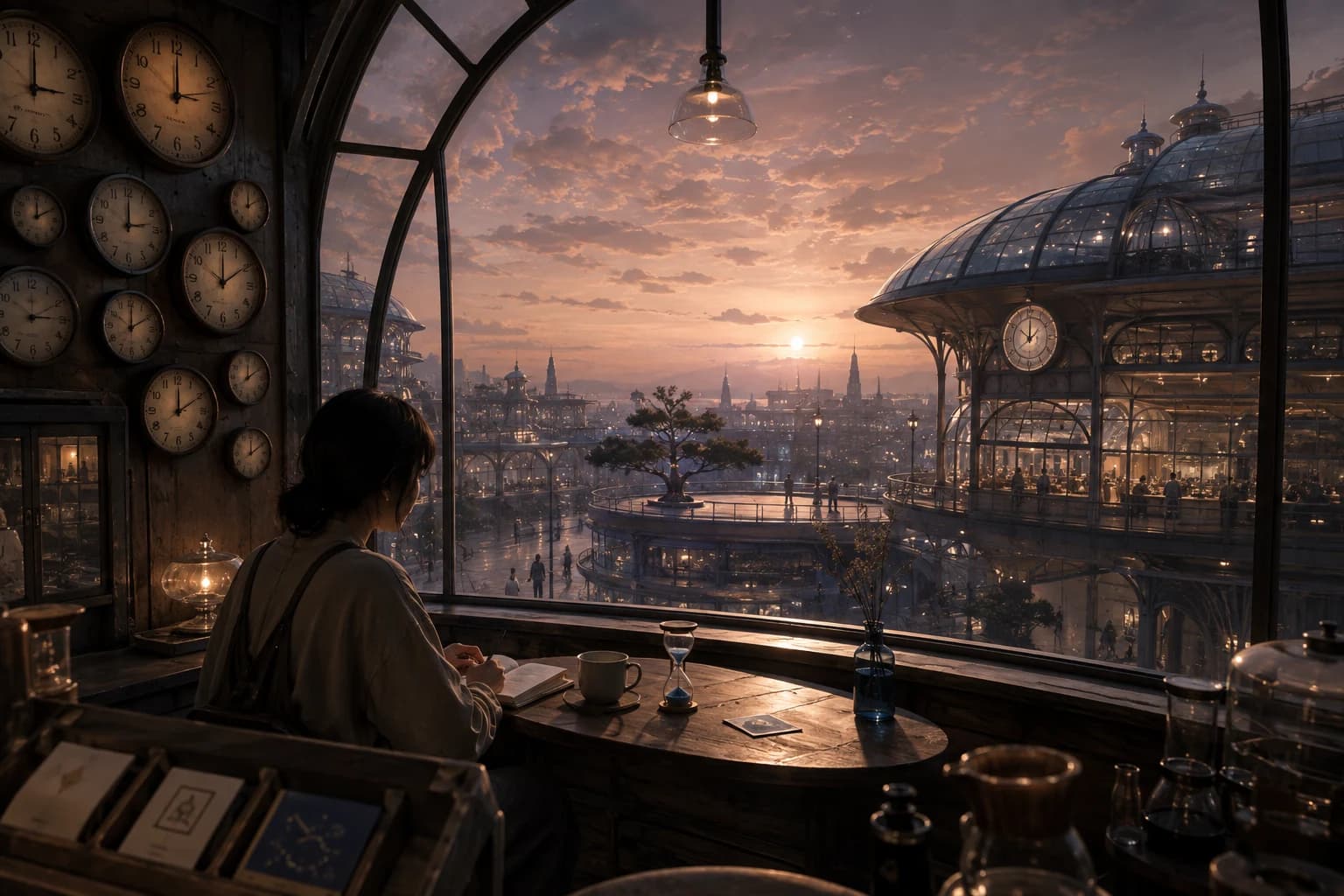
On a planet where every clock in the city has stopped at 18:40, a café at its center does not sell time; it lets people feel time again.
The sun never sets and night never comes. The light remains fixed at the density of twilight, and shadows lie long at the same angle all day. Everyone feels a strange fatigue when first arriving on this planet. Because the day never ends, its beginning becomes uncertain; without closure, the sense of achievement also fades. Time seems to flow, yet nothing becomes settled. People here call this feeling “the perpetually unfinished evening.”
The glass-greenhouse café in the city center was designed to address this feeling of incompletion. Its name is Twilight Station. From outside, it resembles a small laboratory with cups, cards, and hourglasses neatly arranged under warm light. There is no showy music or stimulating screen inside. Instead, the walls are covered with analog clocks whose second hands only tremble slightly, never advancing a single tick.
The café has a simple rule. Orders are placed not for drinks, but for units of stay. The menu lists names such as three minutes of breathing, seven minutes of focus, and twelve minutes of organizing. During the chosen unit, a guest performs just one action: tidying a line of notes, writing tomorrow’s first sentence, or steadying their breathing while holding an empty mug. What matters is not accomplishing a great deal, but gathering scattered attention back into a single point.
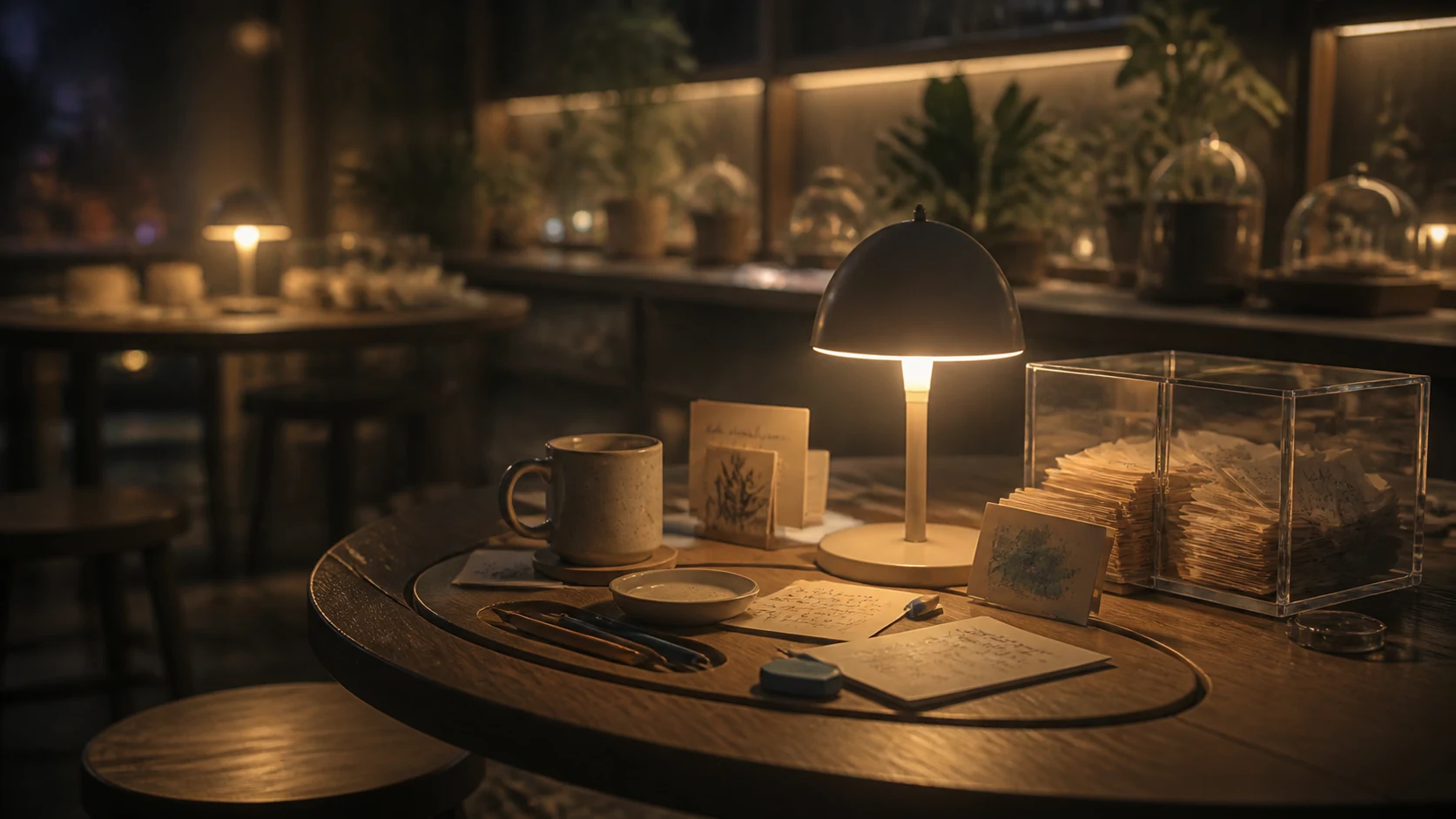 Everlasting evening planet cafe interiorView original
Space shapes action, and action steadies emotion
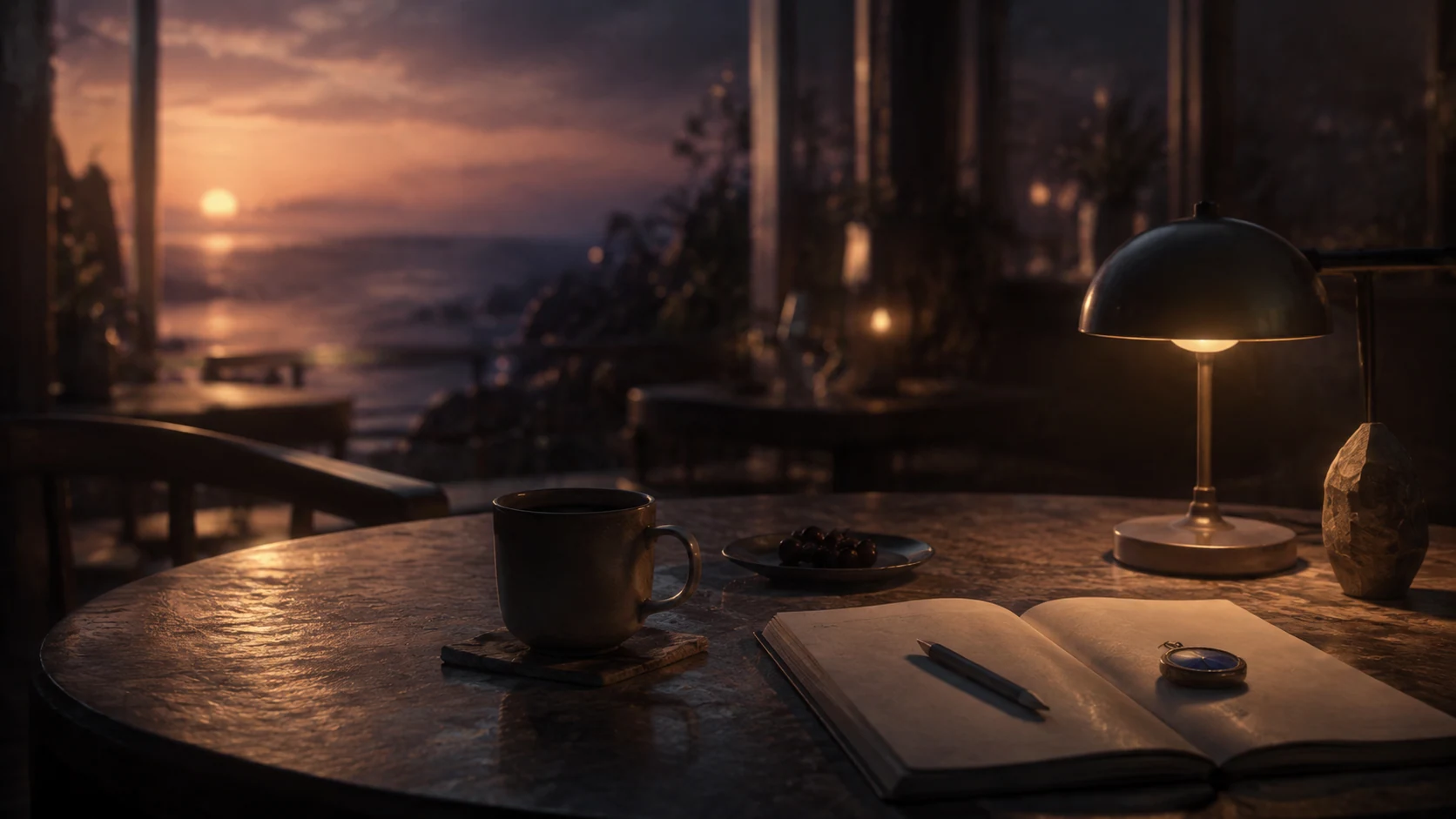
Every piece of furniture in this café is round. Shallow grooves in the tabletops keep pencils, coasters, and small cards from rolling beyond them. It seems a minor design choice, but its effect is large. Reducing unnecessary hand movements also reduces mental noise. Space organizes movement, and organized movement lowers the amplitude of emotion.
On the windowsill stands an “unfinished archive.” The transparent box holds fragments of unfinished sentences, half-colored designs, and letter drafts that have merely been saved. On this planet, incompletion is not evidence of failure. It is a normal state that can be carried into the next evening. The same phrase therefore always stands before the box: Connection before completion. It means leaving a marker so you can pick something up tomorrow even if you cannot finish it today.
The lighting follows the same philosophy. No light illuminates the whole ceiling; only a low lamp at the center of each table is on. It dims so slowly that the change is almost imperceptible. At a certain point, people naturally stop their hands and write their next starting point on a card. Evening never ends here, but work always receives an ending. A rhythm of closure is needed to find the strength to begin again.
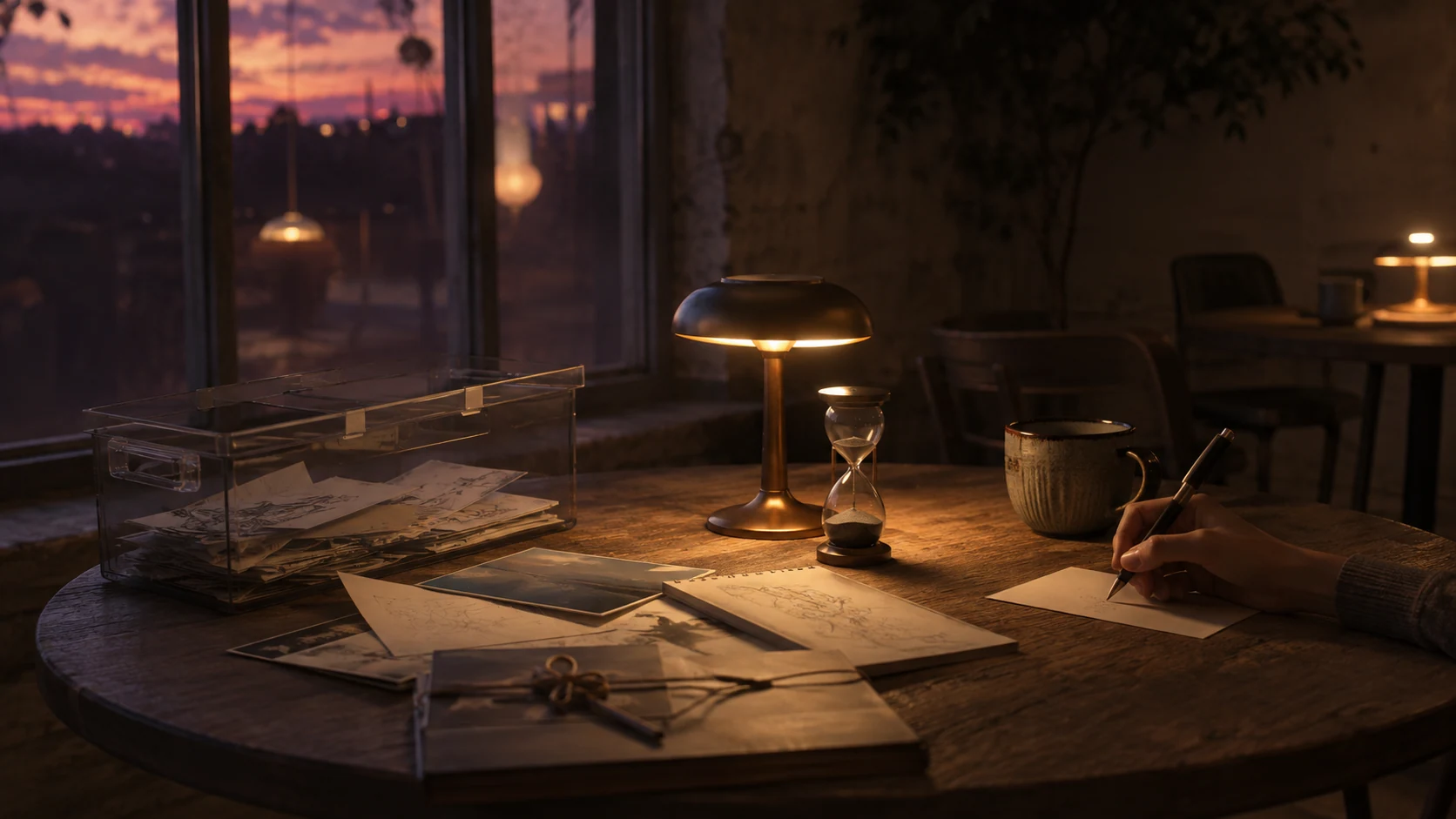 Round table workflow with unfinished archive boxView original
Returnable units matter more than grand resolutions
Twilight Station is special not because it expounds a grand philosophy, but because its way of comforting people is concrete. Here, “I’ll do it properly someday” is forbidden, while “just seven minutes now” is encouraged. Cut life into pieces small enough to return to, and people can move forward little by little even in frozen time.
This message is not valid only in a distant-future fantasy. Our reality is much the same. Notifications keep arriving, unanswered messages accumulate, and postponed decisions keep consuming energy in a corner of the mind. Many days therefore end with time having passed while the mind remains in place. What changes such days is not a bold declaration of self-improvement, but a small, specific unit of stay.
Three minutes of breathing to settle the nervous system, seven minutes of organizing to bring tasks into the present, and twelve minutes of focus to advance actual work by even one step.
These three units do not test diligence. They simply create a foothold to return to. Once that foothold exists, we stop fearing pauses, because even if we stumble, we know the next action. Recovery is ultimately determined not by the size of our willpower, but by whether a route back exists.
The café on the planet of endless evening teaches one thing. We remember time not by its length, but by the density with which we passed through today. What changes today is not more time, but the smallest starting point we can hold onto now.
 Low table lamp and hourglass for restart rhythmView original